Kyung Hee University, Hankuk University of Foreign Studies and University of Seoul student councils co-host forum; six teams present local policy proposals
University of Seoul's 'Green On' team proposes bulk buying of off-spec produce from traditional markets, with sorted byproducts turned into compost
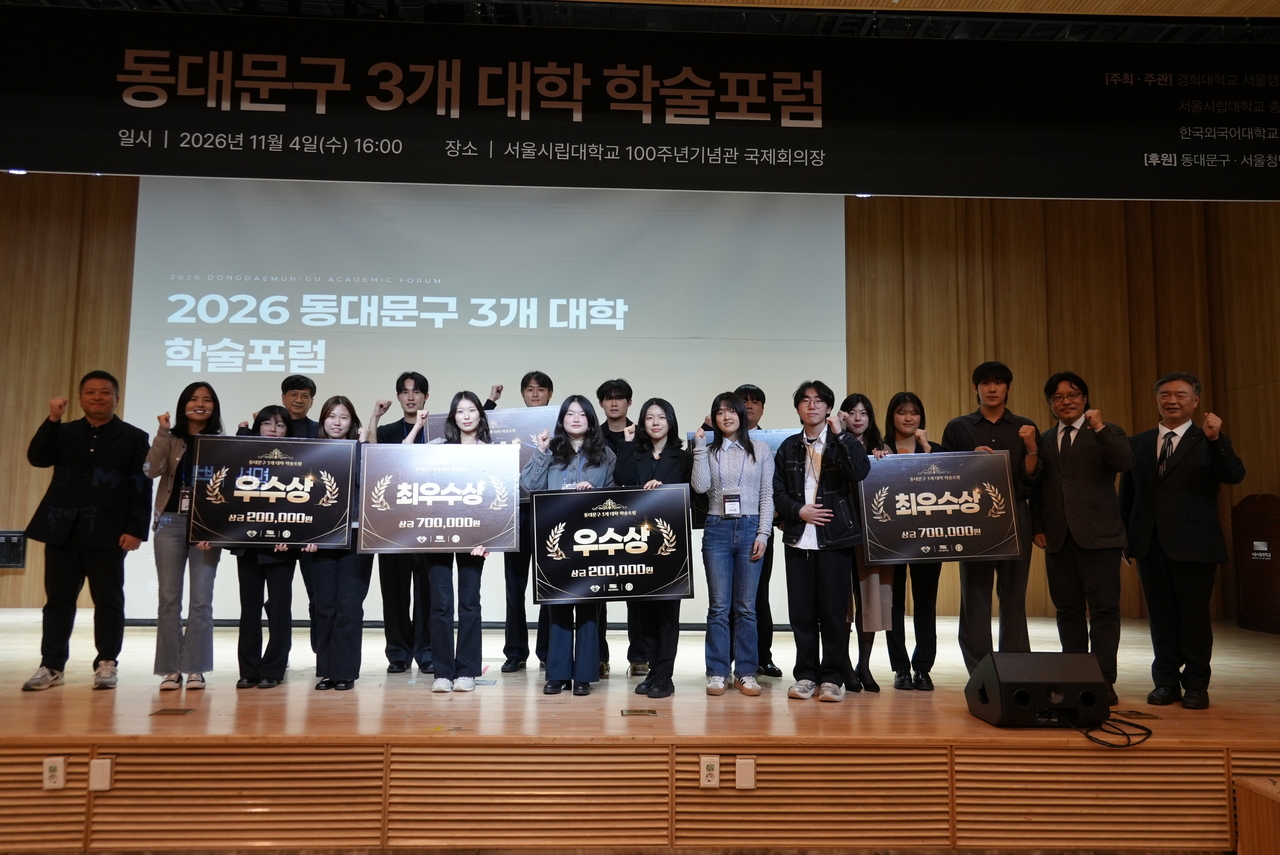
Dongdaemun-gu held the Dongdaemun-gu Three-University Academic Forum on Wednesday at the International Conference Hall of the University of Seoul's Centennial Memorial Building.
Held under the theme "Youth Stories for a Sustainable Future City," the forum was co-hosted by the student councils of Kyung Hee University, Hankuk University of Foreign Studies and the University of Seoul, with support from Dongdaemun-gu and the Seoul Youth Center Dongdaemun. About 100 students and student council members from the three universities attended, sharing research on local community issues and the challenges facing the youth generation.
The opening ceremony featured remarks by Won Yong-geol, president of the University of Seoul, and a video congratulatory address by Dongdaemun-gu District Mayor Choi Dong-min. The keynote was delivered by Kim Byeong-min, chief executive of the Seoul Tourism Foundation, who spoke on the theme "G3 Seoul Built Together by Universities, Youth and Local Communities," outlining the key competencies Seoul needs to break into the global top three cities and the roles universities, young people and local communities must play.
Six teams that had advanced through university-level preliminary rounds presented analyses of Dongdaemun-gu issues and proposed policy solutions.
The presentation topics were: a gap analysis and improvement plan for the youth crime-victim support delivery system (Nanal, Kyung Hee University); solutions to address temporal medical-service deserts near university campuses (Hospitalier, Kyung Hee University); creating a democratic public city through use of the Jungnangcheon stream and a "youth urban laboratory" (Oejiin, Hankuk University of Foreign Studies); temporal constraints on youth and the spatiotemporal accessibility of public urban services (Young Team, Hankuk University of Foreign Studies); a local co-prosperity model and autonomous ordinance linking traditional markets, international students and youth (Jeongyeong Juibo, University of Seoul); and campus circulation of off-spec produce from traditional markets (Green On, University of Seoul).
The University of Seoul's Green On team took the grand prize. Hospitalier from Kyung Hee University and Young Team from Hankuk University of Foreign Studies shared the excellence award, while the merit award went to Jeongyeong Juibo from the University of Seoul, Oejiin from Hankuk University of Foreign Studies and Nanal from Kyung Hee University.
The grand-prize-winning Green On team proposed the "Cheongnyangni Food Loop," a model connecting the problem of insufficient vegetable consumption among young people living alone with traditional markets' difficulty disposing of off-spec produce. Under the model, students pre-order and collectively purchase affordable produce bundles, while sorted byproducts are channeled into on-campus composting and community garden plots. The proposal drew high marks for being designed so that students can operate it themselves using existing systems.
A panel discussion followed, moderated by Oh Chae-un, director of the Seoul Youth Center Dongdaemun, with participation from Jang Seok-won, technology innovation team leader at Kyung Hee University's Industry-Academia Cooperation Foundation; Shin So-mi, director of the Seoul Metropolitan Youth Center; Kim Sung-hwan, chief executive of Mobility Innovation Studio Newscene; and the student council presidents of the three universities. The panelists examined the theme "Dongdaemun-gu's Development and the Future of Youth: How Is a Sustainable City Possible?" — addressing the sustainability crisis facing young people, including soaring residential costs, shifts in the commercial landscape around university campuses and post-graduation youth exodus, and discussing the conditions under which the benefits of development can lead to coexistence between youth and local communities.
Dongdaemun-gu District Mayor Choi Dong-min said it was meaningful that young people had looked directly at local issues and proposed solutions, adding that the district would consistently create opportunities to listen to and communicate with youth going forward.
seouldream01@heraldcorp.com