Inaugural World Digital Assets Forum opens
under 'New Financial Architecture' theme
Tokenization blurs boundaries between assets
Bank revenue models, corporate finance in flux
AI agent authority and accountability take center stage
The routes that money travels across borders are getting shorter, and the line between cash and investment assets is growing blurry. Stablecoins are compressing remittance chains that once passed through multiple banks, while tokenization is linking asset management with payments. A "new financial architecture" is taking shape — one that goes beyond faster money transfers to reshape how banks generate revenue and how companies manage their capital.
Voices are growing louder that the focus must now shift from the potential of individual technologies to the structural changes digital assets will bring to finance and how it operates. Strengthening security and establishing clear frameworks for accountability and control over transactions are also seen as critical tasks as the era of AI agents executing asset management and trades draws near. With discussions on enacting a basic digital assets law now gaining momentum, South Korea's financial sector must identify growth opportunities and develop strategies aligned with the new financial order, analysts say.
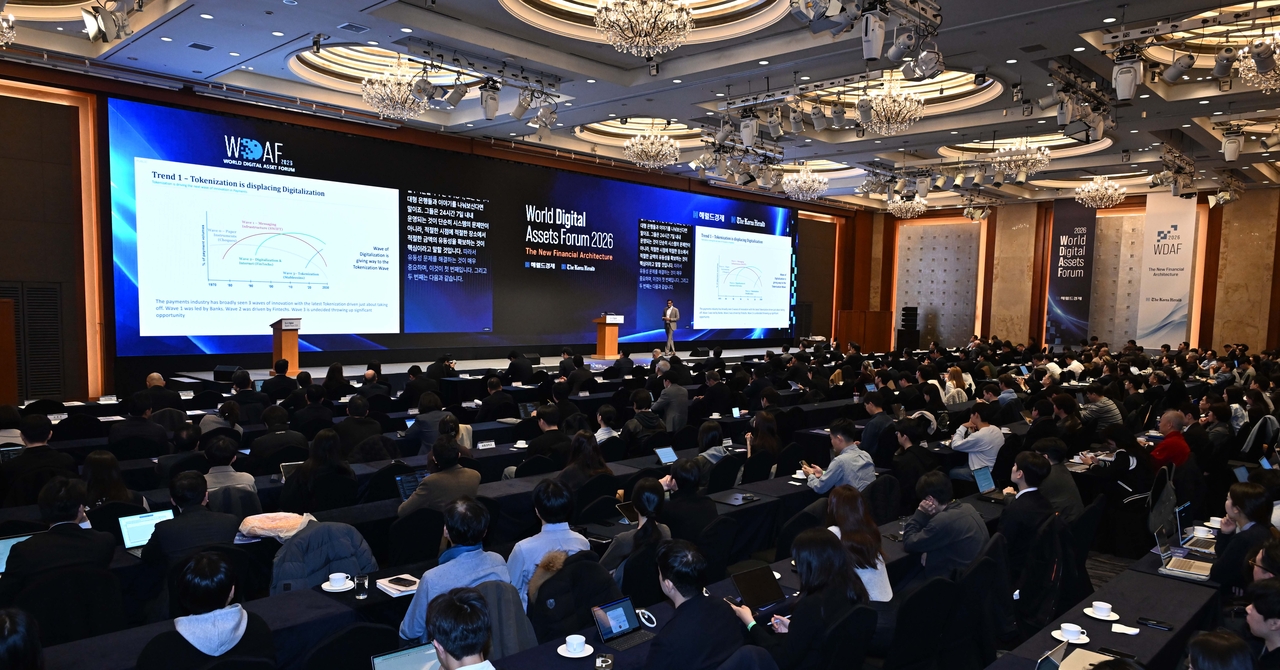
The inaugural World Digital Assets Forum — known as WDAF — opened Monday at The Grand Lotte Seoul in Sogong-dong, organized by The Herald Business and the Korea Herald. The forum took "The New Financial Architecture" as its theme and offered an in-depth examination of the shifts underway in financial markets and the digital asset industry, along with how to respond.
The forum, organized by Herald Media Group, brought together 22 senior figures from global financial institutions and digital asset companies, including Standard Chartered, Avantus, Sygnum, Ondo Finance, BNY, Circle and Tether. Lawmakers from both the ruling and opposition parties who are leading legislative discussions also attended, adding significance to the event as the government prepares to release a digital assets bill this month.
Paolo Ardoino, CEO of Tether, delivered a video message highlighting the potential for South Korean companies to expand into global markets through digital assets. "Korean companies have always made the products the world wants, and digital assets can help those products reach every customer," he said.
Min Byeong-deok, a lawmaker of the Democratic Party of Korea, said in congratulatory remarks that the forum's theme resonated directly with his own work in the National Assembly. "The theme of this forum — 'The New Financial Architecture' — is exactly the question I am grappling with in the Assembly right now," he said. "We will establish a legal basis for institutional investor participation in the market, and build a trustworthy market for domestic and foreign financial institutions by ensuring transparent trading, secure asset custody and robust investor protection."
Pre-registration topped 1,000 applicants before the forum even opened, reflecting strong interest. Attendees entered the venue wearing green wristbands, adding to the festive atmosphere. Ambassadors from several countries were also present, including those from El Salvador, which adopted bitcoin as legal tender, and Bahrain, which has established a regulatory framework for stablecoins. Corporate practitioners and executives working on new digital asset businesses attended alongside university students from Sejong University, Sookmyung Women's University and other institutions. Throughout the hall, attendees could be seen with laptops open, carefully noting key remarks.
The keynote address was delivered by Navin Mallela, global head of payments at Standard Chartered, who until recently served as global co-head of Kinexys, JP Morgan's blockchain business unit. Mallela examined how tokenization is breaking down the boundary between traditional banking and digital finance, and what that means for financial structures and the role of banks.
"The distinction between cash and yield-bearing financial products is increasingly blurring," Mallela said. "By combining payments, custody and market functions in new ways, entirely new products can be created." He also projected that banks' revenue models would shift away from reliance on liquidity in overseas payment accounts and intermediary fees, toward earning returns through conversions between fiat currency and digital assets.
The expanding use of digital assets by corporations and the dawn of an era in which AI agents execute transactions were also central topics. Don Tapscott, a globally recognized scholar in the blockchain field, said it is essential to verify the identity and transaction authority of AI agents and to ensure that accountability for their actions flows back to the human principals who delegated them.
"Agents act, but they cannot be held accountable in the same way as a person or a company," Tapscott said. "Governance must be built into the design from the outset, not bolted on afterward." He added that "every action must be traceable, explainable and auditable," and called for safeguards including spending limits, transaction circuit breakers and the ability for humans to intervene.
forest@heraldcorp.com
kyoung@heraldcorp.com