Herald's WDAF 2026 opening message
'A connector role … focused on cross-border trade settlement'
Hyundai Motor pilot cuts intercompany transfer from 3–4 hours to 7 minutes
Strong K-beauty demand in Latin America, but payment barriers remain
'SMEs lacking overseas channels can leverage USDT'
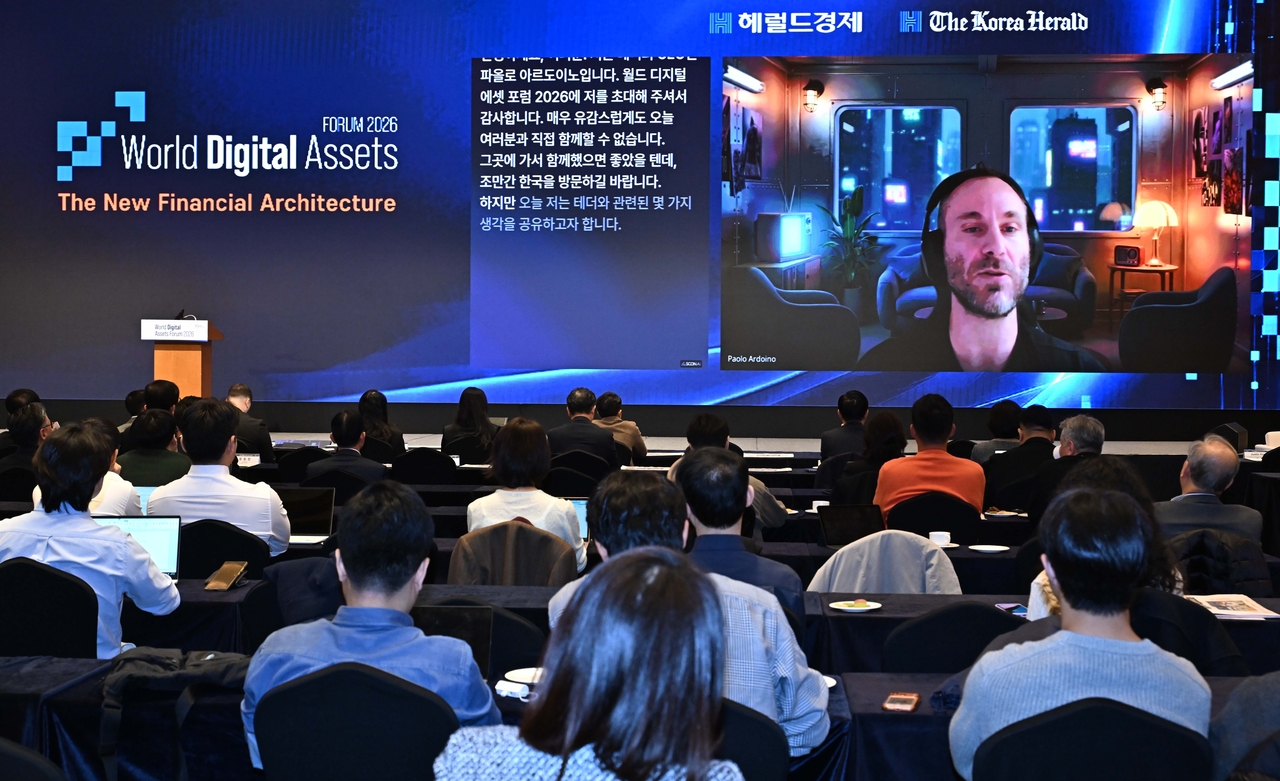
Paolo Ardoino, founder and CEO of Tether, said USDT serves as "a second layer of international trade" connecting Korean companies with overseas customers who already use digital dollars, signaling his interest in partnering with Korean businesses.
Ardoino delivered the message in a video address Monday at the inaugural World Digital Assets Forum (WDAF), hosted by The Herald Business and The Korea Herald at The Grand Lotte Seoul in Sogong-dong. "Korean products — cars, electronics, entertainment, food, beauty — are in high demand across Latin America, Southeast Asia, the Middle East and Africa, and in those regions USDT has already become part of daily life," he said.
Tether is the issuer of the stablecoin USDT. Launched in 2014, USDT is designed to maintain a 1:1 peg with the US dollar. Its market capitalization currently stands at approximately $180 billion.
Ardoino was clear that USDT poses no threat to Korea's existing payment infrastructure. "USDT does not replace Korea's won-based payment system, and we have no plans to do so," he said, adding that Tether is "very interested in cooperating as a connector between Korea and the rest of the world." He said the company intends to focus on improving cross-border trade settlement efficiency, particularly in markets that already use the dollar.
Ardoino cited Hyundai Motor as an example of how stablecoins can streamline trade payments.
In July, Hyundai Motor conducted a proof-of-concept through Hyundai Card, transferring $20,000 worth of USDT from its US subsidiary to its Mexico subsidiary. "A bank transfer that used to take three to four hours took less than seven minutes with USDT," Ardoino said. "I take great pride in the fact that a major Korean conglomerate is actually using USDT for real treasury management."
He pointed to K-beauty as another opportunity. "Demand for Korean cosmetics is strong in Brazil, Argentina, Mexico and across Latin America, but payment solutions have not kept up," he said. "Many consumers there do not have international credit cards, and local payment networks are not connected to Korean platforms. There is demand, but without a payment method, sales opportunities are going elsewhere."
"With USDT, consumers can pay in seconds using the digital dollars they already have, and Korean sellers receive the funds immediately," he said, adding that small and medium-sized enterprises struggling to find overseas sales channels could put USDT to use.
According to Ardoino, the number of USDT users worldwide has surpassed 730 million, with about 30 million new users joining every quarter.
"This is growth at the pace of a social network, not a fintech company — the greatest financial inclusion success story in history," he said. "We did not build USDT for Wall Street. We built it for those left out of the traditional financial system, for the Bitcoin and crypto industry, and ultimately for everyone."
Ardoino also stressed Tether's credibility. "Companies will only settle real trade payments in USDT if they trust the dollars behind it," he said, pointing to the company's receipt this year of an unqualified audit opinion from KPMG on its fiscal year 2025 financial statements. Tether had previously drawn scrutiny from inside and outside the industry for publishing only quarterly reserve attestations rather than full audits.
"Korean companies have always made products the world wants, and digital assets can put those products within reach of every customer," Ardoino said. "730 million USDT users can become customers of Korean companies. We want to help make that happen, and we are ready to start."
kimstar@heraldcorp.com