Five economic hubs to be built, including at Samcheok and Mukho ports
Project types expanded from two to four
Sites lose designation if procurement not launched within 6 months
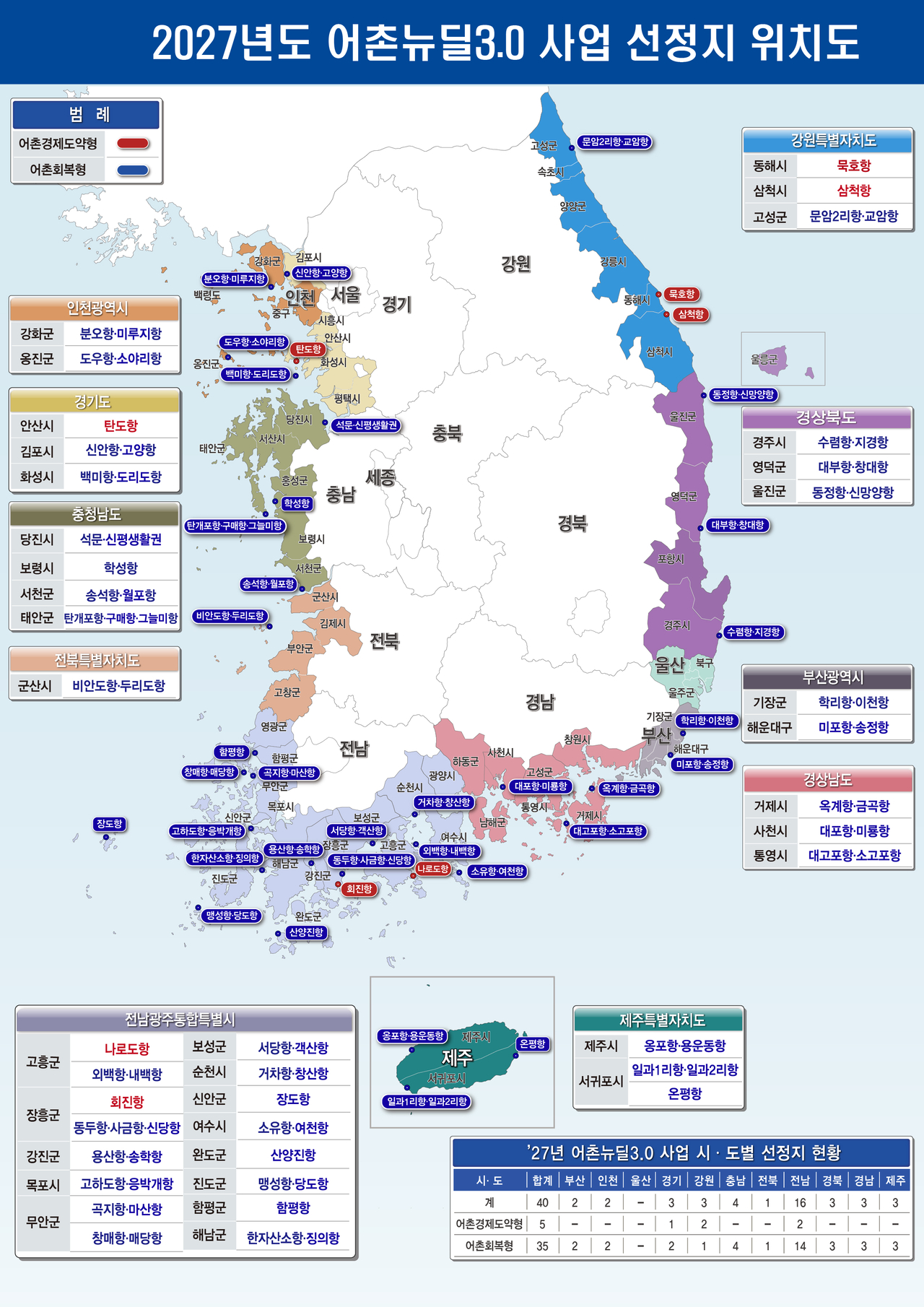
The government has selected 40 new sites for next year's Fishing Village New Deal program and will overhaul the initiative to track operational outcomes — not just the construction of facilities. Local governments that fail to make proper use of completed facilities could face penalties when applying for future projects, and any site that does not launch a procurement process within six months of selection will lose its designation.
South Korea's Ministry of Oceans and Fisheries announced Monday that it had selected 40 sites for the 2027 Fishing Village New Deal 3.0 program and drawn up a restructuring and improvement plan that extends oversight to facility operations after completion.
Seventy-one sites from 40 cities, counties and districts across 11 provinces and metropolitan cities applied for next year's program. The ministry conducted written and on-site evaluations followed by a comprehensive review committee, ultimately selecting five sites under the economic hub category and 35 under the village recovery category.
The five economic hub sites will pursue financial self-sufficiency by linking local tourism resources with industrial infrastructure. Samcheok Port in Samcheok, Gangwon Province, will be developed into a destination tourism hub, combining a resort-style cultural complex with a pedestrian marine-culture corridor connecting Samcheok Station to the port. Mukho Port in Donghae will pursue a resort complex and the recruitment of a specialized university.
Naro Island Port in Goheung-gun, South Jeolla Province — part of the planned Jeonnam-Gwangju integrated special city — will combine an AI- and ICT-based smart aquaculture facility with a fisheries processing support center. Hoejin Port in Jangheung-gun will pair leisure accommodation with a youth entrepreneurship hub, while Tando Port in Ansan, Gyeonggi Province, will receive a multipurpose complex equipped for marine leisure and industrial diving education.
The remaining 35 sites were designated under the village recovery category, which focuses on improving residents' living conditions and port safety infrastructure. Plans call for building community stations offering care, health management, cultural and welfare services, along with shared community facilities, with services to be extended to neighboring villages. Breakwaters and mooring facilities will be expanded, and smart safety management systems installed.
Alongside the new site selections, the ministry said it would restructure the program itself, citing a longstanding problem in which earlier fishing village and port regeneration projects focused so heavily on construction that post-completion management suffered.
The number of project types will be expanded from two to four. The economic hub category will remain unchanged, while the village recovery category will be split into Type I, centered on building new facilities, and Type II, centered on making use of existing ones. A new village safety category will also be created to handle public ferry services and improvements to safety infrastructure against natural disasters.
Project durations will also be extended: the economic hub type from five years to six, and village recovery Type I from four years to five. The restructuring of project types and the duration extensions are subject to final confirmation following consultations with the Ministry of Planning and Budget.
Standards will be tightened across the entire project cycle, from selection through post-completion management. Local governments that fall short of national budget execution benchmarks will be barred from applying for new projects, and the utilization record of existing facilities will factor into evaluations. Project plans with insufficient economic feasibility analyses will be rejected at the preliminary review stage.
Sites that fail to launch a procurement process within six months of selection will have their designation revoked. After completion, facility operations will be monitored on an ongoing basis, with graduated measures applied depending on how long a facility remains idle. Changes to a facility's designated use will be permitted with flexibility, but a responsibility management framework grounded in local ordinances will also be established.
The ministry plans to revise its public application guidelines and project implementation directives before the end of this year. The restructured project types, site selection criteria and master plan review standards will take effect starting with the 2028 application round. Amendments related to project implementation and post-completion management will also apply to projects currently under way.
Oceans and Fisheries Minister Hwang Jong-woo said the ministry would "rigorously operate a full life-cycle management system so that newly selected sites can take root as successful projects, and that facilities already built can be put to use as valuable assets for fishing communities."
adastra@heraldcorp.com