Young men who backed Trump now drifting; 'youthquake' candidates surge
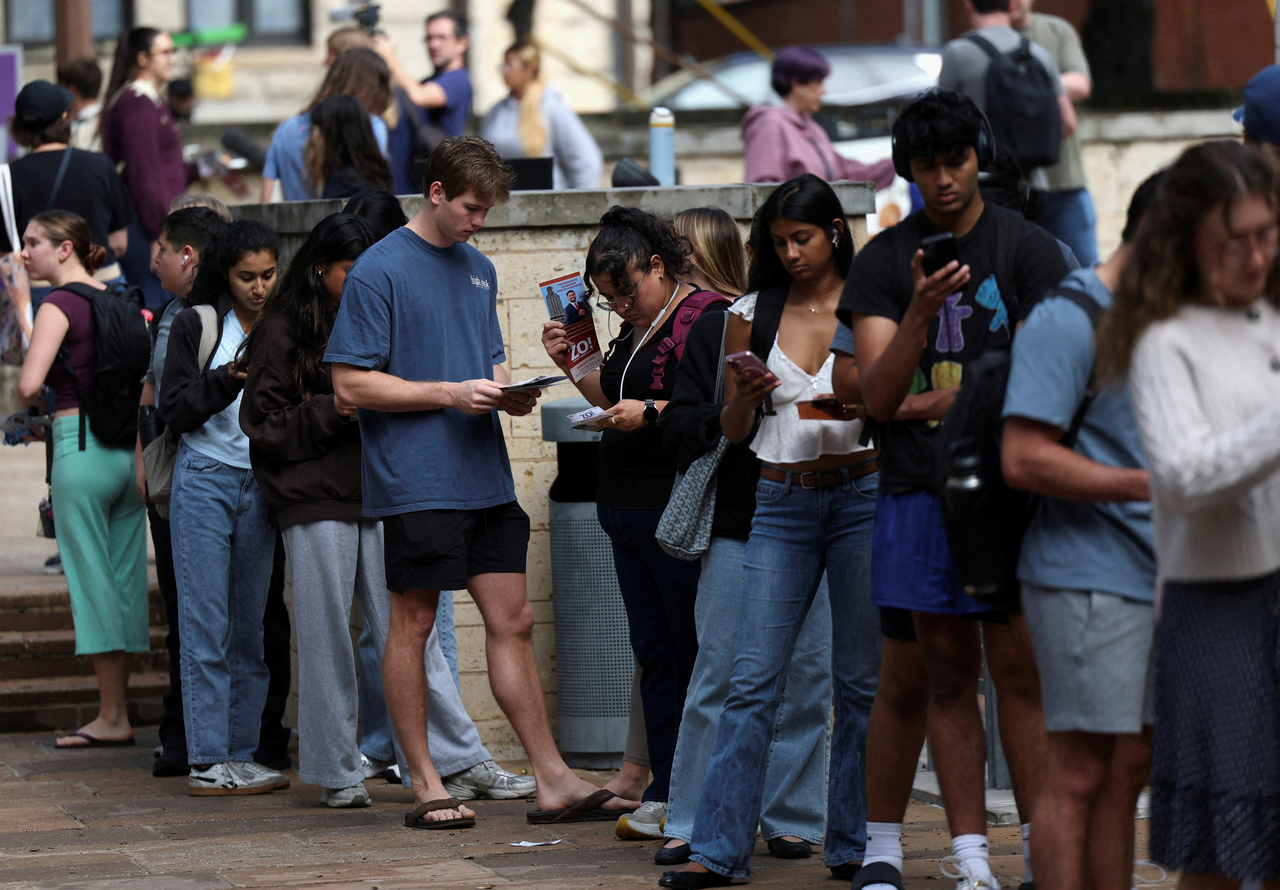
Young Americans who backed President Donald Trump and the Republican Party are reeling from high prices and emerging as a new bloc of swing voters in US politics.
A survey by polling firm SSRS found that Americans aged 18 to 29 gave Democratic candidates in congressional races 20 percentage points more support than they did in 2024, the Wall Street Journal reported Sunday.
The shift was most pronounced among young people without college degrees and white and Hispanic men under 30 — groups that had helped deliver Trump's reelection just two years earlier.
Young voter turnout in this midterm election was about 27 percent, roughly matching the 2022 midterms and well above the roughly 20 percent seen a decade ago, according to estimates from CIRCLE, a youth voting research center at Tufts University.
"There can no longer be a campaign or a politician that doesn't consider young people," CIRCLE Executive Director Lila Strong said.
The main reasons young voters turned away from Trump and the Republican Party were economic: high prices, student loan burdens, difficulty finding work and stagnant wages. The Wall Street Journal reported that some college graduates are stocking shelves in menial jobs because they cannot find suitable employment, and struggle to afford a meal at the fast-food restaurants where they work. The Democratic Party's criticism of the Trump administration's economic record and its focus on affordability helped move those voters, the paper said.
"The Democratic Party is finally listening to us and building policy and campaigns around issues that actually affect young people and the American working class," said Gavin Jacobson, 23, a sports management graduate student in Los Angeles.
Jacobson, who said he had not supported any party or candidate before this year, cast mail-in ballots for Democratic candidates in Minnesota, where he is registered. To repay $120,000 in student loans and make ends meet, his father — a high school teacher — coaches three sports teams for extra income, and his mother works as a dental hygienist, yet Jacobson said he could not afford a $500 plane ticket home for the Thanksgiving holiday. With graduation set for next June, he said he is anxious watching his roommate, who finished school five months ago, still searching for a full-time job.
Many of his friends who had supported Trump did not vote in the midterms because they felt the president had not kept his campaign pledges, Jacobson said.
Joshua Evans, 26, of Kannapolis, North Carolina, told a similar story. Evans voted for Trump in 2020 and 2024 but sat out the midterms, disappointed that Republicans had failed to follow through on their campaign promises even after gaining control of both the White House and Congress. "The Republican Party took young male Generation Z supporters for granted," Evans told the Wall Street Journal.
Evans earned a public relations degree in exchange for $40,000 in student debt but could not find work in the field. He now stocks shelves at a discount store for $21 an hour and pays down $1,000 of that debt each month.
He had hoped Trump would bring down gasoline and grocery prices, but instead watched costs climb further amid the war with Iran. Evans said he still considers himself a Republican but has not decided whether he will vote for Republican candidates in the next election.
Grayson McCartney, 19, and Abby Brookover, 18, both from suburban Ohio, voted Democratic amid economic pressures including student loans, housing costs and high fuel prices. Xavier Cepesi, 18, a college freshman in Kansas City, also voted Democratic after witnessing the polarization surrounding data center development in his area.
Experts said the shift among young men — a group that had been trending conservative — was dramatic.
"Young men have become the new swing voters in American politics," said Richard Reeves, director of the American Institute for Boys and Men, adding that the Democratic Party had focused on issues young men care about. Rather than engaging in culture-war debates that frame men as a problem in American society, Democrats zeroed in on the economic stagnation these voters face, he said.
Young politicians are also making gains on the back of this shift in youth sentiment.
James Talarico, 37, of Texas and Abdul El-Sayed, 42, of Michigan won their races with strong support from young voters, while Melat Kiros, 29, of Colorado became the first Generation Z woman elected to the US House of Representatives.
The Hill, a congressional news outlet, described the surge as a "youthquake."
"There was enormous energy behind young candidates who understand young people's frustration that the system is rigged in favor of the established wealthy," said Santiago Mayer, executive director of the youth civic group Voters of Tomorrow. "Since 2022, baby boomers' assets have grown nearly 30 percent while assets held by people under 30 have fallen 20 percent — young people needed politicians who would fix that," he said.
Experts cautioned, however, that young voters turning away from Republicans does not mean they have become Democrats.
"This group is so volatile that we need to be careful — winning once doesn't mean winning forever," Reeves said. Leila Zaidan, CEO of Future Caucus, agreed. "Generation Z is still forming its political identity," she said. "Their support depends on results."
yckim6452@heraldcorp.com