'Higher floor-area ratio possible compared to private redevelopment'
'22 zones, 39,000 units on track'
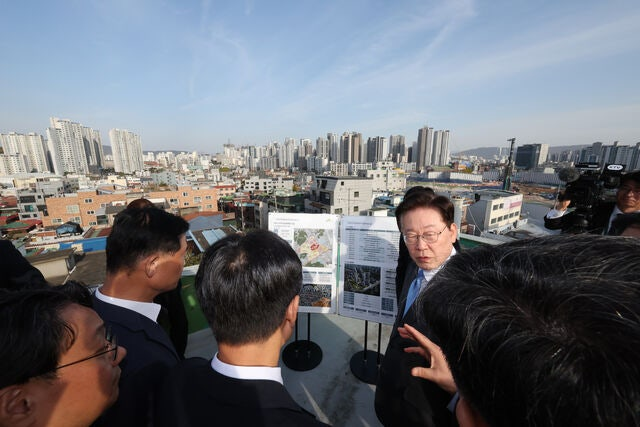
Korea Land and Housing Corporation said Sunday that public-led development projects move faster and are less prone to corruption.
The statement was LH's rebuttal after Seoul Metropolitan Government pushed back against President Lee Jae Myung's call for public-led redevelopment, which he made during a recent visit to a public redevelopment site.
In a press release issued that day, LH said some of Seoul city hall's recent claims about public redevelopment were factually incorrect and reiterated the advantages of the public-led model.
Seoul Metropolitan Government had earlier argued that public execution alone does not guarantee faster timelines or project viability, pointing out that no ground had been broken on any public redevelopment project since the model was introduced in 2020.
The city also criticized the model for generating substantial project management fees, noted that three public redevelopment candidate sites had been canceled, and said some zones were switching to private redevelopment.
Seoul Mayor Oh Se-hoon went further, writing on Facebook to urge President Lee to "move beyond the idea that public development is a cure-all and first listen to the voices of residents who are desperately waiting for redevelopment."
In response, LH said its public redevelopment program — covering 22 zones and 39,000 housing units in the Greater Seoul area — "is proceeding on schedule, with a five-year timeline from zone designation to ground-breaking," adding that construction is set to begin sequentially starting with the Sinseol District 1 zone in 2027.
LH said public execution "speeds up the process and reduces the potential for corruption."
According to LH, approximately 350 cases of corruption occurred in private redevelopment projects between July 2003 and September 2023.
"Private associations frequently face project delays due to bribery, construction cost disputes and litigation," LH said, "whereas LH transparently discloses all project expenditures, including residents' operating funds, leaving no room for corruption."
LH cited the Jangwi District 9 project in Seongbuk-gu, Seoul — the site President Lee visited — as an example, saying the public model allows for a higher floor-area ratio than private redevelopment, adding more than 200 pre-sale units and cutting residents' contributions by more than 50 million won ($37,300) per household, while keeping the share of public-contribution housing at a comparable level.
LH also said that while private associations manage projects through outside contractors, LH charges a minimum fee of 3 percent of project costs and has its own professional staff handle the entire process — including design review, construction cost estimation and construction management — to reduce overall expenses. It added that the fee would be sharply cut to 1 percent of project costs for new zones going forward.
LH also rebuffed the city's claim that zones were converting to private redevelopment, saying that while two public redevelopment candidate sites had been withdrawn by residents themselves due to internal disputes, "there are no zones that have switched to private redevelopment."
shindw@heraldcorp.com