Labor disputes reached 88 cases through end of September, down from 99 a year earlier, but workdays lost jumped 45.2% to 489,190
Repeated partial and full strikes hit major workplaces including Hyundai Motor, HD Hyundai Heavy Industries and Hanwha Ocean
Unions increasingly demanding direct profit-sharing tied to fixed percentages of operating or net profit
Korea Enterprises Federation warns institutionalizing fixed cost burdens will constrain future investment
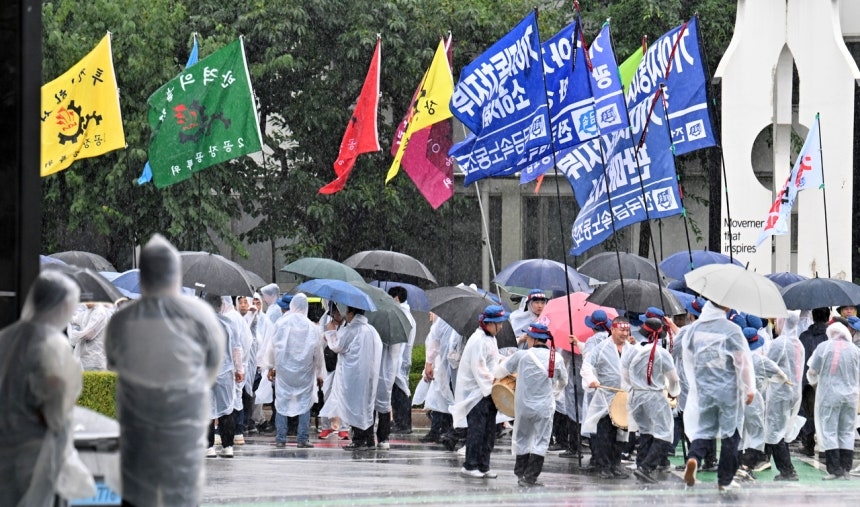
Strikes at major manufacturers including Hyundai Motor, HD Hyundai Heavy Industries and Hanwha Ocean drove a sharp rise in workdays lost to labor action this year, new data shows.
According to a report on labor relations in the automotive, shipbuilding and other key manufacturing sectors released Sunday by the Korea Enterprises Federation, the number of labor disputes stood at 88 through the end of September, down from 99 in the same period a year earlier. Workdays lost, however, surged 45.2% to 489,190 from 336,800 over the same period.
Unions at major workplaces pushed a range of demands that would raise fixed labor costs, including performance bonuses tied to a set percentage of operating or net profit, expansion of regular bonuses, a retirement age extension and abolition of the wage-peak system.
The Korean Metal Workers' Union's Hyundai Motor chapter demanded 30% of the previous year's net profit be shared with workers, while the Hyundai Heavy Industries chapter called for 30% of operating profit. At auto parts maker HL Mando, the union's Mando chapter sought to make a special bonus equivalent to 15% of operating profit a regular practice.
At some workplaces, unions also pressed demands touching on personnel and management rights — including requiring union consent for new hires and the introduction of new technology or automation — alongside calls for retirement age extensions, fixed bonuses and fixed overtime pay that would affect companies' long-term labor costs and workforce management.
The Korea Enterprises Federation warned that if short-term improvements in business conditions or earnings were used as a basis for institutionalizing higher fixed burdens, companies' ability to respond to future economic cycles and their capacity for future investment would be constrained.
Looking at labor relations at major workplaces this year, Hyundai Motor concluded its wage negotiations in late August after its first full strike in a decade. The Hyundai Motor union carried out repeated partial strikes from July before staging an eight-hour full strike on Aug. 21 — its first full walkout since 2016.
Strike hours this year totaled 60 hours per shift rotation, with actual production line shutdowns lasting 120 hours. The industry estimates the stoppages caused production shortfalls of about 55,200 vehicles and sales losses of at least 2.3 trillion won ($1.71 billion).
The HD Hyundai Heavy Industries union staged its first partial strike on Sept. 11 and carried out a total of 11 partial strikes. On Oct. 18, chapter head Kim Dong-ha began a high-altitude sit-in protest on a crane inside the shipyard. A second ratification vote held Oct. 27 passed with 55.06% approval among those who voted.
Hanwha Ocean also reached a wage and collective bargaining agreement on Oct. 29 after a series of strikes and a high-altitude protest. The union began striking in late August, and in September operations of the Goliath crane — a core piece of production equipment at the Geoje shipyard — were shut down.
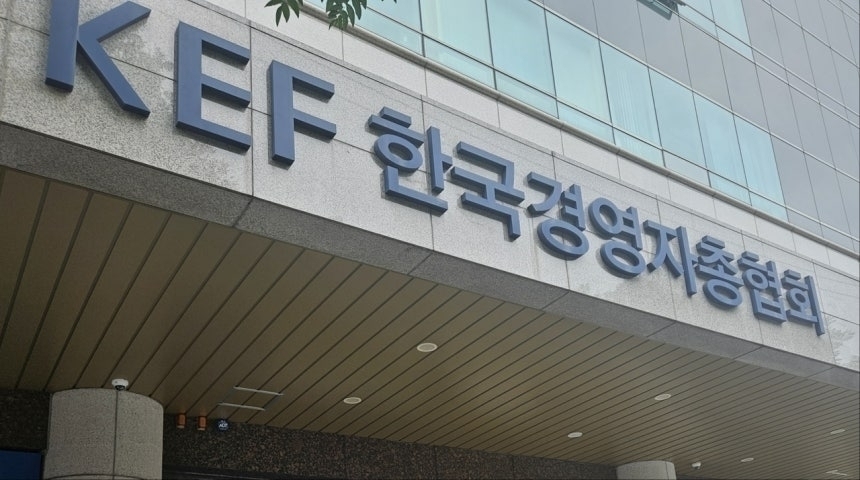
The Korea Enterprises Federation identified two defining features of this year's labor disputes: a spread of demands for profit-sharing tied directly to company earnings at a fixed percentage, and parallel demands that go beyond short-term profit distribution to expand fixed labor costs and workforce obligations.
"Demands for direct payment to workers of a fixed share of company profits — Hyundai Motor's union calling for 30% of net profit, HD Hyundai Heavy Industries for 30% of operating profit, and HL Mando for 15% of operating profit — were raised intensively across major manufacturing sectors," the federation said. It added that if measures such as base pay and fixed bonus increases, retirement age extensions without wage cuts, abolition of the wage-peak system and mandatory replacement of attrition were institutionalized, they would inevitably place a heavy burden on companies when earnings decline or business conditions deteriorate.
The federation also said repeated strikes stemming from labor disputes would inevitably disrupt production and supply at key parts suppliers. Labor conflicts over wage and collective bargaining negotiations and business and production restructuring have recently emerged at major auto parts makers including HL Mando, Hyundai Wia and Hyundai Transys.
HL Mando is a leading auto parts supplier to major automakers, providing Hyundai Motor and Kia with approximately 50.3% of their brakes, about 50.4% of their steering systems and around 75.8% of their suspension systems. A prolonged labor dispute there would directly affect finished-vehicle production lines.
"In key manufacturing sectors such as automobiles and shipbuilding, numerous suppliers and upstream and downstream industries are interconnected, meaning a prolonged strike or production equipment shutdown at a core workplace can affect not only that company but also suppliers' production, sales, employment and delivery schedules," the federation said.
It went on to say that "particularly in the auto parts sector, multilayered trading relationships exist not only between parts makers and automakers but also among parts makers themselves, making it highly likely that a production disruption at one workplace will spread in a chain reaction to other parts suppliers and upstream and downstream industries."
The federation called on labor and management to "form rational bargaining practices by taking into comprehensive consideration not only individual companies' short-term earnings but also industry-wide economic volatility, global competition, the need for future investment and the impact on suppliers."
likehyo85@heraldcorp.com