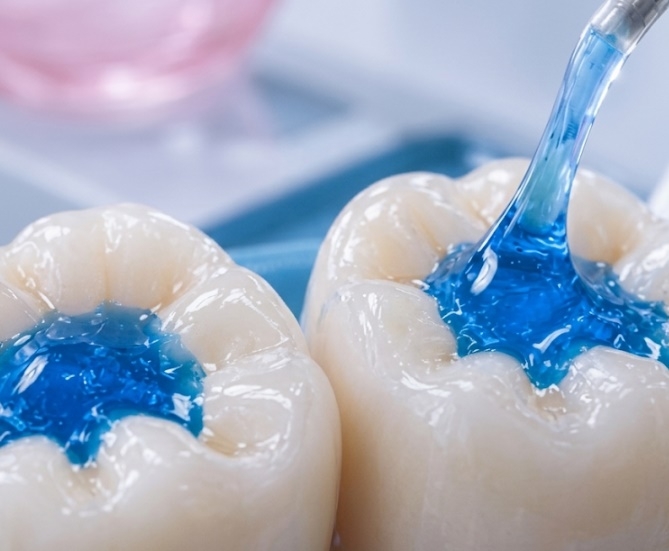
Tooth enamel, the hard outer layer that protects teeth, does not regenerate naturally once damaged. Now, a gel that can restore enamel using minerals found in saliva has been developed.
According to Science Daily, a science news outlet, researchers from the School of Pharmacy and the Department of Chemical and Environmental Engineering at the University of Nottingham in the United Kingdom developed a protein-based gel that regenerates damaged tooth enamel using calcium and phosphate ions naturally present in saliva. The findings were reported Thursday (local time).
The material is designed to mimic the function of proteins involved in forming enamel structure when teeth first develop. When applied to the tooth surface, the gel forms a thin, firm membrane that fills microscopic cracks and gaps.
It then draws in calcium and phosphate ions from saliva, guiding new mineral crystals to grow in the same orientation as existing enamel.
The researchers described this process as "epitaxial mineralization" — a method that does not simply deposit minerals onto the tooth surface but guides new crystals to grow along the existing enamel's crystal arrangement. Restoring enamel's characteristic hardness and durability requires not only the right amount of minerals but also the correct microstructure.
The researchers said the gel can be applied not only to damaged enamel but also to exposed dentin — the tissue beneath the enamel that contains microscopic tubes transmitting external stimuli to the tooth nerve. When gums recede or enamel wears away and dentin becomes exposed, teeth can become sensitive to cold, hot or sweet foods.
In experiments, the researchers evaluated the mechanical strength and durability of enamel formed using the gel. The regenerated enamel showed properties similar to those of healthy natural teeth in tests simulating brushing, chewing and exposure to acidic foods.
Alvaro Mata, a professor at the University of Nottingham who led the research, said the technology was developed with both dental professionals and patients in mind, and was designed to be safe, easy to apply and scalable for mass production.
The research team has established a startup, Mintech-Bio, to commercialize the technology, with a goal of launching its first product in 2027.
"We hope to launch the first product by next year," Mata said. "This innovative technology will soon be able to help patients around the world."
The findings were published in Nature Communications.
bbo@heraldcorp.com