'Taxpayers' money should go to people's livelihoods, not showpiece projects'
'Not opposed to AI youth support — but flawed planning must be fixed first'
'Han River bus allegations to be investigated on the basis of documents and testimony'
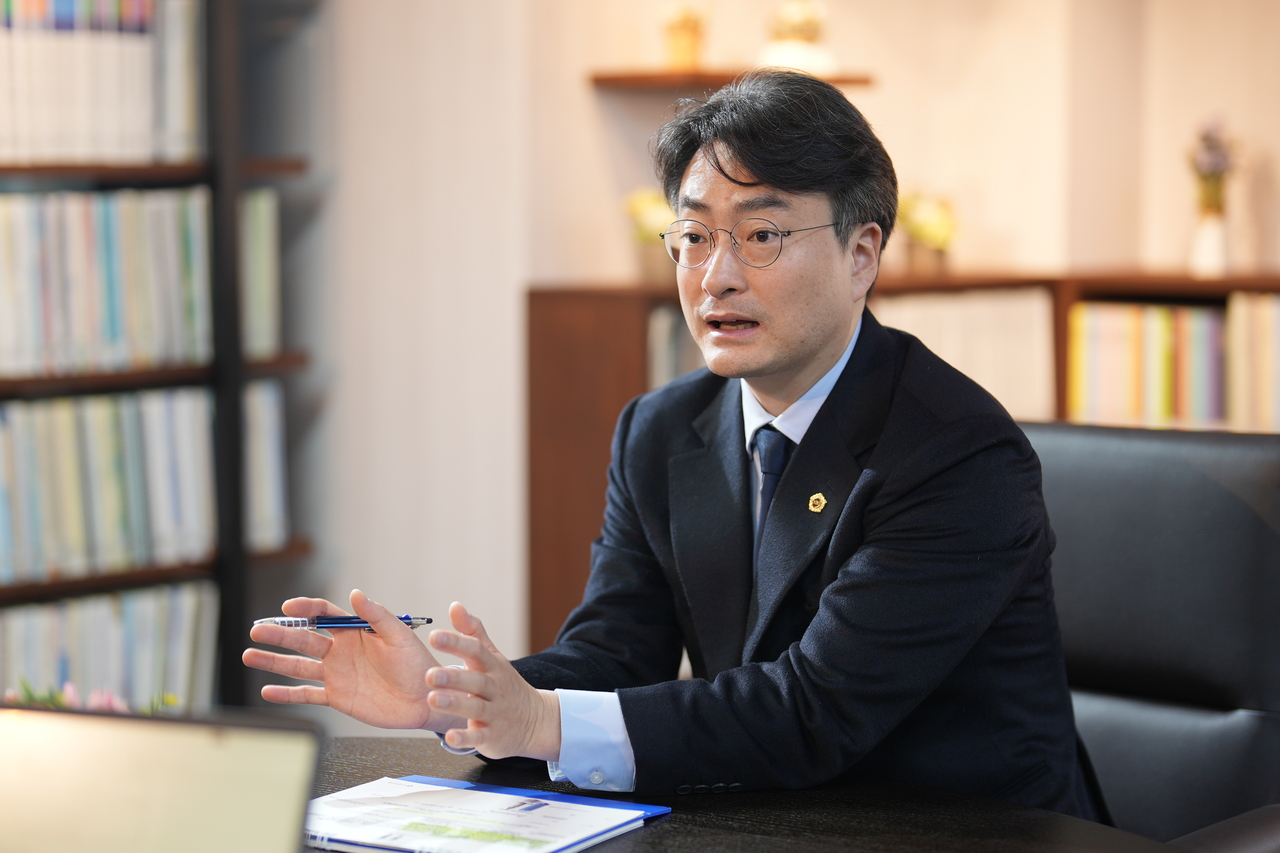
Park Yu-jin, chair of the Seoul Metropolitan Council's Special Committee on Budget and Accounts and a Democratic Party of Korea member representing Eunpyeong District 3, said the guiding principles for managing Seoul's finances must be a focus on residents' livelihoods and the effective use of public funds.
In an interview with The Herald Business on Friday, Park raised questions about allegations surrounding the Han River bus project and the city government's handling of the matter, while also explaining the rationale behind cuts to a youth AI support program budget and outlining the direction of upcoming budget reviews.
Park said the council's role is not simply to cut budgets or clash with the executive branch, but to monitor and check how taxpayers' money is spent so that it reaches where it is needed most.
Park also said that on the issue of mobility rights for people with disabilities and employment for those with severe disabilities, solutions should be pursued through substantive institutional reform and dialogue rather than confrontation.
The following is an edited transcript of the interview.
Seoul's 2027 budget: 'People's lives come before political achievements'
— What is the most important principle guiding your review of next year's Seoul city budget as chair of the budget committee?
▶ The most important principle is people's livelihoods. We need to look first at what difficulties residents are actually facing and what support they need most urgently. The tighter the fiscal conditions, the clearer the budget priorities must be. What matters is not how ambitiously a project is pursued, but whether it brings real change to people's lives. I intend to scrutinize carefully the policies for economically struggling residents and socially vulnerable groups, as well as welfare and safety — areas directly tied to citizens' daily lives. Strict standards must be applied to showcase projects or those that inflate results beyond what is warranted. Any project funded by taxpayers' money must be able to clearly explain its necessity and expected impact. I want to uphold those principles throughout this budget review.
— What aspects will you focus on when reviewing the city's large-scale policy projects?
▶ First, we need to verify the genuine necessity of each project — whether there is real demand, whether the target beneficiaries are appropriate, and whether the expected outcomes justify the budget being allocated. I am not categorically opposed to large-scale projects. However, the more taxpayer money a project requires, the more rigorous the scrutiny must be. In particular, the practice of inflating results with numbers alone, or of drawing up a budget before adequate preparation is in place, must be corrected. Explaining the rationale for a policy and verifying a concrete implementation plan are two separate things. Even a well-intentioned project can run into problems during execution if it is not properly prepared. It is the council's natural duty to examine these matters closely.
— The entire 5.62 billion won ($4.19 million) budget for the city's youth AI skills support program was recently cut. What was the main reason?
▶ The first thing I want to make clear is that I am not opposed to an AI support program for young people as such. AI is a technology that will have a strong impact on youth employment, professional capabilities and industry as a whole. Supporting young people in developing AI skills is necessary. The question is whether the project plan submitted by the Seoul Metropolitan Government was sufficiently prepared. There was not enough examination of who would be supported, what services would be provided, or why that scale of budget was needed. In particular, there were aspects of the preliminary demand survey and the process for selecting eligible recipients that were difficult to accept. Any project funded by taxpayers' money must at minimum present concrete grounds for its necessity, the method of support and the expected outcomes. The better the policy, the more carefully it should be prepared before being pursued.
— What was the most difficult aspect of the project's planning process to understand?
▶ I think the problem started with the order in which the budget was drawn up. Normally, before pursuing a project, you survey the target beneficiaries and assess demand, examine how to provide support, and then calculate the budget needed. In this case, however, the budget was submitted first and the demand survey came afterward — and that is where the problem lies. The order was reversed. If the goal was to provide AI services to young people, the city should first have surveyed how many people actually need them, what services they want and how they would use them. Submitting a budget to the council without that groundwork and asking for approval is not appropriate. The council's role in conducting thorough reviews and demanding the necessary evidence is a natural part of protecting taxpayers' money.
— You also raised concerns about the decision to limit eligibility to those aged 19 to 29.
▶ The most important thing in youth policy is ensuring that opportunities reach those who actually need support. Yet this program restricted eligibility to those aged 19 to 29. If someone can receive support up to age 29 but is excluded simply because they have turned 30, we need to ask whether that cutoff is reasonable. In practice, there are many people in their early 30s who are still job-hunting or need AI skills to find a new career. The age criteria also need to be compared against the basic standards used in Seoul's broader youth policies. I am not saying the eligible age range should simply be expanded. I am saying we need to confirm why that age range was chosen, on what basis the number of eligible recipients was calculated, and whether actual policy demand was adequately reflected. The tighter the budget, the more precisely support must reach those who need it.
— The Seoul Metropolitan Government has pointed out that the budget cut could cause project delays. How do you respond?
▶ I believe rigorous budget scrutiny by the council can actually improve the terms under which a project is carried out. Pursuing a project requires comparing alternatives and finding better conditions — the same applies when entering into contracts with companies. Just because a project is large does not mean the initial terms presented must be accepted as they are. On the contrary, if the council carefully verifies the necessary conditions and demands better arrangements, the outcome can be more favorable for citizens. The essence of budget review is checks and balances. The council's role is to ensure projects are pursued under better conditions through thorough verification. Viewing that process as an obstacle to getting things done reflects a fundamental misunderstanding of the council's budget oversight function.
— In that case, how do you think the youth AI support program should be pursued going forward?
▶ I agree with the basic direction of ensuring young people are not left behind as AI technology advances. However, if the program is to be relaunched, the target beneficiaries must be analyzed more precisely and the method of support designed in concrete terms. It is also worth examining whether simply providing access to AI services is sufficient. Education and programs that young people can actually use to find jobs or strengthen their professional capabilities need to be considered alongside that. There should also be a review of whether the program overlaps with similar AI support policies being pursued by the central government. Where necessary, the views of experts, relevant companies and young people themselves should be heard broadly to improve the policy's effectiveness. If the program is properly prepared, there is room for active discussion on how to ensure more young people receive genuine benefits. What matters is not how many people can be cited in a press release as having received support, but what real change the program brings to the lives of those young people.
Han River bus allegations: 'A question of administrative accountability, not political point-scoring'
— You held a press conference on Tuesday focused on allegations surrounding the Han River bus project. What is the core issue?
▶ This matter is not simply about whether the Han River bus project was appropriate or about budget concerns. The more fundamental issue is what process was followed in investigating allegations of misconduct raised within the Seoul city government, and how the findings were handled. After making contact with a whistleblower involved in the case, I received a detailed account of the investigation process at the time. I subsequently reviewed the relevant documents and testimony, and both the National Assembly and the Seoul Metropolitan Council have each carried out their respective roles in verifying the facts. I consider it particularly significant that testimony exists from officials who were directly responsible for the investigation. This cannot stop at simply raising allegations. We need to establish what reports were made, who made what decisions, and whether those decisions were lawful. This matter goes beyond the political interests of any individual — it is directly tied to the accountability of Seoul's city administration.
— What specifically are you taking issue with?
▶ If a report on misconduct allegations was prepared and delivered to the mayor, what action was taken afterward is what matters. If evidence of civil servant misconduct was confirmed, the relevant regulations require that appropriate measures — such as an audit or a referral for investigation — be taken. Yet based on the documents and testimony reviewed, there are several questions about how the investigation findings were handled at the time. In particular, it is necessary to examine what judgment was made during the process of considering a referral for investigation and a request for an audit, and why the relevant measures were taken when they were. I am not prejudging the mayor as bearing all responsibility. However, whether appropriate action was taken after receiving the report, and whether that process was consistent with the relevant laws and principles of public administration, must be made clear.
— You also raised allegations that investigation materials were destroyed or concealed.
▶ We are reviewing testimony and related circumstances indicating that an order was given to destroy materials produced during the investigation. This is a key issue in establishing the facts of the case. Documents prepared by investigators in the course of their duties must be preserved and managed according to established procedures. When those documents relate to misconduct allegations, their importance is even greater. We need to establish who ordered the destruction of the materials, what action was actually taken, and whether improper pressure was applied in that process. We are examining the allegations on the basis of the documents and testimony obtained, and I believe the facts need to be established through the relevant investigative authorities.
— Why do you believe there were problems in the process of requesting a Board of Audit and Inspection audit and making a referral for investigation?
▶ The fact that an audit was requested from the Board of Audit and Inspection is an entirely different matter from the conclusion that an audit was conducted and no problems were found. The two must not be conflated. The Seoul Metropolitan Government has its own internal audit function. If evidence of misconduct was confirmed through an internal investigation, appropriate follow-up measures should have been taken in accordance with the relevant regulations. In this case, however, it is necessary to examine the circumstances under which the audit request and the investigation referral were pursued, and whether the necessary steps were delayed or altered in that process. In particular, if the relevant materials had already been secured, the question arises as to whether corresponding action should have been taken at that point. Whether this entire sequence of events was simply a matter of administrative judgment, or whether something else was at play, must be clearly established.
— You have also mentioned the possibility of multiple legal violations. What are your plans going forward?
▶ We are currently reviewing, on the basis of the relevant documents and testimony, allegations related to dereliction of duty, abuse of authority, destruction of evidence, the making of false statements under the Public Official Election Act, and issues concerning the protection of whistleblowers. What matters is examining each allegation with a focus on specific acts and evidence. This is not simply about holding someone politically accountable. It is about establishing what actually happened and whether any conduct violated the relevant laws. Another important aspect is the protection of whistleblowers. People who identify problems within an organization and come forward must not face retaliation as a result. Carefully reviewing the testimony of whistleblowers and the related materials, and establishing the truth through the necessary legal procedures, is what is important here. The essence of this matter is not political point-scoring — it is about transparency in public administration and the accountability of public officials.
Disability mobility and welfare: 'We need solutions, not repeated conflict'
— You have consistently paid attention to the issue of mobility rights for people with disabilities.
▶ Mobility rights for people with disabilities are not about asking for special privileges. They are a matter of the basic right of every person to move freely and participate in society. People without disabilities can generally use public transportation with relative ease when they need to, but people with disabilities sometimes have to wait a long time just to get around. Disability call-taxi services also need to be improved from the perspective of actual users. It is not enough to look only at how many vehicles have been added or how much budget has been allocated. What matters is how quickly people with disabilities can travel when they need to, and how much inconvenience has been reduced in their daily lives. I believe we need to develop measures to address these issues through institutional reform.
— What is your position on rights-centered employment for people with severe disabilities and on subway protests by disability advocacy groups?
▶ Many people with severe disabilities find it difficult to secure employment within the existing labor market structure. That does not mean their social contributions and the value of their work should go unrecognized. Activities aimed at raising awareness about disability or advancing the rights of people with disabilities are also socially meaningful. We need to think about policies that connect such activities to employment and provide appropriate support. The same applies to subway protests by disability advocacy groups. The inconvenience caused to other commuters by such protests must certainly be taken into account. But we also need to look carefully at why these protests keep happening and what people with disabilities are demanding. Mutual blame and repeated conflict will not resolve the underlying problems. Concrete institutional solutions must be developed to guarantee mobility rights for people with disabilities and provide opportunities for social participation for those with severe disabilities. Where necessary, the council should play its role in addressing these issues through relevant ordinances and budget allocations. That, I believe, is what politics is for.
— As chair of the budget committee, what direction do you see for your legislative work going forward, and is there a message you would like to send to Seoul residents?
▶ I believe politics must play a role in actually changing people's lives. The council's role is neither to oppose the executive branch at every turn nor to rubber-stamp whatever projects it pursues. What matters is clearly identifying what is wrong, and ensuring that necessary policies are pursued in a better direction. Above all, the budget is made up of money paid by citizens in taxes. Every single won of it must be used with care. What is important is not how impressive a project's name sounds or how much money has been poured into it, but what real benefit it delivers to residents and how much it improves their daily lives. Going forward, I will continue to look more closely at the difficulties facing residents and work to ensure that the budget properly reflects what is needed for livelihoods and welfare. I am committed to ensuring the Seoul Metropolitan Council faithfully fulfills its role of both protecting taxpayers' money and improving the lives of the people it serves.
7toy7@heraldcorp.com