Strengthening cabin crew response to in-flight fires
Expansion of hands-on training continues
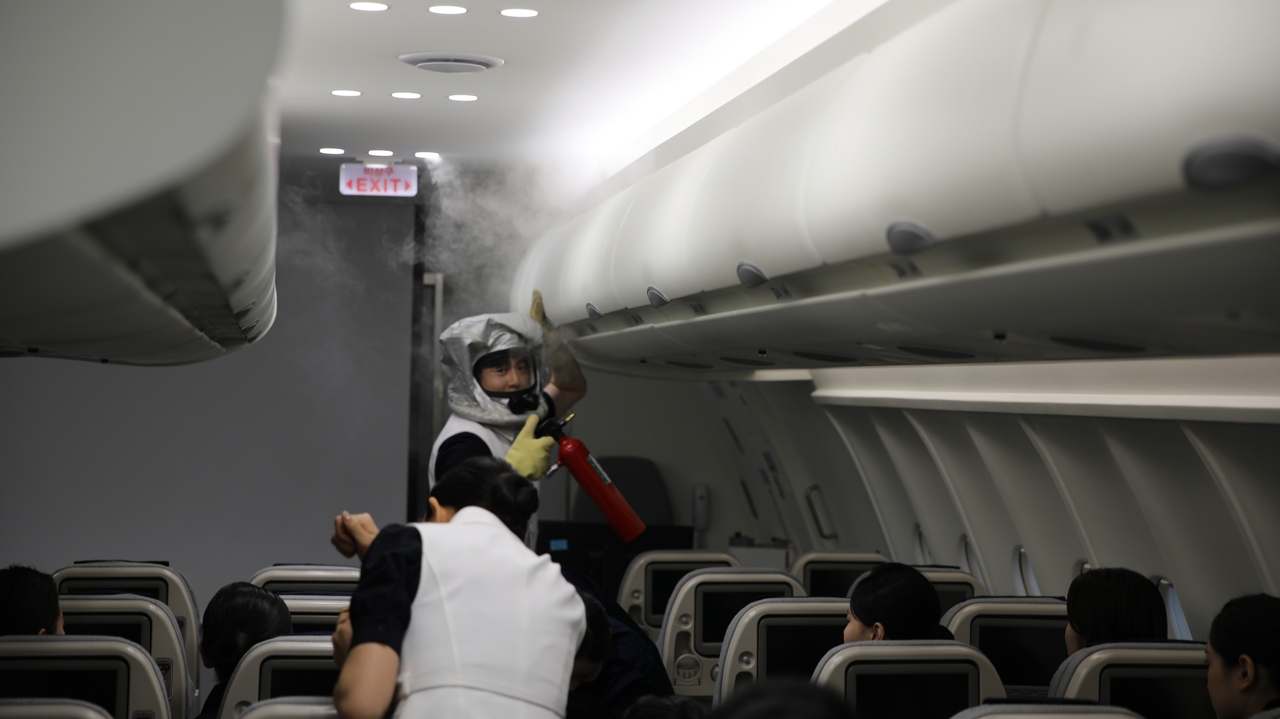
Parata Air said Friday it held a fire-suppression training exercise for cabin crew at the Yuhan University–Parata Air Aviation Training Center on Thursday.
The drill comes amid growing concern over lithium battery fires aboard aircraft — particularly those involving portable battery packs — and was designed to strengthen cabin crew's ability to respond to in-flight fires through realistic, scenario-based training.
The exercise focused on building the practical skills cabin crew need to respond quickly and accurately when a fire breaks out in the cabin. Parata Air went beyond familiarizing crew with procedures and theory, using a professional fire-suppression training facility that generates real flames and smoke so crew members could experience fire conditions firsthand and practice their response.
Participants practiced identifying a fire in a simulated environment, then suppressing it using onboard firefighting equipment. The training aimed to build the composure and on-scene response capability needed to act calmly under pressure.
Because aircraft cabins carry large numbers of passengers in a confined space, a swift initial response to any fire is critical. As portable battery packs and other electronic devices become ubiquitous, the importance of both prevention and crew readiness for real emergencies has grown.
In response to this changing environment, Parata Air has been reinforcing hands-on training to ensure cabin crew can execute established safety procedures accurately when it matters most.
Parata Air resumed operations in September last year, and despite little more than a year of service, the airline has continued to invest in education and training with safety as its top priority. The carrier plans to strengthen the human capabilities that underpin operational safety in line with its growth and route expansion, and to run training programs that crew can apply directly on the job.
"Responding swiftly to in-flight emergencies requires more than memorizing a manual — repeated practice in conditions that closely mirror reality is essential," a Parata Air official said. "We will continue to reinforce hands-on safety education so passengers can fly with confidence, and we will keep investing in and working toward safety."
Meanwhile, Parata Air recently recorded an overall in-flight service satisfaction rate of 93 percent in its fourth customer satisfaction survey of 2026, matching the result of its first survey conducted in February despite an expansion in routes and flight volume.
likehyo85@heraldcorp.com