Housing prices in July–September rose more than 1.5 times the inflation rate
Semiconductor belt price surge spills into adjacent unregulated areas
Low inflation also a factor; Land Ministry says no immediate plans for new designations
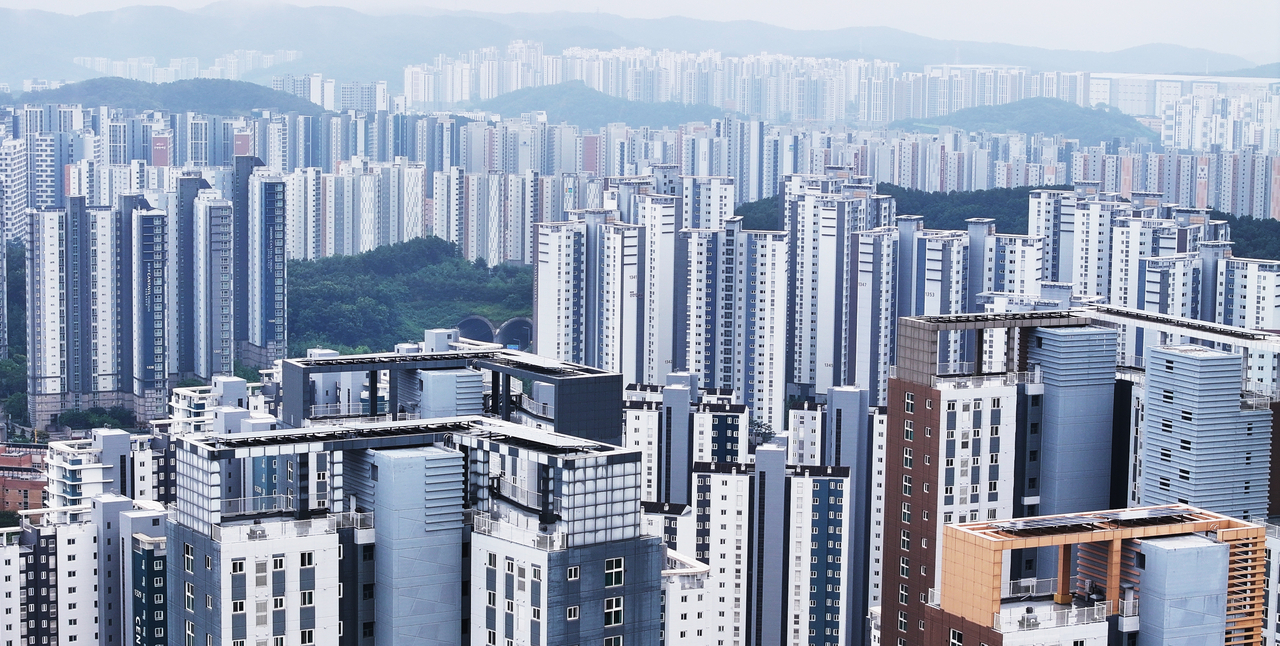
Rising apartment prices have spread to the outer reaches of Gyeonggi Province, with 34 areas meeting the quantitative criteria for designation as speculative overheating districts as of September. The surge, driven largely by the semiconductor industry corridor in southern Gyeonggi Province, has been spilling into neighboring areas, expanding the pool of zones that could face tighter regulation. South Korea's Ministry of Land, Infrastructure and Transport said it has no immediate plans to designate additional regulated areas.
34 areas in Gyeonggi Province meet speculative overheating district criteria
According to the Ministry of Statistics and the Korea Real Estate Board, 34 areas in Gyeonggi Province recorded housing price increases between July and September that exceeded 0.15 percent — 1.5 times the regional consumer price inflation rate of 0.1 percent — the quantitative threshold for speculative overheating district designation. Ten areas fell below the threshold: Ansan's Sangnok-gu, Pyeongtaek, Icheon, Yeoju, Gimpo, Goyang's Ilsandong-gu and Ilsanseo-gu, Paju, Pocheon and Dongducheon.
The price surge was particularly pronounced even in areas not already designated as either adjustment target zones or speculative overheating districts — 15 such designated areas were excluded from the count. Gunpo recorded the steepest rise among unregulated areas, with its housing price index climbing from 101.09 to 104.08 between July and September, a gain of roughly 2.96 percent — about 30 times Gyeonggi Province's consumer price inflation rate over the same period. Hwaseong's Byeongjeom-gu (2.69 percent), Suwon's Gwonseon-gu (2.46 percent), Anyang's Manan-gu (1.61 percent), Namyangju (1.52 percent) and Bucheon's Wonmi-gu (1.45 percent) also posted sharp gains.
Under the Housing Act, an area may be designated a regulated zone when its housing price increase rate is significantly higher than the inflation rate. The standard quantitative threshold is a three-month housing price increase of more than 1.3 times the consumer price inflation rate for adjustment target zone designation, and more than 1.5 times for speculative overheating district designation. Authorities also weigh broader market conditions — including subscription competition rates, overall price levels and housing supply ratios — before making a final determination. In effect, most of Gyeonggi Province now meets the quantitative criteria for regulated zone status.
Low inflation has also played a role. Consumer price inflation in Gyeonggi Province turned negative in August and remained subdued throughout the July–September period, making it easier for housing price gains to clear the regulatory threshold. Even so, analysts note that price increases once concentrated in specific areas are now visibly spreading to neighboring unregulated zones — a trend worth watching.
Balloon effect drives record highs; Land Ministry says no immediate action planned
Many of the areas that now meet the quantitative criteria for speculative overheating district designation had seen flat or declining prices when the government last expanded its regulated zone list — designating all of Seoul and 12 areas in Gyeonggi Province under its Oct. 15 package last year. Gunpo's housing price growth rate stood at minus 0.05 percent in September last year, while Suwon's Gwonseon-gu posted minus 0.03 percent. Gwonseon-gu was, at the time, the only district in Suwon left off the regulated zone list.
Since then, prices have surged in what is known as the semiconductor belt — centered on Suwon's Yeongton-gu and Hwaseong's Dongtan-gu — pushing demand into surrounding areas. As bonuses and in-house loans from major chipmakers fueled a wave of home purchases, buyers priced out of the core semiconductor corridor have increasingly turned to lower-priced neighboring districts. The pattern is clear: demand that cannot be met in Dongtan has shifted to Byeongjeom-gu, and buyers shut out of Yeongton-gu have moved on to Gwonseon-gu.
Korea Real Estate Board data confirm the trend. For the week ending Monday, Hwaseong's Dongtan-gu posted the highest year-to-date apartment price gain nationwide at 21.91 percent. Gwangmyeong followed at 18.01 percent, with Suwon's Yeongton-gu (17.97 percent) and Seongnam's Bundang-gu (17.13 percent) also among the top performers. With the exception of Gwangmyeong, all of these areas are adjacent to major semiconductor industry facilities.
Record-high transactions have continued at the individual complex level as well. According to the Land Ministry's actual transaction price disclosure system, an 84-square-meter unit at Sindongtan Forêt de Ville in Hwaseong's Byeongjeom-gu sold for 1.14 billion won ($849,000) on Sept. 11, setting a new high for the complex. A same-sized unit at Maegyo Station Palucid in Suwon's Gwonseon-gu — a complex currently in the move-in phase — also set a new record, changing hands in October for 1.1383 billion won on the seventh floor.

The Land Ministry is closely monitoring the price surge spreading to outer Gyeonggi Province. Officials said that when assessing whether to designate a speculative overheating district, they look beyond the quantitative criteria to consider factors such as how long the price increase has persisted and the overall degree of market overheating. The ministry is also examining the impact on the housing market of semiconductor industry bonuses and in-house loans, which have been widely cited as a driver of the price surge in southern Gyeonggi Province.
The ministry nonetheless said it has no immediate plans to add new regulated zones. "The situation does not call for designating any specific area as a regulated zone right now," a ministry official said. "We are continuously monitoring the market and will convene the Housing Policy Deliberation Committee for a formal review if and when that becomes necessary."
hss@heraldcorp.com