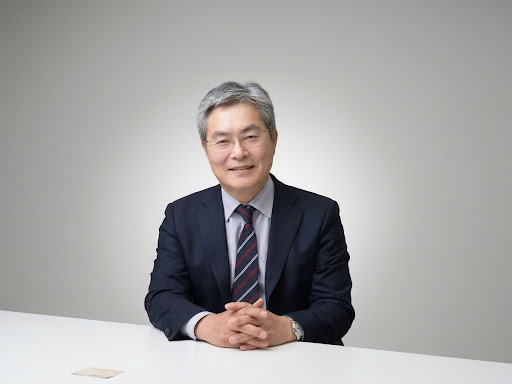
Yang Ho-seok, former senior education attaché at South Korea's Embassy in Tokyo, oversaw overseas education affairs
"We expanded opportunities for learners who had hesitated to take the test because testing sites were too far away"
In Japan, interest in the Korean language has long since moved beyond a passing trend.
What began as affection for drama series and music has migrated into classrooms and, from there, into formal certification. People who once memorized vocabulary as a hobby are now preparing for exams with an eye toward Korean universities or jobs at Korean companies. The clearest measure of that shift is TOPIK. The number of test-takers in Japan grew from about 27,000 in 2019 to about 50,000 in 2025 — roughly 1.9 times, or in effect nearly double.
TOPIK, administered since 1997 by the National Institute for International Education under the Ministry of Education, is designed for non-native speakers — foreign nationals and overseas Koreans alike. Scores are used for university admission and graduation in Korea, employment at Korean companies and public institutions, and residency status reviews. Applicants to Korean universities typically need at least a Level 3 score. The exam is broadly comparable to the TOEFL in English-speaking countries. According to Ministry of Education figures, the global applicant pool grew from 330,016 in 2021 to 553,237 in 2025, with the test now administered at 368 sites across 89 countries. Japan ranks among the largest overseas markets, alongside China and Vietnam.
The surge was not driven by interest alone. Over the same period, the number of TOPIK testing sites in Japan grew from 35 in 2019 to about 80. Demand had been there; what was missing was capacity. The official who coordinated that expansion on the ground in Japan was Yang Ho-seok, former senior education attaché at South Korea's Embassy in Tokyo. Yang, who oversaw overseas education affairs and returned to Korea in September after completing his term, cited those figures as the most tangible change during his tenure in an interview Thursday.
Yang declined to take personal credit for the expansion of testing sites. "Education institute staff, the Korean Residents Union in Japan and Korean-language education specialists at universities worked together to bring the number of sites to about 80," he said. "We expanded opportunities for learners who had hesitated to take the test because testing sites were too far away." He acknowledged the role of growing interest in Korean culture, but the point he returned to repeatedly was accessibility — the distance to a testing site, he said, was often a bigger obstacle than any lack of motivation to learn.
The rise in TOPIK applicants is part of a broader shift. Yang said that as Korea's development and international standing have grown, Japanese society has begun to take an interest in Korean education policy itself. He said that during his tenure, efforts to introduce Korean education policy to Japan and deepen exchanges between educational institutions in the two countries helped broaden cooperation — from exchanges limited to elementary, middle and high school students and teachers to partnerships involving universities and research institutions.
A 70-year-old school with no students who refuse to attend
At the center of Korean education in Japan stands a school that has been there for seven decades. Tokyo Korean School was founded in April 1954 through the combined efforts of what was then South Korea's mission to Japan, the Korean Residents Union and the overseas Korean community. It opened with 26 students and six classrooms, marked its 70th anniversary in 2024, and has produced 13,000 graduates. Today it operates an elementary division, a middle school division and a high school division — each with three classes per grade — with a capacity of 1,440 students and a teaching staff of about 100. Accredited by both the Korean government and the Tokyo Metropolitan Government as a private miscellaneous school, it follows the Korean national curriculum while supplementing it with Japanese coursework. The principal is a Korean education specialist dispatched by the Korean government, and teachers are drawn from a wide range of backgrounds — Koreans, overseas Koreans, new settlers, Japanese nationals and other foreign nationals.
When Yang named the school's greatest strength, it was not the curriculum. It was the fact that, despite a compact campus, students from first grade through the final year of high school share the same space and interact constantly. "Sunbae set an example for their juniors, and juniors can lean on their sunbae without hesitation," he said. "Because there is mutual trust and a sense of ease, a free and peaceful atmosphere takes hold naturally."
School refusal — students who stop attending — is a significant educational challenge in Japan. Recalling his time in the post, Yang said he was told that Tokyo Korean School had no students who refused to attend. "I took that as the result of the school community paying close attention to each and every student," he said. He drew a line, however, against overgeneralizing: "A single school's experience cannot be used to rank Korean and Japanese education as a whole."
Tokyo Korean School runs a K track for students aiming at Korean universities, a J track for those targeting Japanese universities, and an English immersion program. "Being able to develop Korean, Japanese and English together and explore a range of paths to higher education is a major strength," Yang said. He added that compared with international schools or elite local schools in Japan, the trust and communication between students and teachers is a clear advantage that sets the Korean school apart. He identified securing high-quality teachers and developing global education programs as the remaining challenges.
'Ample support, restrained intervention'
Overseas Korean schools receive budget support and oversight from South Korea's Ministry of Education while being expected to operate autonomously in line with local conditions. Yang acknowledged that some overseas Korean schools have run into operational problems, but assessed Tokyo Korean School as a case where internal governance mechanisms and external oversight work in balance — a balance that has become a long-standing tradition.
His formula was straightforward. "Providing ample support while restraining intervention, and having the school respond to that trust with responsible management" — that, he said, is the right balance. "Where there are problems, intervene clearly; where a school is well run, give it more autonomy," he added. He also cautioned that external oversight must not substitute for the school's own self-governance.
Beyond the school gates, he pointed to a practical problem that parents regularly face: the special admissions track for overseas Koreans at South Korean universities. The "three-year exception" track and the track for students who completed their entire education abroad carry different eligibility requirements and review criteria, generating confusion every year. Disputes over overseas residency periods, parents' employment arrangements, visa status and actual residency requirements recur regularly.
"Clear and consistent criteria, sufficient advance notice and accurate information are what matter most," Yang said. "For criteria that are easy to misinterpret, it would also help to compile and distribute a casebook of examples." He called on the Korean Council for University Education to take the lead in systematically guiding applicants through university-specific criteria and key cases, and urged admissions offices at individual universities to use their professional networks to prevent well-intentioned applicants from being caught out. He also noted that universities' autonomy in selecting students must be respected.
He shared his own measure of a good school — and it had nothing to do with grades or university placement rates. "A school where graduates come back to greet their teachers and proudly show their juniors who they have become. That, I think, is what a truly great school looks like," he said.
Since leaving his post, Yang has been working to reshape the framework for student exchanges between Korean and Japanese universities. He wants to move beyond short visits and one-off events toward a sustained program in which students from both countries identify local issues together, conduct field research and propose solutions. "I am developing a structure that moves from preparatory study through field research, joint projects and the sharing of results, and I have recently been consulting with specialists on the idea," he said, and went on to say: "I want to make use of digital platforms and whatever AI tools are needed, but keep student-led inquiry and trust between Korean and Japanese universities at the center."
ahnbc@heraldcorp.com