Auto parts, clean-fuel technology drive Korea expansion push
Canada submarine race: 'No big gap' with Hanwha Ocean
Steel unit IPO planned; financial holding company target set for 2030
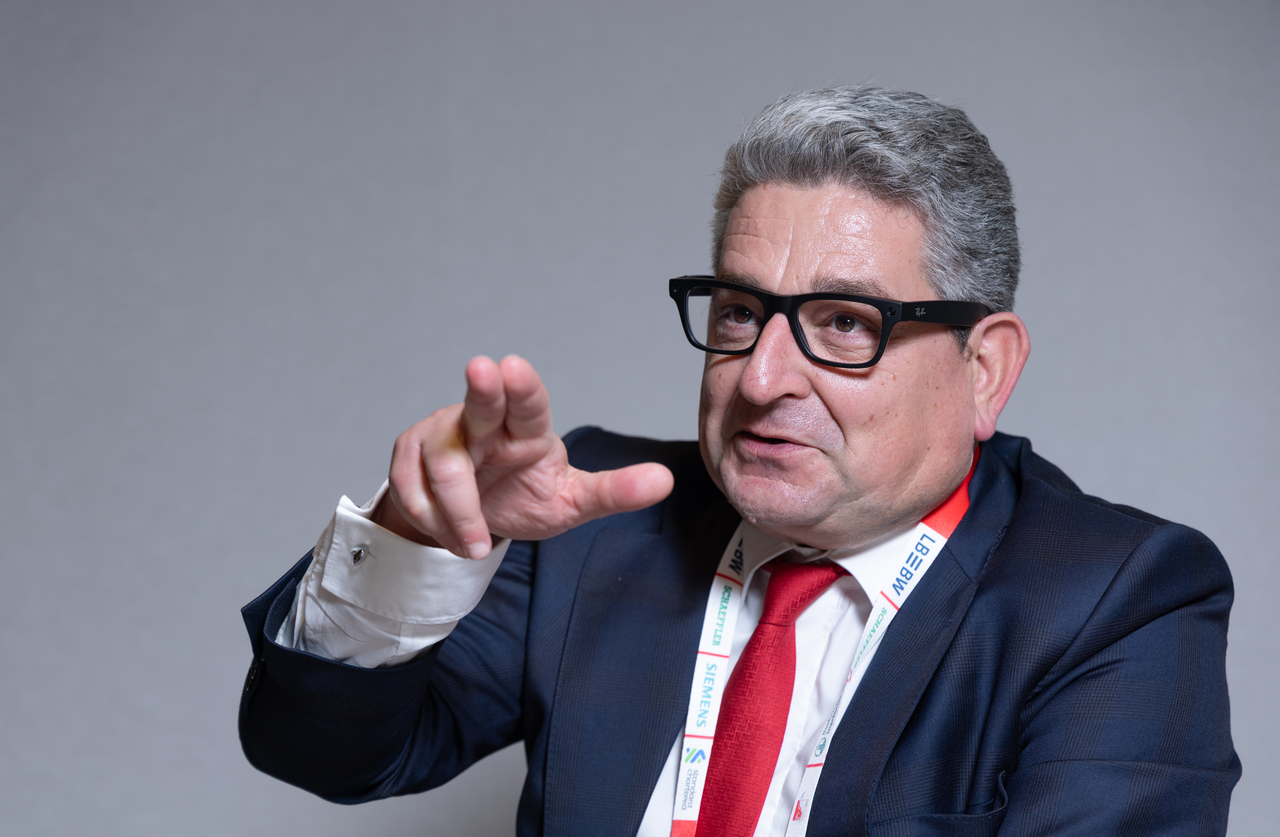
Thyssenkrupp CEO Miguel Angel Lopez Borrego said the German industrial conglomerate plans to deepen its push into the South Korean market through automotive components and decarbonization technologies such as hydrogen, while also leaving open the possibility of cooperation with Korean defense companies it recently competed against.
Speaking to Herald Media Group on the sidelines of the 19th Asia-Pacific German Business Conference (APK 2026) in Seoul on Friday, Lopez said South Korea's industrial capabilities and competitiveness warranted a larger share of the company's business than it currently holds. "Korea's weight in our business is not sufficient given the country's industrial strength and competitiveness," he said. "That leaves room for expansion."
Founded in 1811, Thyssenkrupp is one of Germany's flagship steel and industrial groups, operating five business divisions: steel, naval shipbuilding, materials retail, automotive technology and decarbonization. Lopez took office in June 2023, having previously held senior roles at Siemens and other companies.
He identified automotive components and decarbonization as the two main growth opportunities in Korea. Thyssenkrupp produces steering systems and other automotive parts, and said its steering components are found in one in four vehicles worldwide. "Our market share with Korean automakers is very low, which means there is considerable room to grow," Lopez said.
On the decarbonization side, the company highlighted its electrolysis equipment and clean-fuel technologies. Subsidiary Nucera produces electrolyzers that split water to produce green hydrogen. Another subsidiary, Uhde, a chemical plant design and construction firm, won a contract to build a coke plant at Hyundai Steel's Dangjin steelworks in 2007 and has participated in multiple scale-ups of Posco's coke plant operations.
"We are developing new clean-fuel segments — including electro-based sustainable aviation fuel, e-methanol and biomass gasification — using our electrolyzer technology and Thyssenkrupp Uhde's expertise," Lopez said. "This visit has allowed us to start conversations with relevant companies, and I am optimistic these will lead to concrete agreements."
Lopez also raised the prospect of defense cooperation. Thyssenkrupp's subsidiary TKMS was selected in July as the preferred bidder for Canada's submarine program, a contract worth up to 60 trillion won, beating out Hanwha Ocean. TKMS was separately listed in October last year, with Thyssenkrupp retaining a 51 percent stake.
Lopez described the Canadian competition as a close contest. "I don't think there was a big gap between the two companies," he said. "It was a very good competition, fought at a very close level."
Asked about the possibility of jointly pursuing third-country defense projects or technology cooperation, he said geopolitical shifts were creating new opportunities between the EU, Germany and South Korea. "I am convinced that in the coming years we will see much more cooperation between German and European companies and Korean companies," he said.
The company is also exploring the deployment of humanoid robots in its factories, with hazardous workplaces such as steel production facilities and chemical plants among the first candidates. "We want to use new technology not only to improve productivity but also to enhance the safety of our employees," Lopez said. "Once humanoid robots have learned basic tasks, the scope of their application can expand quite rapidly."
Thyssenkrupp is restructuring from an industrial conglomerate into a financial holding company. Following the separate listings of TKMS and the materials retail division, the company plans to spin off its steel, automotive and decarbonization technology units in succession, with the full transition targeted for completion by 2030. Under the plan, Thyssenkrupp will retain a 51 percent stake in each spun-off unit, with the remaining 49 percent distributed to existing shareholders.
For the steel division, the company is pursuing a stock market listing rather than an outright sale. Thyssenkrupp is Germany's largest steelmaker, ranking 47th globally with crude steel output of 9.41 million tons last year. Negotiations to sell a stake in the steel unit to India's Jindal Steel were put on hold in May, and the company is restructuring to reduce annual production capacity from around 11.5 million tons to a shipment-based level of 8.7 million to 9 million tons.
At a capital markets day on Sept. 28, the steel division set a medium-term target of raising its adjusted EBITDA to at least 1.2 billion euros ($1.34 billion) from 384 million euros in the most recent fiscal year. Lopez said a market listing would generate more value than other transaction structures. "Considering the potential for value appreciation, a capital markets transaction can create greater value than other types of deals," he said.
The company is also pursuing a green steel transition. Thyssenkrupp plans to replace one blast furnace at its Duisburg steelworks in Germany with a direct reduced iron facility capable of producing 2.5 million tons annually. Because green hydrogen is not yet cost-competitive, the plant will initially run on a mix of 80 percent natural gas and 20 percent green hydrogen. "Even using only natural gas, we can cut carbon dioxide emissions by about 50 percent compared with the existing process," Lopez said. "The new facility could reduce Germany's total emissions by around 0.5 percent."
eyre@heraldcorp.com