DGIST, GIST and Kyungpook National University develop triple-layer semiconductor structure

South Korean researchers have developed a technology that can precisely analyze light composed of multiple mixed wavelengths using just a single sensor, reducing wavelength reconstruction error by 95.6% compared with existing methods.
Daegu Gyeongbuk Institute of Science and Technology (DGIST) announced Wednesday that a team led by Professor Lee Jong-su of its energy engineering department, working jointly with Professor Yoon Hun-han of Gwangju Institute of Science and Technology (GIST) and Professor Na Hyun-su of Kyungpook National University, had developed a single-photodetector-based "multidimensional computational spectroscopy" technology.
A spectrometer is a device that separates light by wavelength to analyze the composition and properties of materials. The instruments are widely used in medical diagnostics, environmental monitoring, food safety inspection and semiconductor manufacturing.
Conventional spectrometers require prisms or multiple sensors to separate light, making them bulky and complex. Computational spectrometers that use AI to address these limitations have emerged, but they struggle to accurately distinguish light containing multiple mixed wavelengths and tend to produce large measurement errors even with minor noise.
The research team found a way forward by redesigning the semiconductor structure itself.
The team built a three-layer stack of molybdenum disulfide (MoS₂), tungsten diselenide (WSe₂) and molybdenum disulfide, creating a specialized structure that allows two types of voltage to be controlled simultaneously.
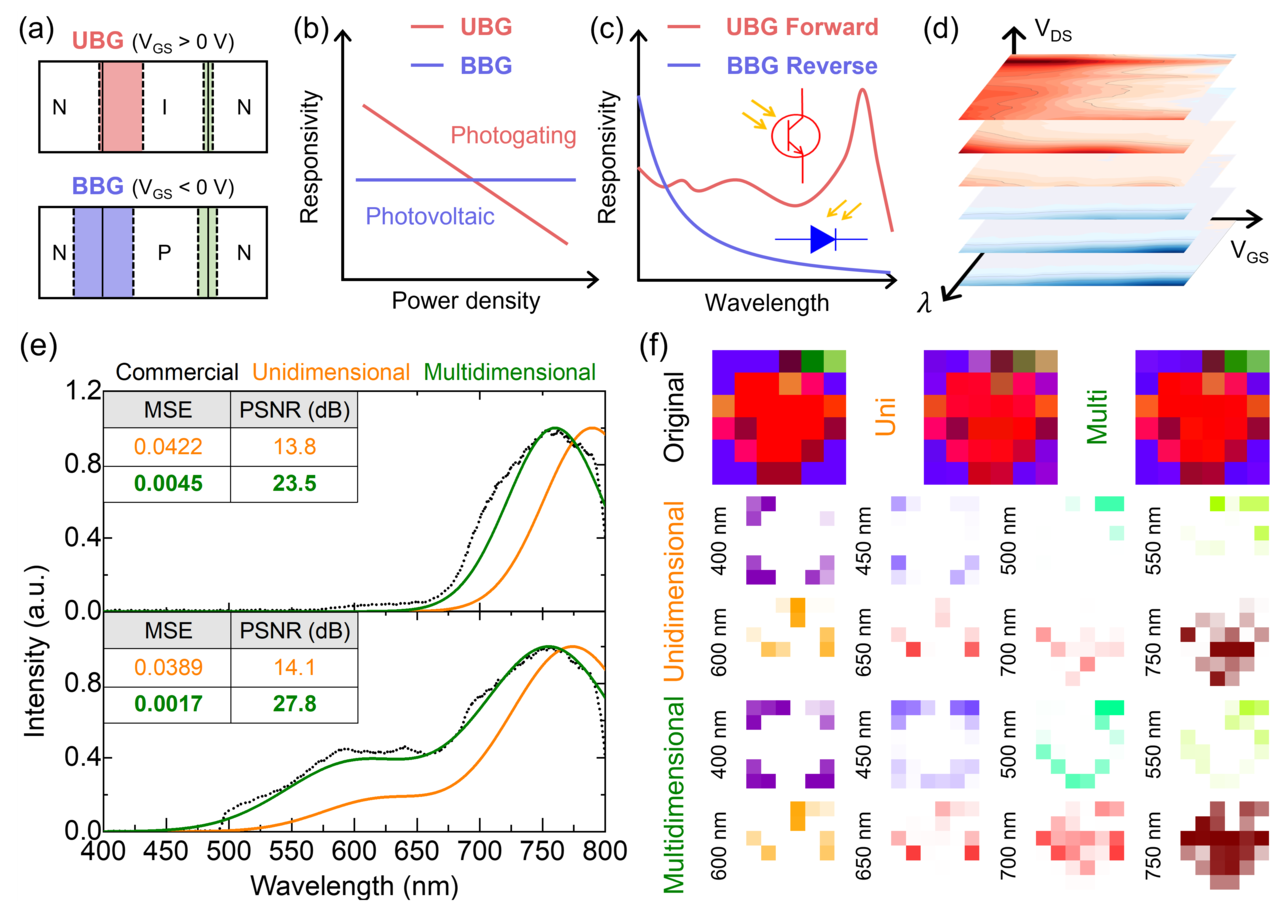
The key innovation lies in using voltage adjustments to alter the path along which electric charges travel inside the semiconductor. Even with a single sensor, varying the voltage combination allows the device to respond differently to different types of light, enabling it to distinguish information across multiple wavelengths.
The approach reduced signal overlap between different wavelengths — a persistent problem in existing technology — by more than 32%, while cutting the error that occurs when reconstructing wavelength information from complex light by 95.6%.
The peak signal-to-noise ratio (PSNR), a measure of image reconstruction quality, also improved dramatically, rising from 14.1 decibels (dB) to 27.7 dB. The team successfully reconstructed wavelength information and color-distribution images even in environments where only minimal current flows.
The technology is significant because it raises precision without increasing the number of sensors. It could eventually be applied to smartphones analyzing material composition, drones collecting environmental data, and self-driving cars identifying the optical properties of surrounding objects.
The research team plans to develop prototypes of a portable spectrometer and a compact spectral sensor, though a specific commercialization timeline has not yet been set.
"This is a technological achievement that dramatically improves the reconstruction quality of both spectra and images simultaneously using only a single sensor," Lee said. "It can replace the large, heavy spectrometers of today and be applied across a wide range of industries, including ultra-compact, low-power wearable devices and intelligent optical sensors."
Yoon of GIST described the work as "a representative example of AI-semiconductor-sensor convergence research that significantly enhances sensor performance by combining electrical control at semiconductor interfaces with multidimensional AI learning."
The findings were published in the October online edition of the international journal Advanced Functional Materials.
nbgkoo@heraldcorp.com