Lawmaker grills city spokesperson over removal of MBC from internal news monitoring and cuts to ad spending... 'Blocking critical coverage is information control'
Criminal complaint against professors who appeared on 'PD Notebook' raises free-expression concerns
Spokesperson Ho Jun-seok defends legal action, rules out mediation
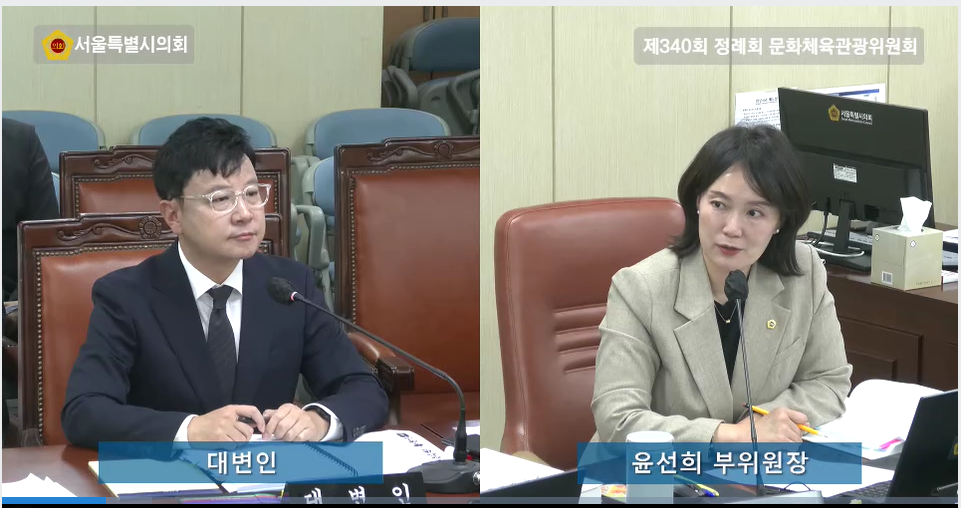
A sharp exchange erupted at the Seoul Metropolitan Council's administrative audit after it emerged that the Seoul Metropolitan Government had excluded a critical broadcaster from its internal news monitoring and filed criminal complaints against professors who appeared on a television program to share their views. The dispute over press fairness has broadened into questions about public institutions' obligations to provide information and protect freedom of expression.
Yoon Sun-hee, vice chairperson of the council's Culture, Sports and Tourism Committee and a Democratic Party of Korea member representing Jongno District 1, pressed the city's spokesperson Tuesday over the removal of MBC from the city's internal news clipping service, a reduction in advertising spending directed at the broadcaster, and criminal complaints filed against the production crew and professors involved in coverage of the Sewoon District 4 redevelopment project.
The audit also put a spotlight on the media philosophy of Ho Jun-seok, the newly appointed Seoul Metropolitan Government spokesperson who spent more than 30 years as a journalist. Yoon said it was troubling that a former journalist who had championed press freedom was now actively backing the city's aggressive stance toward the media.
According to Yoon, the city's communications office removed MBC from its internal news monitoring in June, citing the broadcaster's coverage of missing rebar at the GTX-A Samsung Station construction site, among other reports. The move effectively cut off city civil servants from receiving MBC's news in the daily media briefings distributed internally.
Yoon said the news clipping service exists as an administrative tool to help the city grasp a range of public opinion and criticism about city governance. Coverage critical of policy, Yoon argued, is precisely the kind of information needed to identify problems and chart improvements.
"The clipping service was created so that civil servants could understand the full range of public opinion and criticism surrounding city administration and incorporate that feedback into governance," Yoon said. "The communications office taking the lead in weeding out a specific outlet because it dislikes critical coverage, and artificially cutting off city hall employees from that information, is blatant information control."
Ho pushed back, saying MBC's coverage lacked fairness. "MBC conducted interviews that represented only one side without grounding them in fact," Ho said. "I do not believe it is worth clipping because it is not fair reporting."
The city's advertising spending also drew fire. Yoon pointed out that Seoul's ad placements with MBC amounted to just one-fifth of what it spent with other terrestrial broadcasters, and that no advertising had been placed with MBC at all this year. Yoon pressed the city to explain why the exclusion from news monitoring and the reduction in advertising had occurred at the same time.
The sharpest questioning centered on criminal complaints related to MBC's "PD Notebook" program, which covered the Sewoon District 4 redevelopment. Yoon expressed concern that the city had filed complaints not only against the production crew but also against Seoul National University professors who appeared on the program to offer academic views, warning that such action could have a chilling effect on press freedom and academic inquiry.
"Directing the legal sword at Seoul National University professors who simply gave interviews and shared personal opinions in connection with the 'PD Notebook' coverage is a violation of freedom of the press and freedom of expression," Yoon said.
Yoon then asked whether Ho, as the official overseeing the city's media relations, would be willing to advise Seoul Mayor Oh Se-hoon to reconsider the legal action or to mediate a withdrawal of the complaints.
Ho said he had no such plans, signaling that the city would maintain its current legal strategy.
Yoon said a spokesperson with a journalism background should do more than promote city policies — the role also demands mediating tensions between the press and the administration and remaining open to diverse criticism. Yoon said it was contradictory for Ho, who had previously championed press freedom as a journalist, to now vigorously defend the city's confrontational approach to the media.
The audit session broadened into a wider debate over how far a local government may go in responding to critical press coverage, and what principles should govern a public institution's media information services and advertising decisions. Particular attention fell on the potential impact that legal action against outside experts who participated in news coverage could have on academic commentary and public debate.
"As the top official responsible for overseeing the city's media relations and advising the mayor on press matters, you must immediately halt the one-sided press suppression and legally retaliatory administration that Seoul is carrying out, and set city governance back on the right course," Yoon said.
7toy7@heraldcorp.com