
Budget for Seoul's model apartment complex support program slashed from 2.67 billion won to 263.2 million won
Cut contradicts expansion pledge made in February
Execution rates exceeded 99% for three consecutive years
City maintains target of 120 supported complexes despite near-elimination of funding
The Seoul Metropolitan Government has cut more than 90 percent of the budget for a program it pledged to expand less than a year ago — one designed to improve living conditions in apartment complexes and promote community cooperation among residents. The city has offered no concrete evaluation to justify the reduction, even though the program's budget execution rate has exceeded 99 percent for each of the past three years. The near-elimination of funding alongside unchanged performance targets has drawn scrutiny over the coherence of Seoul's housing policy and the soundness of its budget planning.
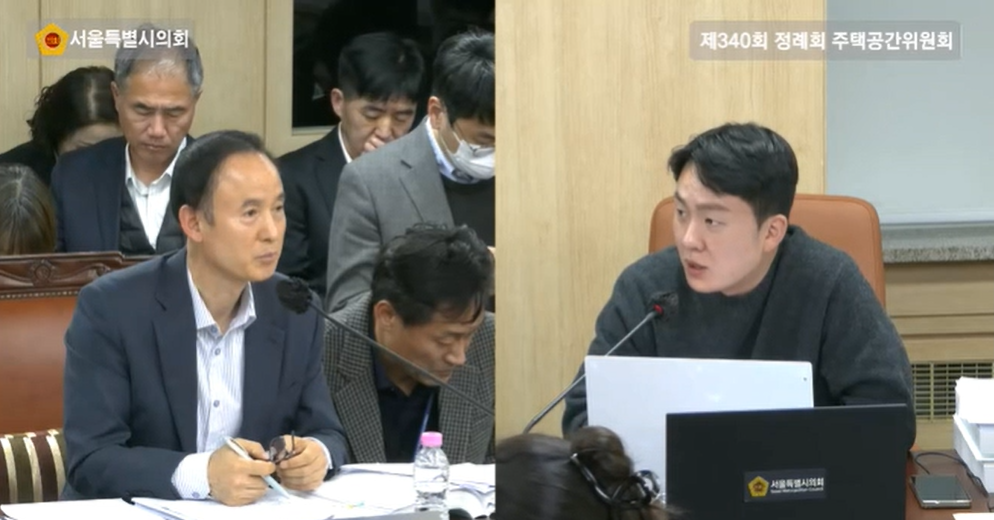
Noh Seong-cheol, a lawmaker on the Seoul Metropolitan Council's Housing and Space Committee representing the Democratic Party of Korea from Dongjak District 3, raised the issue Monday during a review of the 2027 housing bureau budget, calling on the city to establish a rational basis for its budget allocations.
According to the budget proposal submitted by the city and a review report by the committee's expert staff, the budget for the "apartment management survey and model complex support" program will fall from 2.67 billion won ($2 million) this year to 263.2 million won next year — a reduction of 2.41 billion won, or 90.1 percent.
The cut runs counter to the policy direction the city announced earlier this year. In February, Seoul said it would provide up to 30 million won per model complex, citing improved working conditions for building staff such as security guards and cleaners, and the promotion of a culture of mutual consideration among residents, as its main policy goals. At the time, Choi Jin-seok, head of the city's housing bureau, also said support for model complexes would be steadily expanded.
Noh pressed the city on the gap between that announcement and the actual budget. "Can the policy direction really shift enough to justify a 90 percent cut in the very budget cycle that followed the expansion pledge?" Noh said, demanding an explanation for the reversal and the specific reasoning behind it.
The housing bureau said the reduction reflected a comprehensive adjustment by the city's planning and coordination office, which weighed overall fiscal conditions and project priorities in drawing up the budget. The bureau was unable to provide specific grounds for the cut, however — such as a decline in program effectiveness or a drop in demand for support.
The high execution rates further undermine the rationale for the reduction. According to the expert staff review, the program's execution rates were 99.9 percent in 2024, 99.1 percent in 2025 and 99.4 percent in 2026 — all above 99 percent. Given that nearly all allocated funds were spent each year, critics say the city should clearly explain the program-specific grounds for such a steep cut, regardless of any broader fiscal pressures.
The validity of the performance targets has also emerged as a point of contention. Despite cutting the program budget by 90.1 percent, the city kept its target of supporting 120 complexes next year — the same as before. In response, city officials said the number of supported complexes or the amount allocated per complex may need to be adjusted to reflect the reduced budget.
The expert staff review also noted that maintaining the same performance target while reducing both the number of selected complexes and the per-complex support amount represents a mismatch between budget planning and goal-setting. It said the city needs a performance management framework that accounts not only for the number of supported complexes but also for actual funding levels and program outcomes.
The model complex support program has also been used to improve living conditions in local apartment communities. Last year, eight complexes in Dongjak-gu were selected — Raemian Isuyeok Roipark, Boraemae Samsung Sherville, Boraemae Parkville, Sadang Woosung 3 danji, Sangdo Daelim, Sangdo Park Xi, Sindaebang Gyeongnam Honors Ville and iPark Sangdo — receiving a combined total of about 83 million won in support.
The funds were earmarked for areas closely tied to residents' daily lives, including upgrades to security guard booths and cleaner rest areas, repairs to shared facilities, and community-building initiatives. The budget reduction raises questions about how many complexes will be supported next year and at what level.
During the budget review, Noh said that even if some program adjustments are warranted by fiscal conditions, the city must weigh its existing policy commitments, program outcomes and on-the-ground demand for support together. Noh added that it would be difficult to ensure the program's real-world impact if the city continues to hold performance targets steady after such a large funding cut.
The criticism goes beyond a dispute over budget figures, raising broader questions about the continuity of policies the city has publicly announced and the accountability of its fiscal management. The adequacy of the justification for the reduction, the appropriate scale of support and the realism of the performance targets are all expected to come under further scrutiny as the budget review process continues.
7toy7@heraldcorp.com




