Analysis of 24,731 students' mock exam and CSAT scores from last year
Rating improvements: 16.9% for current students vs. 9.8% for repeat test-takers
Current students led even when compared within the same rating band
'Focus remaining 2 weeks on wrong answers, time management and test-day readiness'
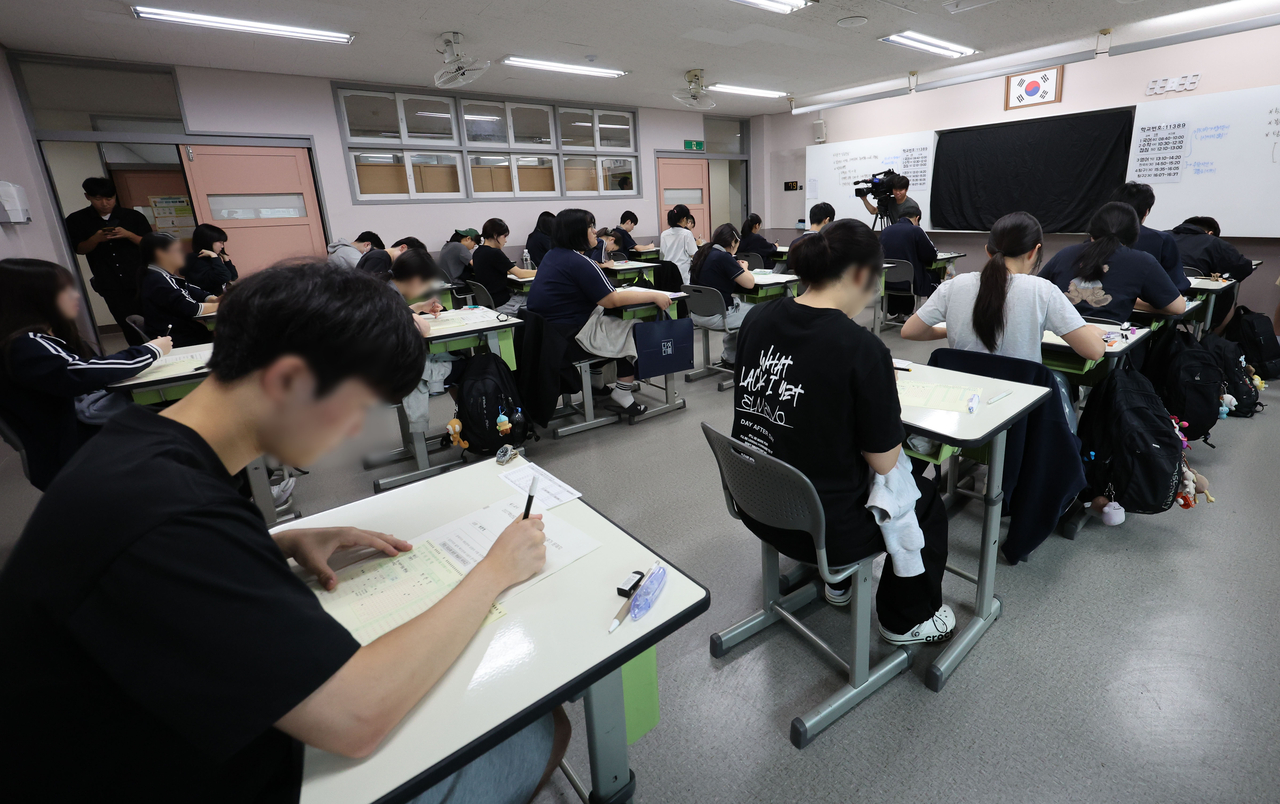
Current high school seniors were more likely than repeat test-takers to improve their ratings between last year's September mock exam and the actual College Scholastic Ability Test, an analysis has found. The advantage held even when students who received the same mock exam rating were compared directly, with current students posting higher improvement rates across the second through fourth rating bands in Korean, math and English.
College admissions platform Jinhaksa released the findings Wednesday after analyzing data from 24,731 test-takers. The results are based on last year's cohort and do not cover all CSAT candidates nationwide.
Among those analyzed, 16.9 percent of current students improved their combined average rating in Korean, math and elective subjects between the mock exam and the actual CSAT, compared with 9.8 percent of repeat test-takers — a gap of 7.1 percentage points. Elective subject scores were calculated as the average of two subjects. In the other direction, 33.2 percent of current students saw their average rating fall, versus 45.4 percent of repeat test-takers.
Current students also led in rating improvements across every individual subject. The gap was widest in elective subjects, where 25.0 percent of current students improved compared with 15.8 percent of repeat test-takers — a difference of 9.2 percentage points. In math, the figures were 24.3 percent and 17.9 percent respectively; in Korean, 22.2 percent and 15.6 percent. Even in English, which is graded on an absolute scale, current students came in at 16.1 percent versus 12.7 percent for repeat test-takers.
The comparison, however, measures only the share of students who improved their rating after the mock exam. It does not mean that current students' overall CSAT scores were higher than those of repeat test-takers.
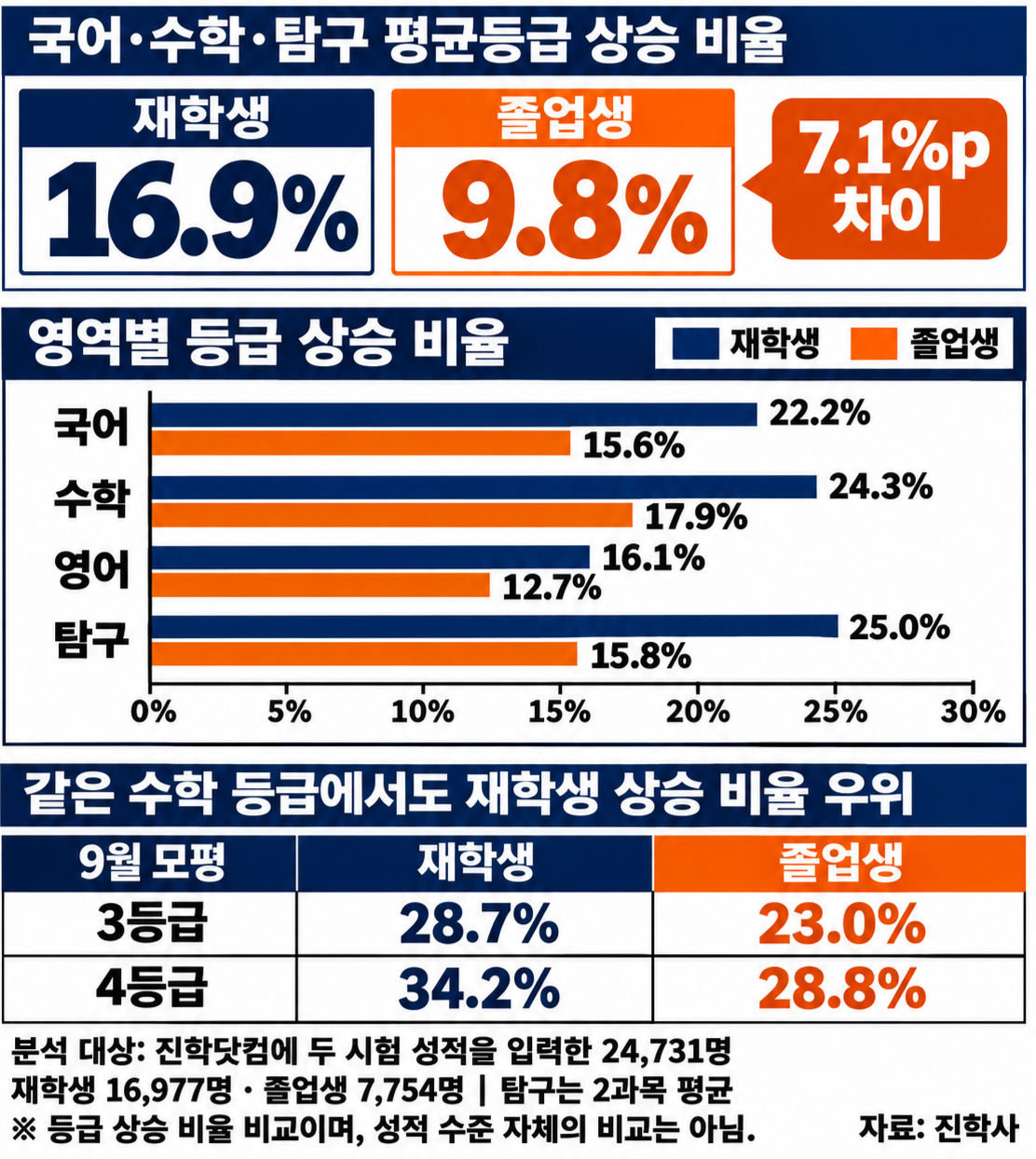
Even among students who received the same rating on the September mock exam, current students posted higher improvement rates than repeat test-takers in the second through fourth rating bands for Korean, math and English. The difference was particularly pronounced in math: 28.7 percent of current students who scored a third-band rating on the mock exam improved on the actual CSAT, compared with 23.0 percent of repeat test-takers. Among those in the fourth band, current students again led — 34.2 percent versus 28.8 percent, a gap of 5.4 percentage points.
In Korean, current students' improvement rates exceeded those of repeat test-takers by 3.8 to 4.0 percentage points across the second through fourth bands. However, the pattern did not hold across all rating levels. In the fifth band for Korean and English, repeat test-takers showed higher improvement rates. In the third and fourth bands for elective subjects, repeat test-takers also edged ahead by 0.5 percentage points each.
Jinhaksa said the shift in study conditions after the mock exam may be a contributing factor. Once current students finish submitting their school records and early admissions applications, they can devote their full attention to CSAT preparation. Repeat test-takers, by contrast, have typically been focused on the exam for longer, meaning the change in study conditions at this stage may be less significant for them.
"The dominance of repeat test-takers does not necessarily mean current students' scores will fall, so there is no need to limit your own expectations with time still remaining," said Woo Yeon-cheol, head of the admissions strategy research institute at Jinhaksa. "Rather than trying to fill every gap at this point, what matters most is consolidating what you have already studied, and identifying recurring mistakes and time-management issues."
brunch@heraldcorp.com