Total spending at record 820.9 trillion won
New future response fund to cut bond issuance by 12.5 trillion won
AI, three mega-projects to see investment nearly doubled
Minister of Planning and Budget Park Hong-keun said Wednesday that the 2027 budget proposal centers on bold investment to raise the country's potential growth rate and on easing K-shaped inequality to stabilize livelihoods.
Park made the remarks while presenting the 2027 budget and fund management plan to the National Assembly's Budget and Accounts Special Committee. "The time has come to go beyond recovery and take flight," he said.
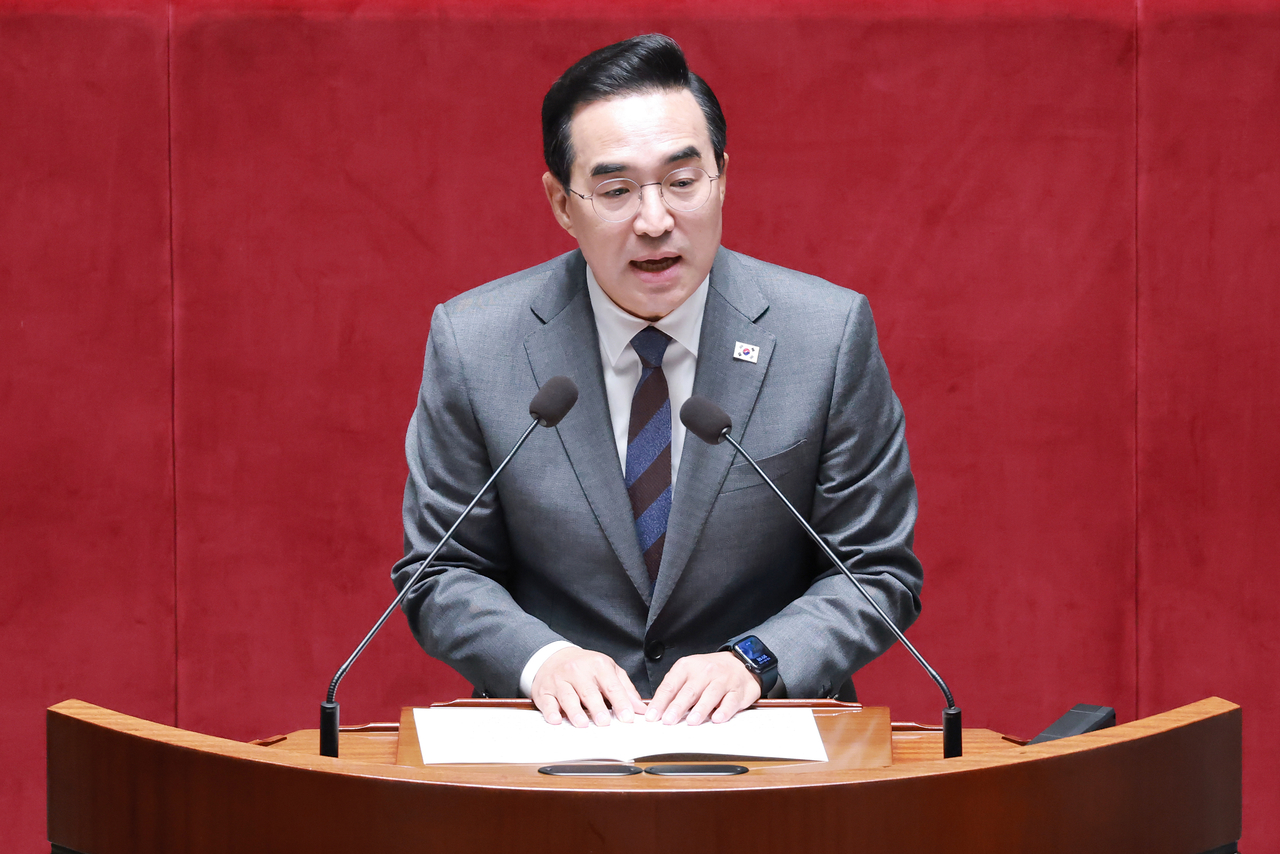
Park said the global race for technological supremacy has become an existential question for nations. "With AI reshaping the industrial landscape, countries around the world are pouring money into AI investment — even taking on debt — in an all-out battle for survival," he said. "The competition for technological dominance is no longer a matter of living better or worse; it is a matter of national destiny."
He said South Korea is in a position to seize the moment. "The AI-driven boom has sharply increased our semiconductor exports, giving us precious resources to move further ahead than others," Park said. "Not letting this opportunity slip away and turning it into the foundation for future growth is the responsible duty of the current generation toward the next."
Park also said reducing inequality is essential to broad-based growth. "An economy where only some prosper cannot achieve a leap forward for the whole of South Korea," he said. "If incomes do not rise evenly, domestic demand cannot recover, and if growth opportunities are concentrated in certain generations and regions, the potential of young people and the regions cannot be fully realized."
The government set total expenditure for next year at 820.9 trillion won ($612 billion), up 12.8 percent from this year and the largest in the country's history. Total revenue is projected at 880.8 trillion won, with national tax revenue forecast to reach 584.4 trillion won, driven by higher corporate and income taxes on the back of the semiconductor boom.
Park said the managed fiscal deficit as a share of GDP would narrow by 3.8 percentage points from the previous year to around minus 0.1 percent, while the national debt-to-GDP ratio would fall from 51.6 percent to 48.3 percent.
The centerpiece of the fiscal framework overhaul is the creation of a new Future Response Fund. The government plans to channel 162.3 trillion won in additional tax revenue — above the 10-year trend line for domestic taxes — into the fund, allocating 45.4 trillion won across four priority areas: youth, growth engines, regional development and education talent. It will also reduce new government bond issuance by 12.5 trillion won. The remaining 104.4 trillion won will be held as a buffer to absorb tax revenue volatility or cover shortfalls.
"The Future Response Fund is a strategic investment platform that puts large-scale tax revenue to productive use, and a fiscal stabilizer that cushions against revenue volatility," Park said.
The government will cut discretionary spending by a record 38.6 trillion won by eliminating more than 2,100 non-essential projects, and trim mandatory spending by 69 trillion won through institutional reforms. The formula for local education grants will also be revised to reflect school-age population trends and economic growth.
The number of projects subject to a regional preference principle will expand from seven to 61. A new supra-regional special account worth 2.8 trillion won will be established to support the five-pole, three-special-zone development framework, and block grants that local governments can allocate autonomously will be expanded to 11.9 trillion won. Municipalities that merge into integrated metropolitan cities will receive administrative integration incentives of up to 5 trillion won per year, or up to 20 trillion won over four years.
On the investment side, the combined budget for the three mega-projects and AI will nearly double, rising from 10.8 trillion won to 21.3 trillion won.
Some 3.4 trillion won will go toward building out the semiconductor production base and securing core technologies, while 3.1 trillion won will fund field demonstrations of physical AI and AI solution development across eight key sectors including manufacturing, construction and agriculture. Advanced strategic industries — space and aviation, cutting-edge biotech and nuclear energy — will receive 41.4 trillion won.
The youth budget will grow more than 50 percent, from 28.2 trillion won to 43.3 trillion won. Some 60,000 university students will be offered a first career opportunity through an internship semester program, and work experience and training support will be expanded to cover 720,000 people.
The youth savings account program will be opened to all young people regardless of income, and 106,000 units of public housing will be supplied for young people and newlyweds. A new three-part package — a marriage support payment, a newborn welcome payment and a basic child allowance — will provide up to 75 million won per child through age 12.
The anti-inequality budget will rise by 32 trillion won to 117.1 trillion won. A new special subsidy for growth-engine anchor companies will cover up to 50 percent of facility investment costs when those firms make large-scale investments in regional areas under the five-pole, three-special-zone framework, and a new regional future growth support fund of 3.5 trillion won will also be introduced.
Long-overdue debts of small business owners will be subject to special restructuring, and the coverage of the rural basic income program will expand to 35 regions. The standard median income will be raised by 6.7 percent, lifting the monthly livelihood benefit for a four-person household to 2.22 million won.
National security and peace will receive 38.3 trillion won. The budget covers the acquisition of nuclear-powered submarines, the KF-21 fighter jet and other core assets for self-reliant defense, along with a new 1.4 trillion won resource security fund to respond to supply chain crises.
"Next year will be a historic turning point — the moment we carry the renewed momentum of recovery into sustained structural growth," Park said. He urged the Assembly to pass the budget within the statutory deadline so that "the effects of these policies can reach the lives of the people as quickly as possible."
y2k@heraldcorp.com