Budget execution rate hits 0.7% through August; next year's allocation rises 2.5-fold
Equipment installation costs 450 million won per vessel, straining small operators
A government project to prevent fuel fraud and illegal distribution in the ship bunkering industry has been hobbled by delays in amending the relevant law and steep equipment installation costs. Only 0.7 percent of this year's budget had been spent as of August. Even as the government has proposed expanding next year's allocation 2.5-fold to 11.15 billion won ($8.31 million), mandatory equipment requirements and cost relief for small operators are seen as essential for the program to take hold.
According to the National Assembly Budget Office's analysis of the 2027 budget proposal by committee, the Ministry of Oceans and Fisheries has earmarked 11.15 billion won for its ship fuel metered supply operations support project next year — up 6.7 billion won, or 150.6 percent, from this year's 4.45 billion won.
Ship fuel metered supply project — budget and support plan Source: National Assembly Budget Office, "2027 Budget Proposal Analysis by Committee"
Category | 2026 | 2027 (proposed) Total project budget | 4.45 billion won | 11.15 billion won Mass flow meter installation support budget | 4.2 billion won | 10.8 billion won Vessels receiving installation support | 24 | 48 Installation cost per vessel | 350 million won | 450 million won Government subsidy rate | 50% | 50% Operator cost per vessel | 175 million won | 225 million won
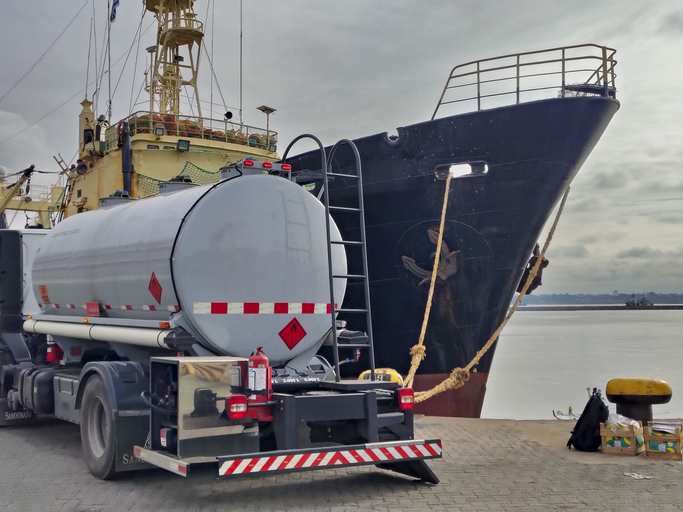
The project subsidizes the installation of mass flow meters (MFMs) on bunkering vessels that supply fuel to ships. The meters precisely measure the volume of fuel actually delivered, reducing disputes between suppliers and recipients over delivery quantities and curbing the illegal distribution of tax-exempt fuel.
Several countries already operate similar systems. Singapore introduced mandatory precise fuel measurement for ship bunkering in 2015. The Ministry of Oceans and Fisheries plans to deploy the same technology at domestic ports to improve the reliability of ship fuel transactions and strengthen the competitiveness of the related industry.
Of next year's budget, 10.8 billion won will go toward installing mass flow meters on 48 bunkering vessels. Installation costs 450 million won per vessel; the government covers half — 225 million won — while the vessel owner bears the remainder. An additional 350 million won has been set aside for program operating expenses.
The central problem is that legislation to make the equipment mandatory has stalled. At the time the National Assembly Budget Office compiled its report, two pending amendments to the Harbor Transport Business Act — both requiring fuel suppliers to measure delivery volumes accurately and install the relevant equipment — were still awaiting action in the National Assembly.
Existing law contains provisions allowing support for harbor transport businesses, and the Ministry of Oceans and Fisheries maintains that this is sufficient legal basis to subsidize installation costs. Without a mandatory installation requirement, however, the ministry has limited ability to drive industry participation.
The cost burden is also significant. Even with the government covering half the bill, vessel owners must pay 225 million won per ship out of pocket. For small bunkering operators, committing hundreds of millions of won to equipment that is not yet legally required is a difficult proposition.
Installation costs have also risen from this year's levels. The per-vessel cost climbs from 350 million won this year to 450 million won next year, a 28.6 percent increase. The Ministry of Oceans and Fisheries said the higher figure reflects rising freight costs for overseas-manufactured equipment, exchange rate movements, and increases in shipyard fees and labor costs.
Budget execution has been sluggish. Of this year's 4.45 billion won allocation, only 30 million won had actually been spent through August — just 0.7 percent of the total. Even factoring in additional spending the ministry said it planned to carry out through October, the projected execution rate reaches only about 26.5 percent.
The number of vessels targeted for support has also fallen well short of initial plans. When the project was evaluated in 2024, the government intended to equip 284 bunkering vessels between 2025 and 2027. That figure has since been cut to 76 vessels — 4 in 2025, 24 in 2026 and 48 in 2027 — representing just 26.8 percent of the original target.
The reduced coverage raises equity concerns: if mandatory installation is eventually enacted, operators that received no government support could face a heavier financial burden than those that did. In last year's budget analysis, the National Assembly Budget Office flagged the potential for fairness issues if only some operators received subsidies, and suggested either expanding the support budget or extending the program's duration.
This year's report, however, cautions against simply increasing the budget while the legislative amendment remains stalled. The office said the ministry should first confirm how many operators have applied for installation support and how many vessels have already had the equipment fitted before revisiting next year's support targets.
The National Assembly Budget Office called on the government to accelerate the legislative amendment mandating mass flow meter installation, and said it should analyze final spending figures for this year alongside operator application data before deciding on the scale of support for next year.
adastra@heraldcorp.com