
5.7 million meals to be supported next year, up 300,000 from this year
Student cost stays at 1,000 won; university recruitment opens Wednesday
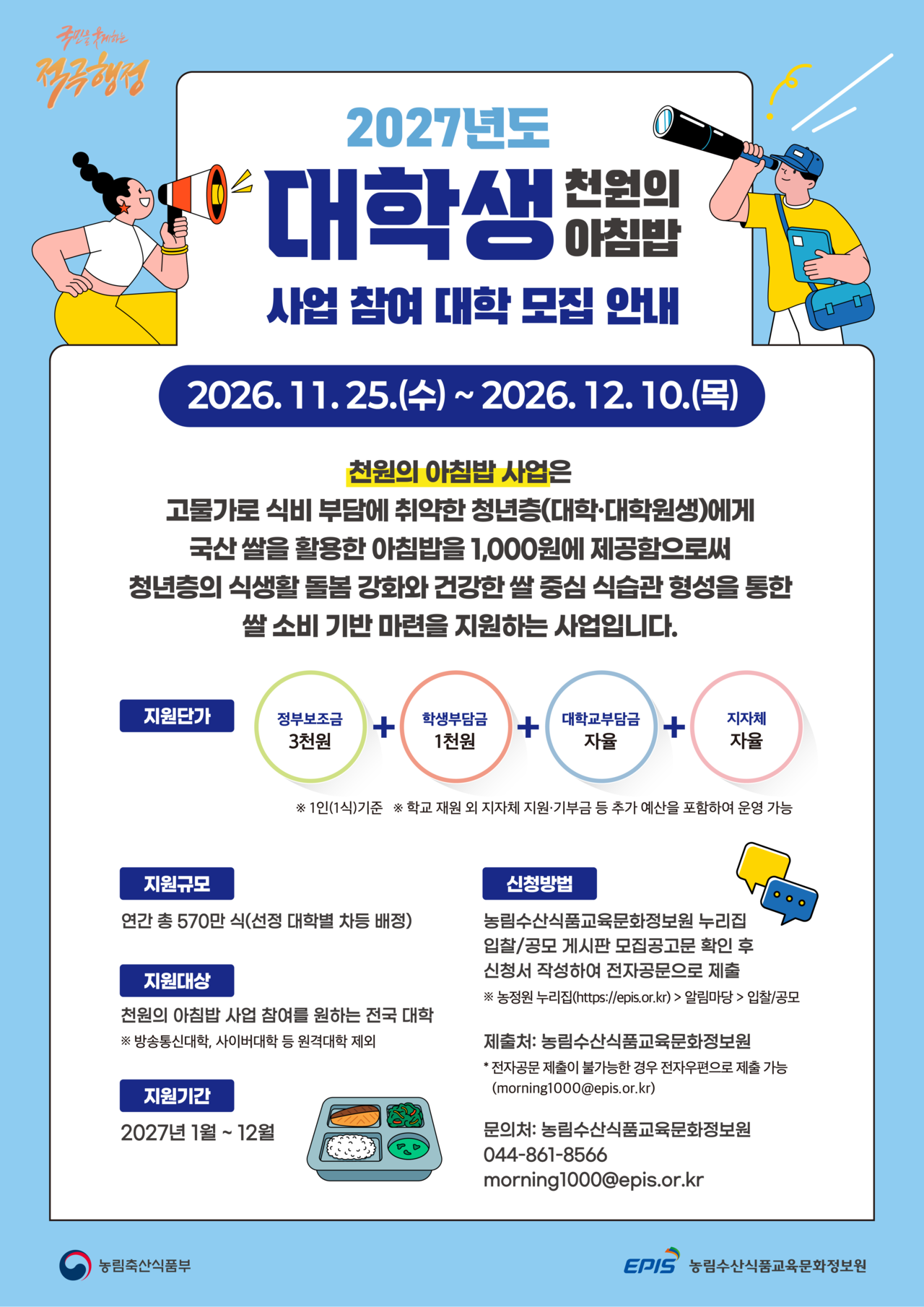
A government program that helps university students eat breakfast for just 1,000 won amid rising prices is set to expand next year. The per-meal government subsidy will increase 50 percent, from 2,000 won to 3,000 won, and the annual number of supported meals will grow from 5.4 million to 5.7 million. The student contribution will remain unchanged at 1,000 won.
The Ministry of Agriculture, Food and Rural Affairs announced Tuesday that it will accept applications from universities wishing to join the "2027 University Students' 1,000-Won Breakfast" program from Wednesday through Dec. 10.
The program allows university students to eat a Korean rice-based breakfast for 1,000 won, with the government, universities and local governments each covering a portion of the meal cost. Launched in 2017, the program currently involves 220 universities nationwide.
Next year's supported meal count will rise by 300,000 to 5.7 million, up from 5.4 million this year. The per-meal government subsidy will climb by 1,000 won to 3,000 won, a move the ministry said reflects strong student demand and the growing financial burden on universities due to inflation.
Despite the higher government subsidy, students will still pay only 1,000 won per meal. Under the cost-sharing model, if a breakfast costs 6,000 won, the government covers 3,000 won and the student pays 1,000 won, with the remaining 2,000 won split between the university and the local government.
Student satisfaction with the program is high. A survey of enrolled students at participating universities last year found a satisfaction score of 96.2 out of 100.
All universities nationwide are eligible to apply, with the exception of distance-learning institutions such as Korea National Open University and cyber universities. Interested universities must submit their applications and supporting documents to the Korea Agriculture and Food Education, Culture and Information Service by 6 p.m. on Dec. 10.
Selected universities will receive subsidies covering part of their breakfast costs from January through December next year. Application forms and eligibility criteria are available on the agency's website.
"The 1,000-won breakfast program is a flagship youth nutrition policy that eases the financial burden on university students and helps them start the day well despite high prices," said Jung Hye-ryeon, the Ministry of Agriculture, Food and Rural Affairs' food policy director. "With both the scale and the per-meal subsidy increasing in 2027, we hope more universities will join so that students can enjoy a healthy breakfast made with Korean rice."
adastra@heraldcorp.com




