APK 2026 wraps up in Seoul, 19 years after last hosting
Over 800 attend, including German Chancellor Merz and business leaders
Conference explores opportunities for Asia-Pacific and Europe amid global upheaval
Discussions cover industry, technology, trade and security cooperation
The sweeping changes reshaping the global order — including the protectionist policies of the Donald Trump administration, China's rise, and the Russia-Ukraine war now in its fourth year and eighth month — could open new opportunities for Asia-Pacific and EU nations, observers said. As the established international economic and industrial order undergoes a fundamental realignment, the Asia-Pacific region's strong growth potential is drawing attention as a major global market. Analysts say cooperation between the region and EU countries could yield mutual gains across a range of industries. Calls were made to move beyond simple trade and broaden collaboration into semiconductors, batteries, energy and manufacturing.
The 19th Asia-Pacific Conference Germany (APK) 2026, held in Seoul from Thursday to Saturday, brought together senior figures for in-depth discussions on how the shifting global order will affect the Asia-Pacific region and EU nations. APK, which held its inaugural edition in 1986, is Germany's premier regional business conference, convening every two years in major Asia-Pacific cities. It is widely regarded as a leading high-level business platform for economic cooperation between Germany and the Asia-Pacific. This year's Seoul edition was only the second time the city has hosted the event, coming 19 years after the 2007 Seoul conference.
Marking the conference's 40th anniversary, this year's gathering drew more than 800 participants, including officials from South Korea's Ministry of Trade, Industry and Energy and Germany's Federal Ministry for Economic Affairs and Energy, as well as executives and industry figures from more than 400 major companies across the Asia-Pacific and Germany. The program opened with a welcome dinner on Thursday, followed by panel discussions on trade, AI, security and other topics at the Parnas hotel on Friday and Saturday.
South Korea and Germany — the host nation and the conference's home country — are both leading manufacturing powers in their respective regions, and both face the shared challenge of building next-generation industrial competitiveness amid the spread of protectionism. Prime Minister Han Seong-sook, delivering a keynote address, said, "At a time when German companies are diversifying their supply chains into the Asia-Pacific and seeking new growth opportunities, Korea is an important strategic hub connecting Asia, the Pacific and Europe, and will be a trustworthy partner that understands Germany well." German Federal Chancellor Friedrich Merz also said in his keynote that "the structural similarities between our two countries' industries present an excellent opportunity to deepen bilateral cooperation."
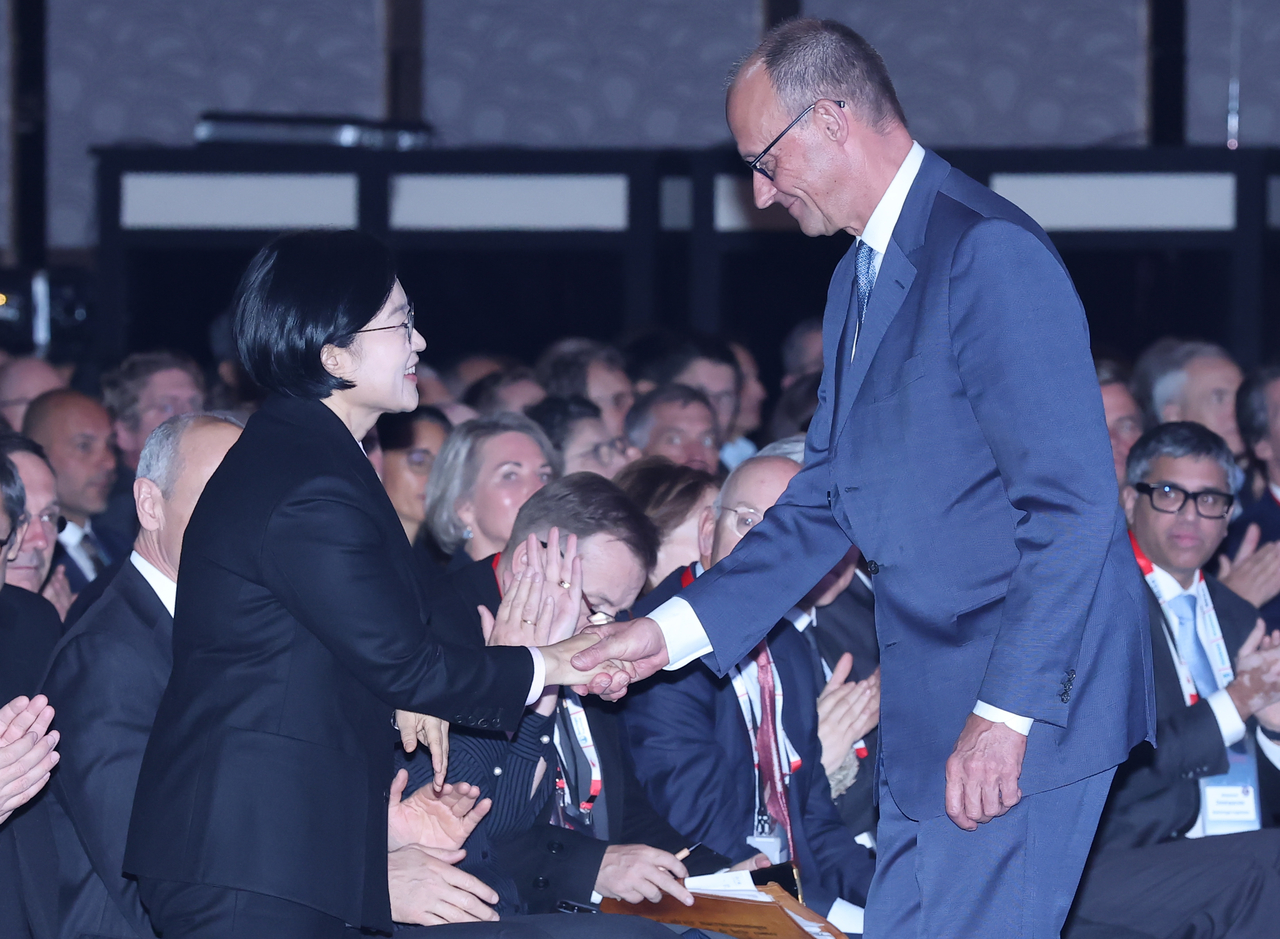
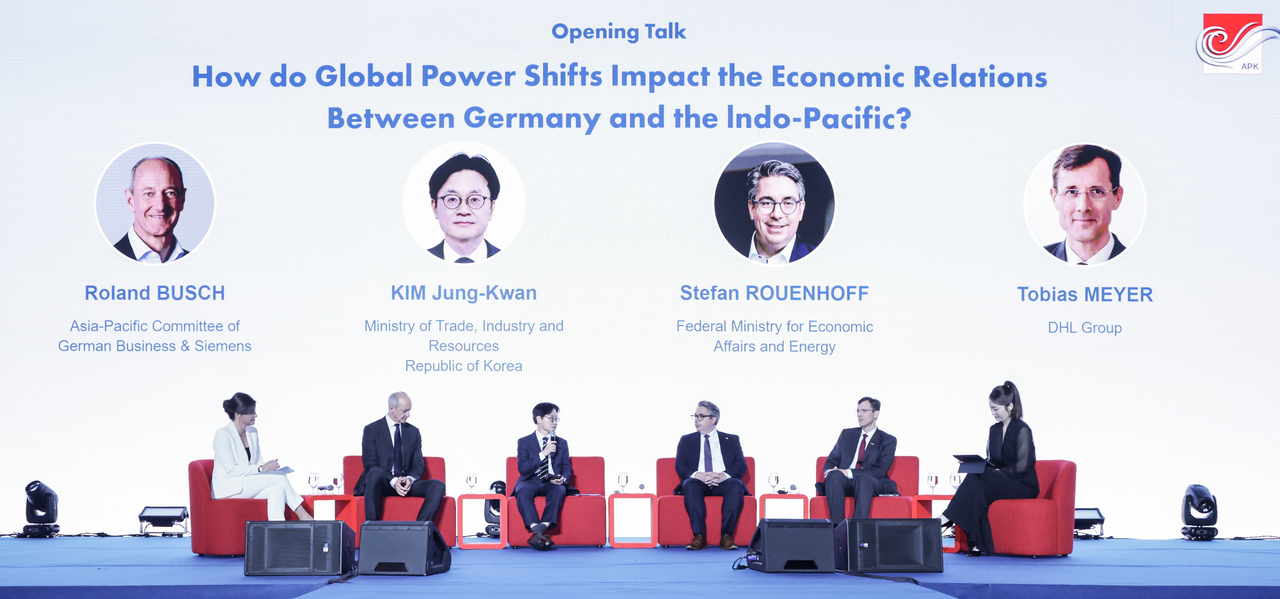
At the opening dialogue on Friday, themed "How does the shift in global power dynamics affect economic relations between Germany and the Indo-Pacific?", Minister of Trade, Industry and Energy Kim Jung-kwan said, "Countries with strong manufacturing bases are heavily dependent on international trade, and openness is essential to securing innovation and competitiveness," adding that "we must strengthen industrial cooperation in semiconductors, batteries, clean energy and advanced manufacturing to build diversified supply chains." Stefan Rouenhoff, parliamentary state secretary at Germany's Federal Ministry for Economic Affairs and Energy, said, "It would be naive to believe that any country or region can become completely independent from others," and added that "we will begin efforts in Europe to reduce dependence on certain components."
On the second day, Roland Busch, chairman of the Asia-Pacific Committee of German Business (APA) and chairman and CEO of Siemens Group, and Choi Soo-yeon, CEO of Naver, held a dialogue on industrial AI. The two discussed the development potential of industrial AI as well as prospects for technology cooperation. Busch said, "If we combine the capabilities of the Asia-Pacific region and European countries, we can achieve a great deal — significantly narrowing the technology gap and developing a range of alternatives." Choi proposed that the Asia-Pacific serve as a testbed, saying, "Many people in the Asia-Pacific are ready to embrace new things."
A separate panel discussion on trade scenarios between the Asia-Pacific and Germany through 2030 yielded forecasts that the region's strong GDP growth would give European companies a new platform for expansion. On security, participants called for stronger cooperation in response to regional instability — including the Russia-Ukraine war and cross-strait tensions — and rising tensions in key maritime zones.
APK 2026 was jointly organized by the Asia-Pacific Committee of German Business, Germany's Federal Ministry for Economic Affairs and Energy, and the global network of German Chambers of Commerce Abroad (AHK). The Korean-German Chamber of Commerce and Industry served as the local co-organizer in Seoul, and Herald Media Group participated as the official domestic media partner.
soho0902@heraldcorp.com