'Goal of improving citizens' lives will not differ'
Seoul submits 55.74 trillion won budget proposal for 2027
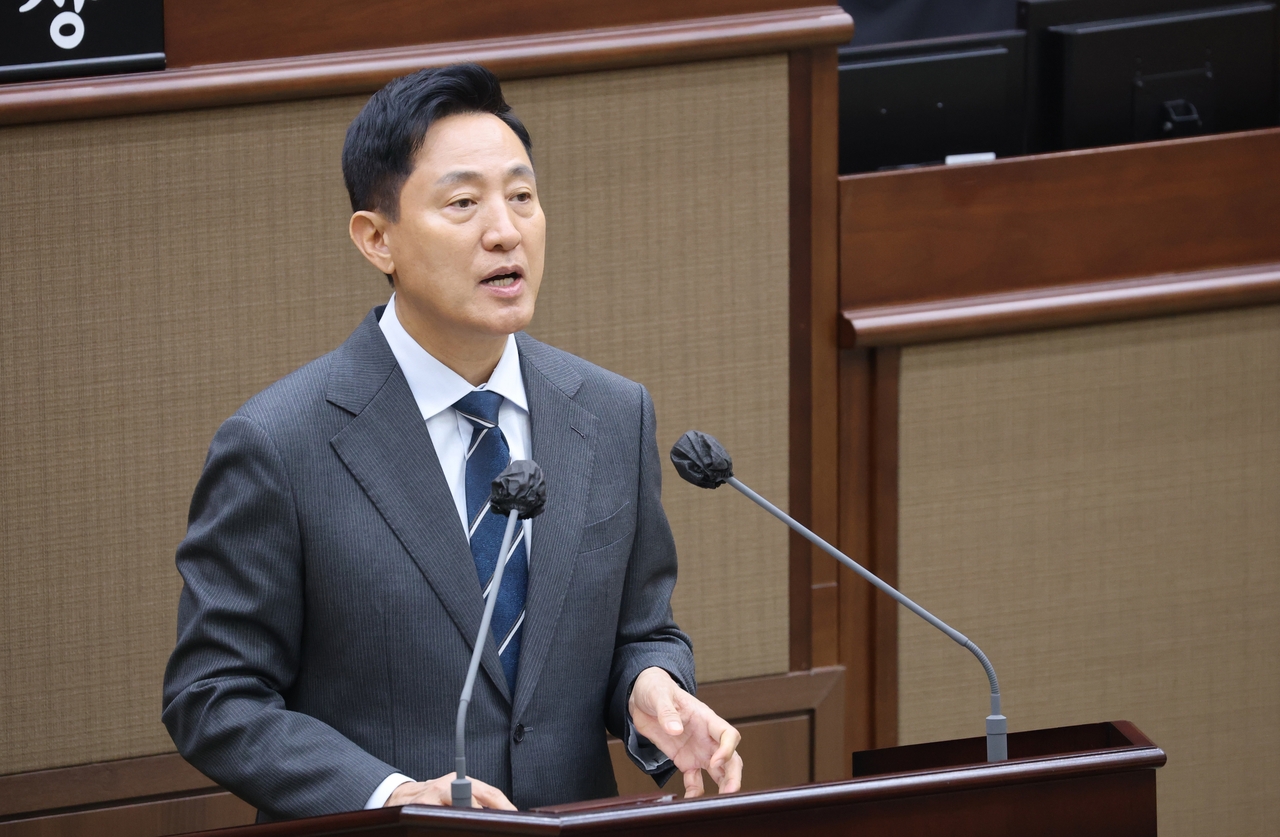
Seoul Mayor Oh Se-hoon submitted the city's 2027 budget proposal to the Seoul Metropolitan Council on Monday, calling on lawmakers to cooperate in its passage.
Speaking at a plenary session of the council that morning, Oh said the city government and the council may sometimes differ on policy priorities and how to pursue them. "I will take the council's criticism and oversight seriously," he said, adding that the city would present clear grounds for contested projects and remain open to consultation on areas needing improvement. He also said he would make a principled case for policies he had pledged to citizens, and expressed confidence that despite differing views, both sides shared the same goal of improving residents' lives. The council was reshuffled after the June 3 local elections, with the Democratic Party holding 80 of 118 seats and the People Power Party holding 38 — leaving Oh's administration in a minority position. The Democratic Party-controlled council had earlier eliminated the entire 5.2 billion won ($3.89 million) youth AI support budget that the city submitted in a supplementary budget in September.
Oh said the value of a budget lies not in how much is spent but in how much it changes citizens' lives, and asked that the city be judged by that standard. "I will bear responsibility for the results as Seoul's mayor," he said, and went on to say he hoped lawmakers would extend their understanding and cooperation so Seoul could become a city where urban growth translates into genuine happiness for its residents.
The city submitted the 55.74 trillion won budget for 2027 to the council on Friday, an increase of 8.3 percent, or 4.27 trillion won, from this year's main budget. The 2027 budget focuses on bridging the AI access gap among young people and stabilizing housing for residents.
A new "Youth AI Growth Pass" program worth 26.6 billion won will provide 500,000 young people with access to generative AI tools — reviving a project scrapped after the council eliminated its entire budget during the second supplementary budget review this year. The initiative aims to prevent disparities in cost and educational opportunity from widening employment and income gaps. A separate program, Seoul Young Careers, budgeted at 22.3 billion won, will support career exploration and job placement. The Youth Employment Academy, with 46 billion won allocated, will train 4,500 AI professionals.
The city also plans to boost its nighttime economy. Ten new venues for the second phase of the "Seoul Moonlight Night Market" will be established at a cost of 10.5 billion won, and Han River camping will be expanded to 300 sites. Nighttime sports and recreation hubs will be built at Ichon and Gwangnaru Han River parks at a cost of 1.9 billion won.
Public jobs for middle-aged residents, senior citizens, people with disabilities and low-income groups will be expanded, with 780.6 billion won allocated. Independence settlement grants worth 700 million won will be provided to youth leaving juvenile welfare facilities. Meal support budgets for children at risk of going hungry, as well as food and snack allowances for children living in child welfare facilities, will be increased, with 39 billion won set aside. A new "Seoul-style In-Between Generation Pension" worth 1.3 billion won will help 10,000 middle-aged people approaching retirement bridge income gaps. Loneliness-care hub "Itda Place," budgeted at 1.5 billion won, and "Seoul Mind Convenience Store," at 800 million won, will also be expanded.
Garden and waterfront spaces will be developed as well. The Seoul International Garden Expo will be held at Namsan park with 5.8 billion won allocated, and a Garden Valley in the G-Valley industrial complex will be created at a cost of 1.8 billion won. The rollout of eco-friendly electric vehicles and chargers will be expanded with 202.2 billion won. Hydrogen bus deployment and a hydrogen charging station at the Songpa public bus depot will be built for 34.9 billion won. Shaded pedestrian access standards will be incorporated into plans ranging from urban master plans to individual development projects, with 2 billion won budgeted. A master plan for expanding and improving Seoul Station Plaza will also be drawn up at a cost of 700 million won.
Urban rail and arterial road networks will also be expanded. A combined 138.3 billion won will be invested in five urban rail projects: the Ui-Sinseol extension line, the Dongbuk Line, the Gangbuk Crosstown Line, the Seonam Line and the Seobu Line. Construction of an underground road beneath the National Assembly Boulevard and a park above it will receive 132.1 billion won.
Some 747.8 billion won will be channeled into public transit fare rebates through the Climate Companion Pass to ease the transportation cost burden on residents. Disability call-taxi services and universal design taxis — accessible to both people with and without disabilities — will be expanded with 101.9 billion won.
Housing supply and residential cost support will proceed in tandem. A total of 1.12 trillion won has been earmarked for public rental housing for young people, newlyweds and housing-vulnerable groups. The public rental housing supply will total 27,200 units, comprising 20,736 purchased units, 3,100 leased units and 3,364 newly constructed units. The city will also support faster progress on private redevelopment projects, including the Rapid Integrated Planning 2.0 scheme (10.8 billion won) and the Moa Town and Moa Housing programs (12.3 billion won).
Five hundred new "Seoul Sprout Studio" units for university students will be supplied on a lease basis. The program uses housing near universities to offer affordable accommodation to students enrolled at Seoul institutions, with plans to deliver 500 leased units through interest-free deposit support and remodeling. Alongside this, 3,027 new safe housing units for young people and newlyweds will be purchased as public rentals. Monthly rent support for young people will be expanded from 23,000 to 32,000 recipients — an increase of 9,000 people — with 126.2 billion won allocated. Interest subsidies on lease deposit loans for homeless newlyweds and young people will also be increased. Housing benefit support for households earning at or below 48 percent of the median income will receive 1.03 trillion won, and interest-free loans of up to 70 million won will be available for long-term jeonse deposits, backed by 72.5 billion won. Homeless tenants will receive up to 500,000 won in jeonse deposit return guarantee premiums, with 11.1 billion won set aside for the program.
cook@heraldcorp.com