Shipping and ports top subsectors at 19.9 trillion won
777,000 employed; global ocean economy grows 2.3-fold in 30 years
Asia's share rises from 16% to 36.2%
South Korea's marine and fisheries sector generated more than 63.2 trillion won ($47.1 billion) in value added in 2023, accounting for 2.8 percent of the country's total industrial output. Shipping and ports led all subsectors in value added, and the sector employed the equivalent of 777,000 full-time workers.
The Ministry of Oceans and Fisheries said Wednesday it will hold an international seminar Thursday at the Busan Port Exhibition and Convention Center on the theme of "Measuring the Ocean Economy: Global and Korean Perspectives." Co-organized with the OECD and the Korea Maritime Institute, the event is a special session of the 20th World Ocean Forum and will present analysis of the domestic marine and fisheries sector's economic scale alongside trends in the global ocean economy.
According to ministry figures, South Korea's marine and fisheries sector posted total output of 197.7 trillion won in 2023, with value added reaching 63.2 trillion won — equivalent to 2.8 percent of all industries. Employment in the sector stood at 777,000 on a full-time equivalent basis.
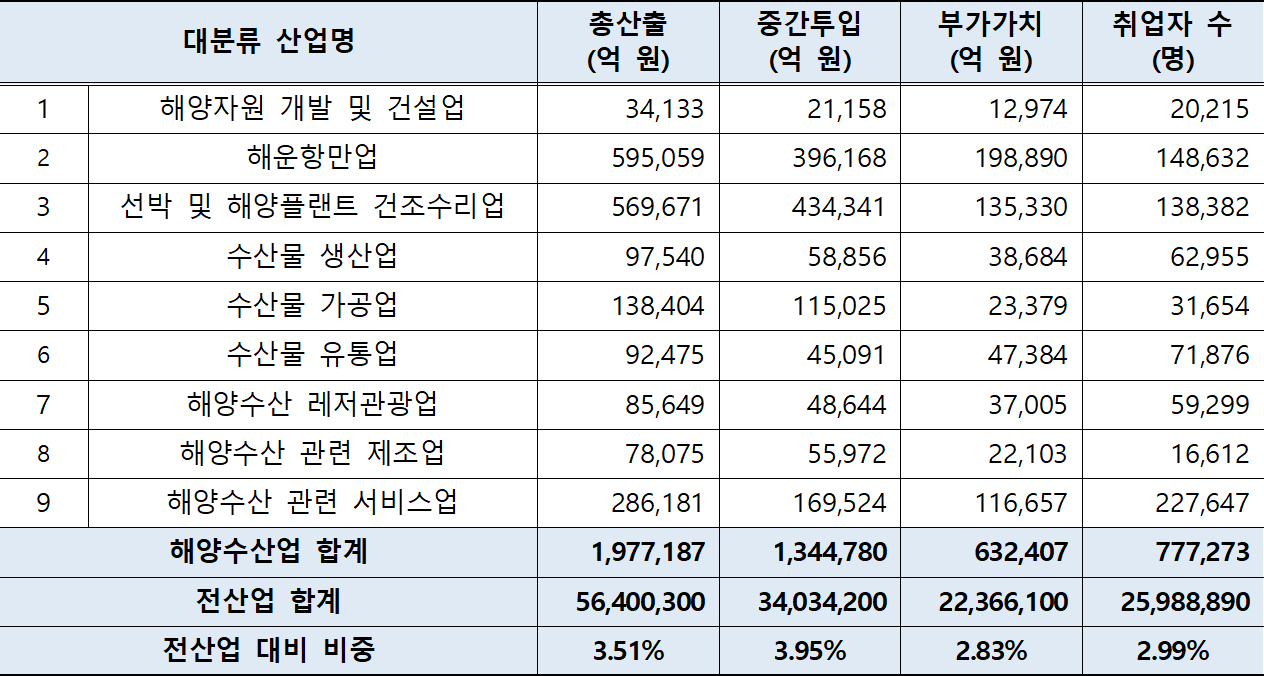
By subsector, shipping and ports recorded the highest value added at 19.9 trillion won. Shipbuilding and offshore plant construction and repair came second at 13.5 trillion won, followed by marine and fisheries-related services at 11.7 trillion won. The combined value added of fisheries production, processing and distribution reached 10.9 trillion won.
The figures were derived from the ministry's marine and fisheries satellite account, a statistical framework that consolidates ocean-related economic activity scattered across industries — including shipping, shipbuilding, fisheries and marine tourism — to measure output and employment in the sector. The account received official government approval as a nationally recognized statistic in December last year.
Asia's rise was a standout trend in the global ocean economy. An OECD report titled "Ocean Economy at a Glance," to be presented at the seminar, found that the global ocean economy grew approximately 2.3-fold between 1995 and 2025.
Non-OECD Asian economies, including China and India, saw their share of global ocean economy value added climb from 16.0 percent in 1995 to 36.2 percent in 2025 — a gain of 20.2 percentage points over 30 years, reflecting a significant expansion of their role in the global ocean economy.
Representatives from the UNESCO Intergovernmental Oceanographic Commission and the national statistics agencies of Portugal and Norway will also participate in the seminar. Discussions will focus on sharing experiences in compiling ocean economy statistics and exploring ways to apply such data to industrial policy and investment decisions.
"It is important to accurately understand the role our marine and fisheries sector plays as the global ocean economy grows rapidly," said Seo Jeong-ho, director general for ocean policy at the ministry. "Through this seminar, we will examine changes in the global ocean economy alongside the current state of our own industry, and work with the OECD and others to chart a path toward sustainable ocean economic development."
adastra@heraldcorp.com