Landlords to receive 50% income tax cut on rental earnings
Agricultural special tax exemption also under consideration
The Ministry of Land, Infrastructure and Transport and the Korea Housing and Urban Guarantee Corporation (HUG) announced Wednesday that they are launching the first landlord recruitment notice for the jeonse and monthly rent safe trust program.
Open enrollment begins Wednesday; move-ins to proceed from January 2027
The jeonse and monthly rent safe trust program is a follow-up measure to the government's housing supply expansion plan. Under the scheme, tenants deposit an amount equivalent to their jeonse deposit with HUG, which then manages the funds and pays landlords a monthly return.
When the lease term ends, HUG returns the deposit directly to the tenant, effectively creating a "deposit-free monthly rent" arrangement between landlord and tenant. Because the deposit equivalent is held by HUG rather than passing through the landlord, it serves as a structural safeguard against jeonse fraud, and landlords bear no obligation to return the deposit themselves.
Starting Wednesday, landlords may apply to join the program at any time through the Safe Jeonse Portal or at any HUG branch nationwide, regardless of where the property is located.
Applications are accepted regardless of whether a tenant has been secured. When landlords wish, HUG will help attract tenants by listing the rental property on its website. After an application is received, the property undergoes eligibility verification, a three-party contract is signed, and the deposit is paid — with move-ins set to begin on a rolling basis from January 2027.
The contracted yield has been set at 4.35% before tax. HUG said it will announce an updated contracted yield with each semiannual recruitment notice, reflecting prevailing market interest rates.
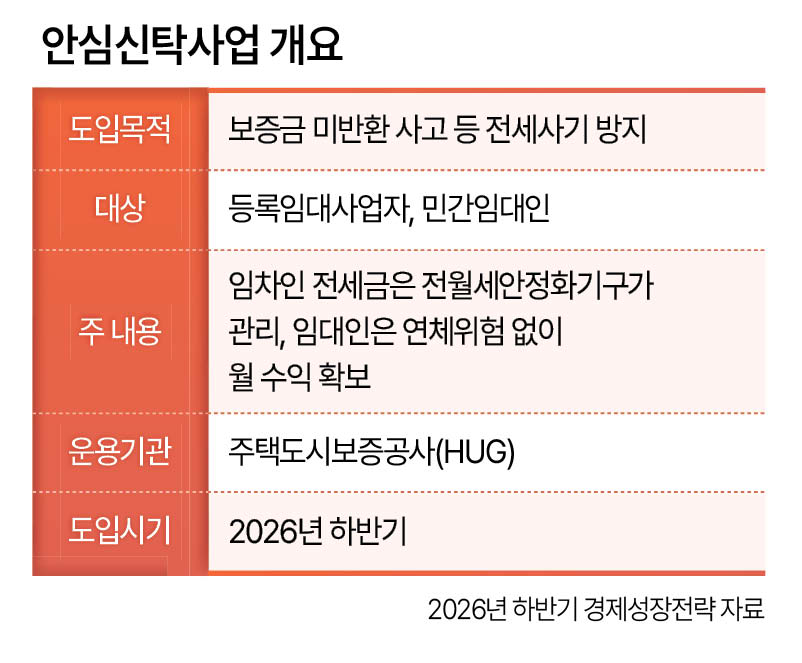
There are no income or asset requirements for landlords or tenants, but some restrictions apply to eligible properties and lease terms to protect tenant housing stability. Any housing type is eligible, but the property's value must not exceed 2 billion won ($1.49 million), and existing senior-ranking debt must not exceed 80 percent of the property's value. Properties where national or local tax arrears or other factors are deemed likely to undermine tenant stability will be excluded.
Semi-jeonse arrangements — monthly rent with a partial deposit — are also eligible. When a tenant pays separate monthly rent, the program will verify that the converted jeonse price, calculated using the regional jeonse-to-monthly-rent conversion rate, falls within the prevailing market jeonse price.
However, given the program's intent to convert monthly-rent properties into jeonse-style arrangements, semi-jeonse properties will be permitted only up to the near-jeonse level. The monthly rent must be less than one-240th of the deposit amount, and the tenant pays the monthly rent directly to the landlord.
Semi-jeonse eligible; landlords receive up to two months' income during vacancies
According to HUG, lease contracts under the safe trust program are subject to the Housing Lease Protection Act, just as ordinary lease contracts are. Tenants are therefore entitled to contract renewal rights, a 5 percent cap on rent increases, and protection against eviction, ensuring stable occupancy.
Because HUG holds and manages the deposit and returns it directly to the tenant, tenants can live without worrying about deposit non-return or jeonse fraud. A key advantage of the program, HUG noted, is that even if the property is seized or auctioned off due to the landlord's debts, the deposit remains safely in HUG's custody.
From the landlord's perspective, the contracted yield set out in the recruitment notice is paid monthly by HUG throughout the lease term, allowing landlords to rent out their properties without concern about rent arrears. However, in recognition of the deposit's traditional role as collateral for property damage and repairs, HUG plans to allow landlords to file a reasonable objection at the time of deposit return, at which point HUG may withhold a portion of the deposit.
Tenants will pay 10 percent of the deposit as a down payment upon signing the contract and the remaining 90 percent upon move-in, both into a dedicated HUG account.
The monthly income HUG pays to individual and corporate landlords will be eligible for a 50 percent reduction in income tax and corporate tax, regardless of whether the property is registered as a rental, in recognition of the program's public benefit in preventing jeonse fraud at the source. The government also plans to pursue an exemption from the special rural development tax — levied at 20 percent on the reduced tax amount — on that income.
In addition, homeowners enrolled in the housing pension scheme who meet certain requirements, sign a safe trust lease contract, and relocate from a regulated zone to a non-metropolitan area will be granted an exemption from the owner-occupancy requirement. This will allow them to receive both the safe trust monthly income and their housing pension, securing a stable retirement income stream.
If a vacancy occurs, HUG will pay landlords up to two months' worth of monthly income on the condition that they continue participating in the safe trust program, enabling landlords to operate rental properties without the risk of arrears or vacancies.
For tenants, the government plans to offer dedicated HUG and Korea Housing Finance Corporation-guaranteed jeonse loans to help cover the deposit, and intends to complete all necessary procedures by year-end to make the Bidimdok loan from the national housing fund available to those who meet income and asset requirements.
Enrollment in jeonse deposit return guarantees and rental deposit guarantees will no longer be necessary, reducing the burden of guarantee fees for both landlords and tenants.
The Ministry of Land, Infrastructure and Transport said it will continue to review and expand additional support measures to promote the safe trust program.
First Vice Minister of Land, Infrastructure and Transport Kim I-tak said the program "offers a new option — one that gives tenants jeonse without the fear of fraud, and landlords monthly rent without the worry of arrears or vacancies, with the public sector taking responsibility for safeguarding the deposit." Kim added that the ministry would "carefully monitor operations to ensure the program runs smoothly in its early stages, provide participation incentives for both landlords and tenants, and work to establish the safe trust program as another standard form of lease contract in the rental market."
hss@heraldcorp.com