Reserves rise $2.6 billion in a month, rebounding after September dip
Investment returns and foreign currency deposits drive increase
Higher exchange rate volatility could cause reserves to fluctuate
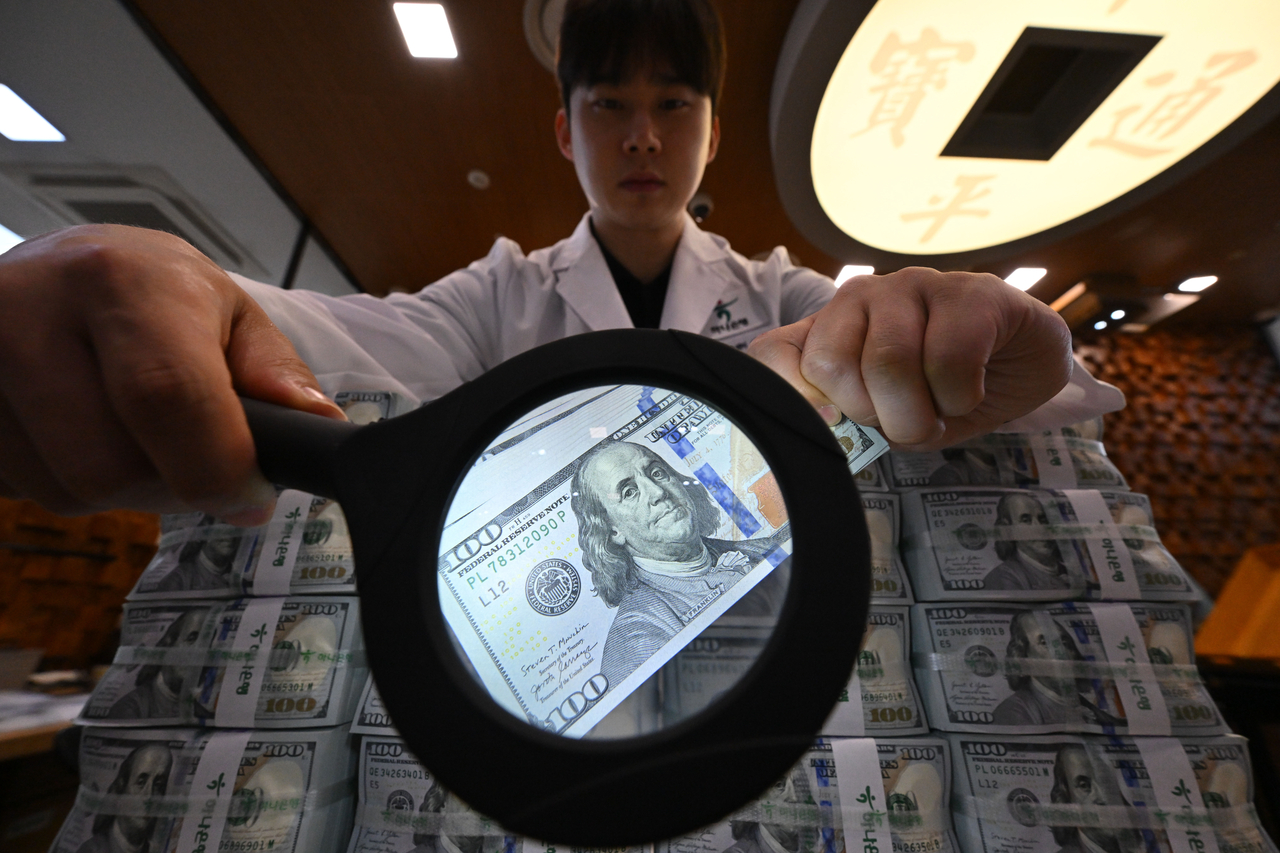
South Korea's foreign exchange reserves climbed to a four-year high last month, rebounding within a month after a September decline, driven by investment returns on foreign assets and an increase in foreign currency deposits held by financial institutions.
The Bank of Korea said Tuesday that the country's foreign reserves stood at $443.16 billion at the end of October, up $2.6 billion from $440.56 billion at the end of September. The increase marks a reversal after reserves fell in September for the first time in four months.
The end-of-October balance surpassed the August figure of $442.28 billion, reaching the highest level since the end of May 2022, when reserves stood at $447.71 billion.
"The increase was mainly attributable to investment returns on foreign assets and a rise in foreign currency deposits at financial institutions — and this time, investment returns were the primary factor," a Bank of Korea official said.
Investment returns encompass interest income from bonds held by the central bank, stock dividends, gains and losses from securities trading, and interest on deposits.
Foreign currency deposits at financial institutions also grew as an increase in current-account receipts from exporters boosted liquidity in the domestic foreign currency market. The Bank of Korea said the current-account surplus reached $46.11 billion in August, the second-largest on record. The cumulative surplus through August this year totaled $279.2 billion, more than double last year's full-year surplus of $123.1 billion. The September current-account figure, due to be released Wednesday, is expected to show an even larger surplus due to the quarter-end effect.
Asset transfers to the Korea-US Strategic Investment Corporation, which had been one of the factors behind the September decline, did not occur in October.
By asset type, deposits — a cash-equivalent holding — rose $6.32 billion from the previous month to $36.27 billion. Securities, including US government bonds, agency bonds and corporate bonds, fell $3.59 billion to $382.43 billion over the same period.
IMF special drawing rights decreased $70 million to $15.41 billion, while the IMF reserve position fell $50 million to $4.25 billion. Gold holdings were unchanged at $4.79 billion.
Some analysts have raised the possibility that reserves could fluctuate in the near term as volatility in the won-dollar exchange rate has increased. When monetary authorities sell or buy dollars as part of market-stabilization measures, reserves fall or rise accordingly.
After weakening to the 1,320-won range against the dollar last month, the won has been gradually falling back. The won-dollar rate hit a year-to-date low of 1,331.4 won on Oct. 16 on a weekly closing basis, then set a new yearly low for five consecutive trading days through Oct. 22, when it closed at 1,324.2 won. It edged back up before falling further to 1,323.1 won on Oct. 26. On Wednesday, however, the rate closed at 1,337.7 won — up 14 won from the previous session — marking its largest single-session advance in about five months since May 12, when it rose 17.5 won.
The exchange rate has been moving in the 1,340-won range so far this month. On Tuesday, the won-dollar rate closed at 1,341 won, down 2.8 won from the previous session's weekly closing price.
"When exchange rate volatility moves beyond normal levels and the rate rises to a high level, we may sell dollars as a market-stabilization measure, and we may buy when it falls," the Bank of Korea official said. "In that process, foreign reserves may be drawn down or increase."
kimstar@heraldcorp.com