Seven joint research projects to cover plant automation, safety enhancement and more
South Korea is moving ahead with efforts to apply AI to nuclear power plant operations, aiming to boost efficiency and strengthen safety management. The initiative envisions integrating AI across plant operations, automation and hydrogen-energy systems to accelerate the digital transformation of the energy sector.
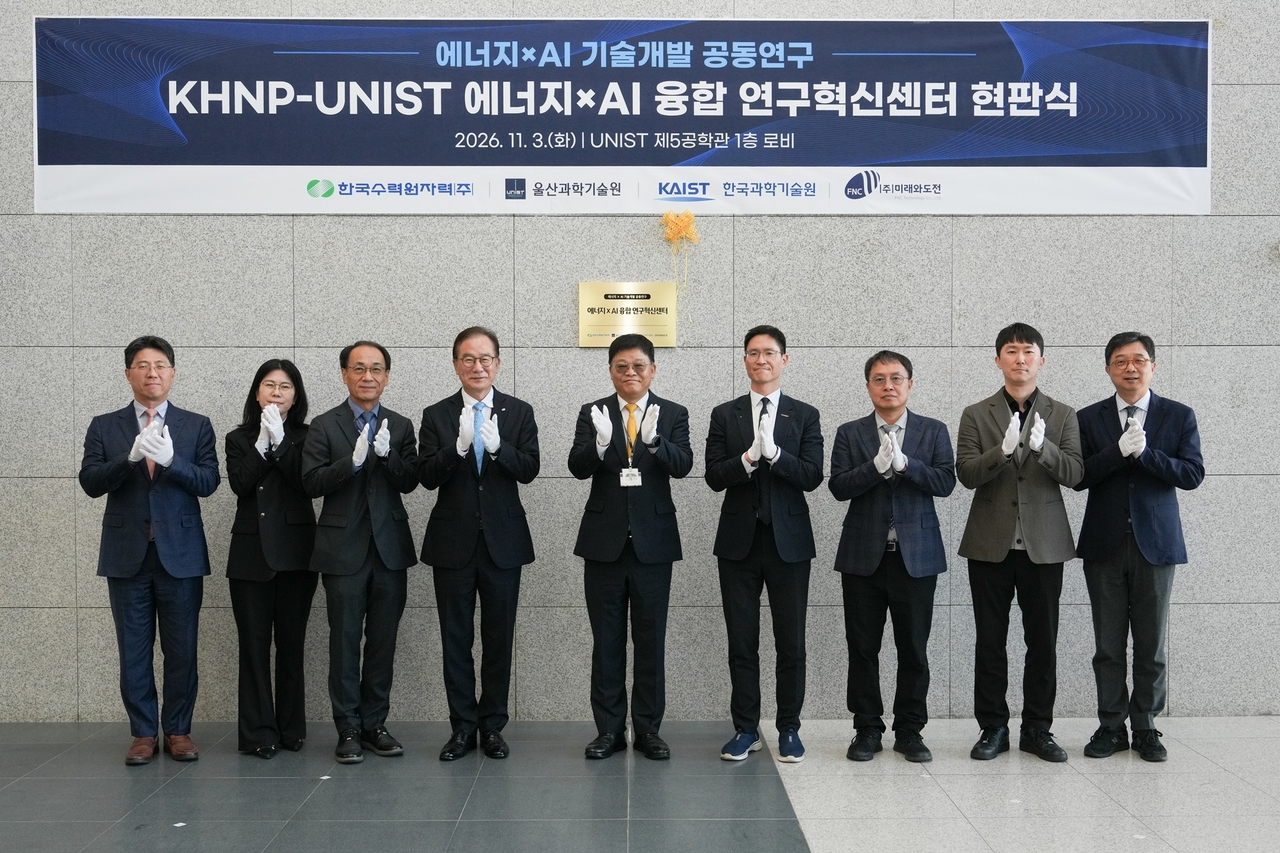
The Ulsan National Institute of Science and Technology (UNIST) said it held an inauguration ceremony Tuesday for the Energy×AI Convergence Research Innovation Center at its Engineering Building 5, jointly with Korea Hydro & Nuclear Power, where the two sides also shared early research findings.
The center was established to combine UNIST's advanced AI research capabilities with Korea Hydro & Nuclear Power's operational experience and industry needs, with the goal of developing technologies that can be applied directly at working power plants.
Key UNIST research units taking part include the Department of Nuclear Engineering, the Graduate School of Artificial Intelligence, the Graduate School of Carbon Neutrality and the U Future Strategy Institute. External partners include KAIST and Mirae-wa-Dojeon, along with other research institutions and companies.
The center is pursuing a total of seven research projects: six core initiatives based on Korea Hydro & Nuclear Power's operational needs, plus a "Quick-Win" track designed to validate technological results in a short timeframe.
Key research areas include AI-driven optimization and safety improvement of nuclear plant operations, plant automation, integrated hydrogen-energy management, and the expansion of AI convergence technology applications.
The center plans to use AI to analyze the large volumes of data generated during nuclear plant operations, improving both operational efficiency and safety, while also exploring the potential for automating plant management tasks.
AI will also be applied to integrated hydrogen-energy management technologies, with researchers seeking more efficient ways to manage complex energy systems.
The two institutions said the inauguration marks the start of a concerted push to apply joint research findings in the field, and that they plan to identify follow-up research projects that reflect emerging technology needs from industry.
To that end, they will expand field-specific seminars and workshops among researchers, and strengthen the collaborative framework linking UNIST's AI, nuclear and energy research capabilities with Korea Hydro & Nuclear Power's on-site expertise.
UNIST President Park Jong-rae said the partnership with Korea Hydro & Nuclear Power is "an important industry-academia collaboration model for bringing the university's research outcomes into real energy industry settings," adding that the center would "produce tangible research results that enhance the safety and competitiveness of the national energy industry through the convergence of AI with nuclear power and energy."
nbgkoo@heraldcorp.com