
Korea Institute of Industrial Technology and National Institute of Agricultural Sciences sign MOU to jointly develop farm automation and low-carbon storage technology
South Korea is set to accelerate the development of advanced smart farming technology that uses AI to predict crop quality and shelf life while deploying robots to handle agricultural tasks — a push aimed at addressing labor shortages driven by climate change and an aging rural population.
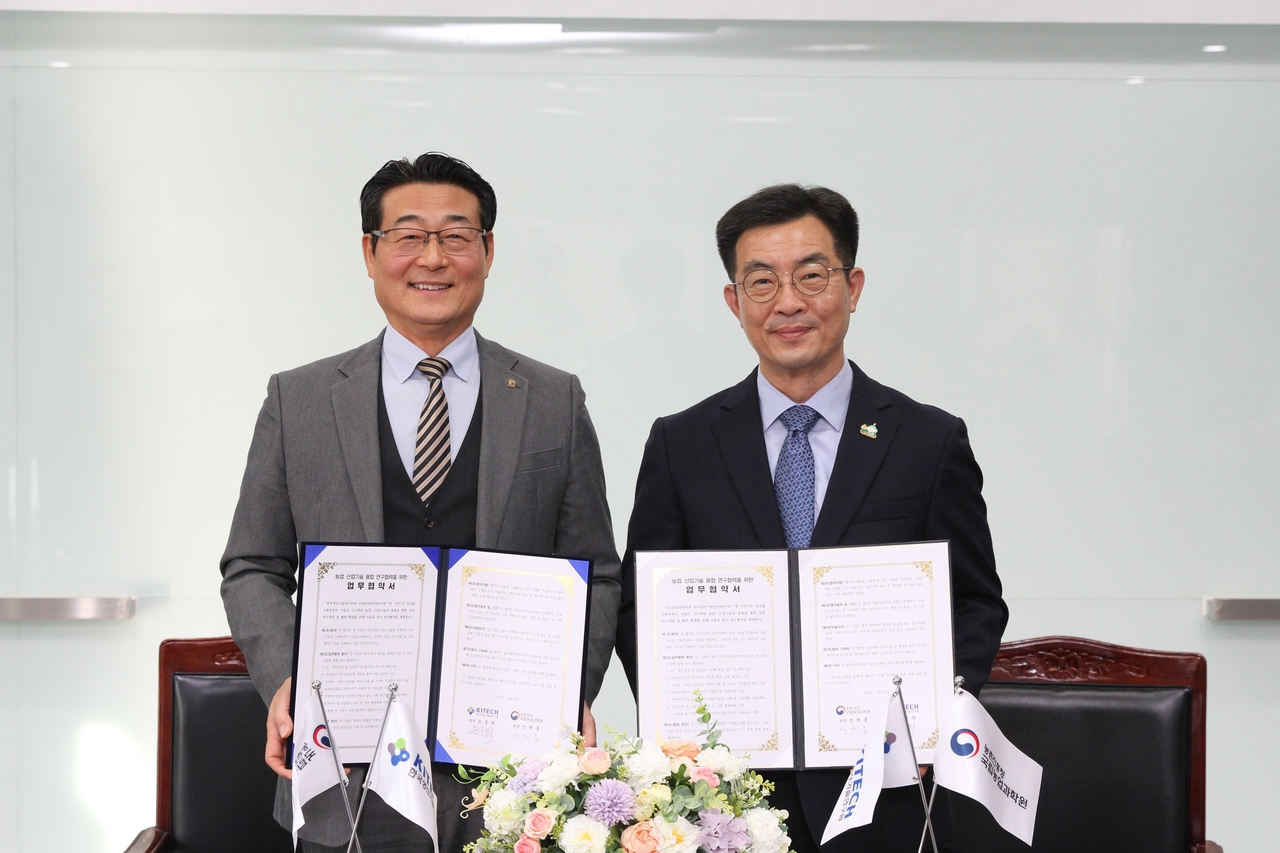
The Korea Institute of Industrial Technology signed an MOU with the National Institute of Agricultural Sciences in Jeonju, North Jeolla Province, on Wednesday to advance joint research combining agricultural and industrial technology.
The partnership's core goal is to pair the institute's expertise in AI, robotics and automation with the agricultural sciences institute's farming knowledge and field-testing capabilities, producing practical technology ready for immediate use on farms.
The two institutions have been exploring applications of AI control and energy management technology in agriculture since September last year. Since January this year, they have been jointly developing a system that links the pre-storage drying stage of onions — known as pre-curing — with the storage process. Next year, they plan to begin full-scale application of AI control technology based on field data.
The MOU will also significantly expand the scope of their research collaboration.
Key joint research areas include advanced sensor- and AI-based prediction of crop quality and shelf life, energy-efficient low-carbon storage systems, robot-based automation of indoor and outdoor farm work, and the recovery and high-value utilization of active compounds from agricultural byproducts.
The two institutions will also step up exchanges of research personnel and technology, operate a working-level consultative body, and identify new joint research projects linked to government research and development programs.
Technologies developed through the partnership will undergo field trials at crop storage facilities, APCs and both greenhouse and open-field sites before being transferred and commercialized for distribution to farms and related industries.
"AI, robotics and automation technologies proven in industrial settings will be the key to unlocking the future competitiveness of agriculture," said Son Ung-hee, president of the Korea Institute of Industrial Technology. "By combining the strengths of both institutions, we will solve the pressing challenges facing our farms and embed innovative technology that leads the way in smart agriculture."
nbgkoo@heraldcorp.com




