Sales hit 9.64 trillion won on ESS shipment surge
Company secures first direct BESS supply deal with big tech
Arizona cylindrical battery factory on track for year-end readiness
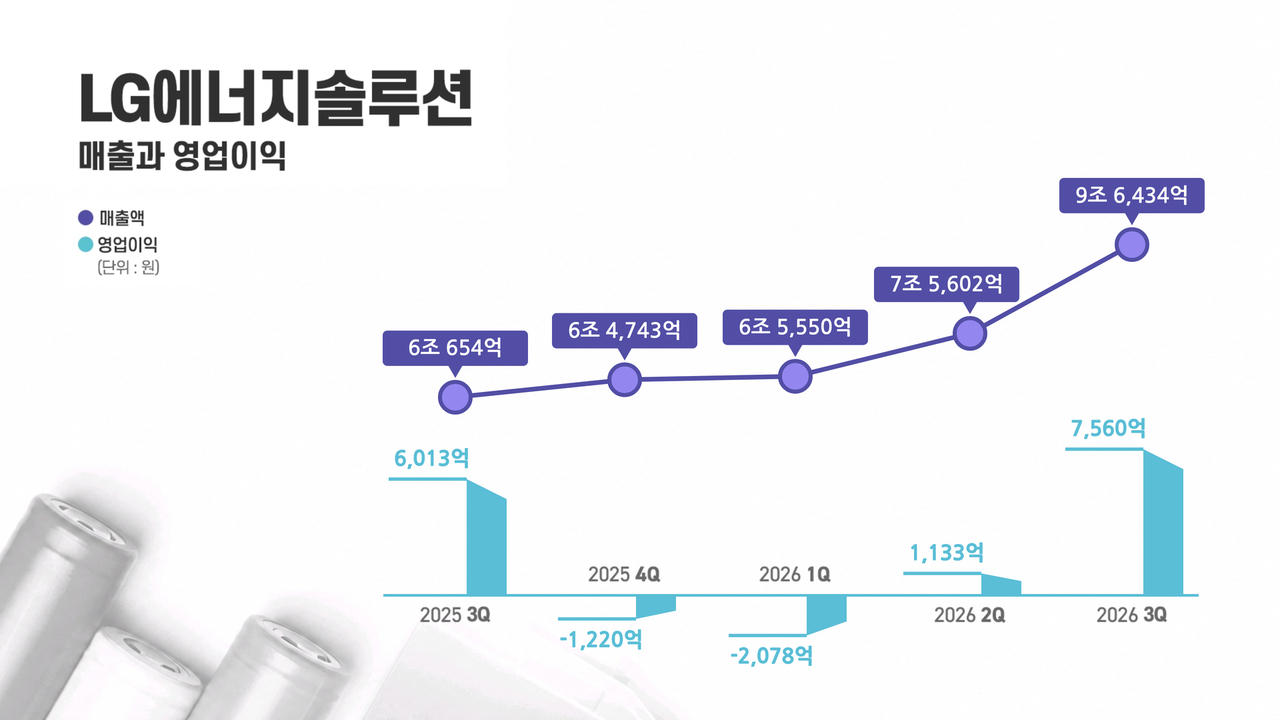
LG Energy Solution posted third-quarter sales of 9.64 trillion won ($7.19 billion) and operating profit of 756 billion won — both quarterly records — the company announced Tuesday. It also set a target to expand its North American ESS production capacity to more than 70 gigawatt-hours by the end of next year, adding new prismatic battery lines to the more than 50 GWh already planned for this year.
Sales rose 59 percent from a year earlier, while operating profit climbed 25.7 percent. The previous records were sales of 8.77 trillion won in the second quarter of 2023 and operating profit of 731.2 billion won in the third quarter of 2023.
North American production subsidies, including Inflation Reduction Act tax credits, contributed 416.9 billion won to third-quarter earnings. Excluding subsidies, operating profit came to 339.1 billion won, a return to the black after an operating loss in the second quarter. The company said it has included North American production subsidies in its revenue figures starting this year and has restated past figures on the same basis.
Lee Chang-sil, LG Energy Solution's chief financial officer and executive vice president, said third-quarter companywide sales rose 28 percent quarter-on-quarter, driven by a sharp increase in ESS shipments alongside volume-led growth in both electric vehicle pouch and cylindrical products.
"On the profit side, the 756 billion won in operating profit reflected improved utilization at the Poland factory, continued cylindrical product supply volumes, and productivity gains at new ESS mass-production sites," Lee added.
The company said it secured its first direct battery energy storage system supply contract with a big tech customer during the third quarter. It also said it was the only Korean battery maker selected as an Nvidia "DSX Ready BESS" partner.
LG Energy Solution said it expects additional orders in the fourth quarter as it continues to negotiate new project supply deals with multiple customers. In the electric vehicle segment, the company said it signed new contracts to expand supply of next-generation high-voltage mid-nickel products, securing a revenue base in the European market.
On the production front, the company brought additional North American ESS cell production lines and new "Link" container-type system assembly lines online. Overall utilization also improved as the GM joint venture in the United States resumed operations.
On the supply chain front, the company strengthened partnerships with lithium iron phosphate cathode material suppliers in response to Prohibited Foreign Entity regulations, and signed contracts to procure 240,000 metric tons of Canadian lithium concentrate over four years and 80,000 metric tons of US-produced lithium carbonate over 10 years.
The United States and Europe are tightening local battery production requirements. The US issued an executive order in August raising supply chain security standards for grid equipment including battery energy storage systems and inverters, with detailed implementing rules expected in December. In Europe, a revised recommendation under the Industrial Acceleration Act published in September narrowed the scope of what qualifies as local production, with final legislation targeted for the first half of 2027.
Against this backdrop, LG Energy Solution said it plans to strengthen its competitiveness by optimizing production capabilities by region and building supply chains that comply with local policies and regulations.
In North America, the company plans to add new prismatic lines to the more than 50 GWh of capacity already planned for this year, reaching more than 70 GWh of ESS production capacity by the end of next year. Its Arizona factory — the company's first North American cylindrical battery production site — is also on track to complete final preparations by year-end.
The Poland factory in Europe is set to gain 46-series production capability from 2029. At the Ochang Energy Plant in South Korea, the company aims to ship sodium-ion battery test products to North American customers in 2027 and begin mass production of LFP-based tabless 2170 cylindrical batteries in the first half of 2027.
"LG Energy Solution plans to respond proactively to market changes while reinforcing a strategy of focus and selectivity, maximizing operational efficiency with limited resources," Lee said.
eyre@heraldcorp.com