Three months of wages and electricity bills left unpaid
Growing public-interest claims threaten rehabilitation plan
Buyer search drags past October with no deal in sight
Financial strain puts store operations at risk this month
Homeplus is grappling with a triple crisis — falling sales, unpaid wages and a stalled sale process — just three months after receiving a 200 billion won ($149 million) emergency debtor-in-possession loan. With major shareholder MBK Partners having stepped back from its controlling stake, the hypermarket chain must navigate the crisis on its own, and the outlook is bleak.
According to retail industry and legal sources, the most pressing threat is the company's growing pile of public-interest claims. Under its rehabilitation plan, Homeplus designated the period through February 2027 — before the start of a new fiscal year — as a preparatory phase, during which it committed to repaying a portion of those claims. Public-interest claims include employee wages, severance pay, compensation and utility bills such as electricity charges.
Instead of shrinking, however, those claims are growing. Homeplus currently owes employees three months' worth of wages: 75 percent of August salaries and the full amounts for September and October. The company notified staff that the August payment, originally due Friday, would be delayed, citing a lack of liquidity.
Data submitted to the National Assembly's Climate, Energy, Environment and Labor Committee by People Power Party lawmaker Kim Wi-sang shows that Homeplus's unpaid wages stood at around 100 billion won as of October. That figure includes 19.7 billion won in August wages, 26.7 billion won for September and an estimated 25 billion won for October. An additional 16.7 billion won in Chuseok bonuses and 12.9 billion won in severance pay also remain outstanding.
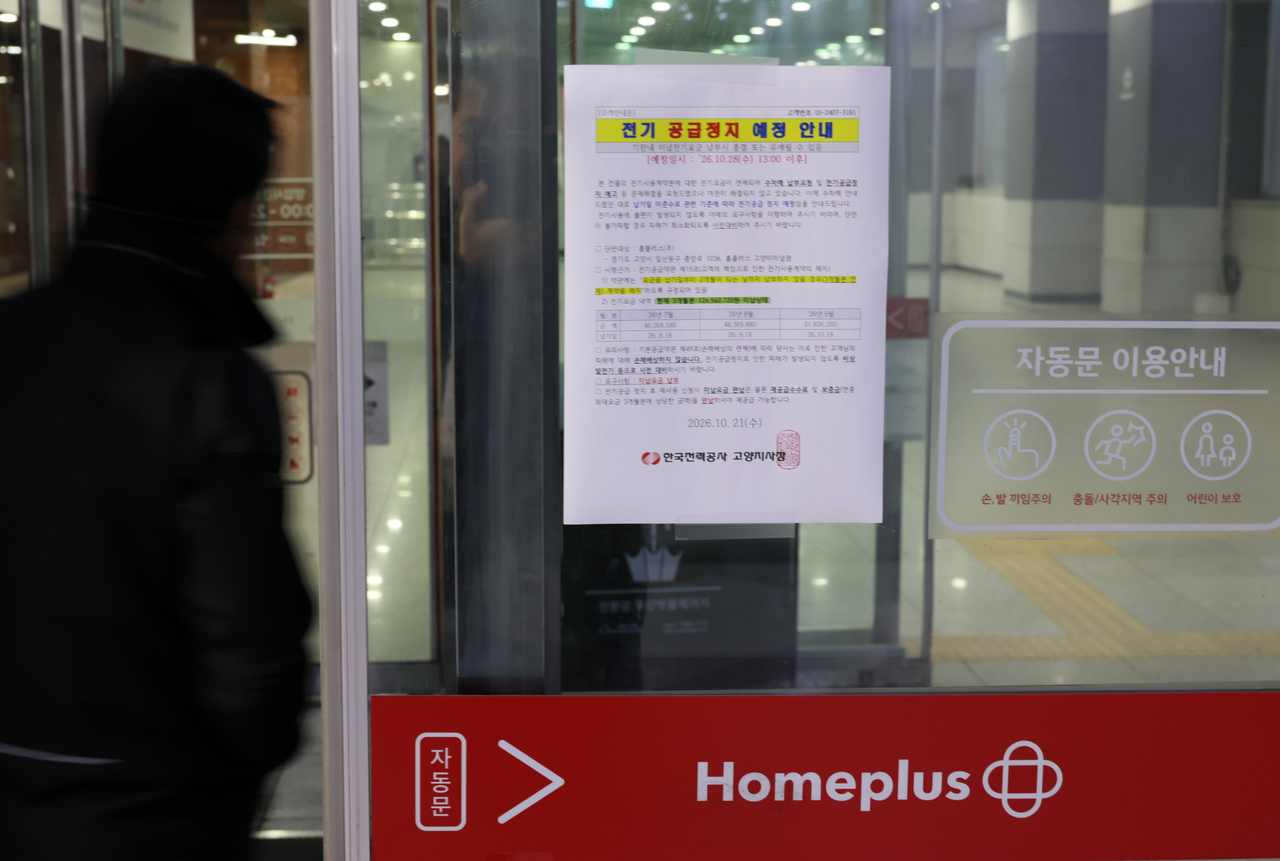
Electricity bills have gone unpaid as well. According to the Homeplus Tenant Store Owners' Association, stores at Centum City, Banyeo, Jamsil, Goyang Terminal, Pocheon Songwu, Namyangju Jincheop, Gajwa, Jinju, Masan and Paju Unjeong have all received notices of impending power cutoffs due to unpaid electricity charges. Arrears at some locations are said to reach as much as 200 million won.
Other indicators point to deepening financial distress. A voluntary redundancy program that had drawn more than 400 applicants was canceled at the end of last month. A legal industry official warned that public-interest claims becoming problematic during the preparatory period "could create serious complications." Under the Debtor Rehabilitation and Bankruptcy Act, a court may declare bankruptcy ex officio — without a separate hearing — if it determines that an approved rehabilitation plan is not being properly carried out.
The search for a buyer, the company's last hope, has yet to yield results. Samil PwC, the sale manager, continues to hold talks with potential acquirers. Contrary to earlier expectations that letters of intent would be collected by the end of October and formal negotiations would begin this month, the process is dragging on. Assets on the block include all 67 currently operating stores, the hypermarket division, headquarters, the online business unit and the real estate of 19 closed locations.
Inside Homeplus, concern is mounting that "November is the breaking point." Continued weak sales could exhaust the funds needed to keep stores running. Most of the 200 billion won DIP facility and the proceeds from the sale of Homeplus Express have already been spent, and MBK Partners — which had provided support through loan guarantees — has withdrawn. "If no pool of potential buyers emerges in November, or if real estate asset sales do not materialize, the situation will only get harder," one official said.


soho0902@heraldcorp.com