System visualizes surface roughness in three levels without requiring haptic devices
Researchers have developed a technology that allows users in virtual reality to perceive the roughness of objects through visual cues alone, without physically touching them.
KAIST announced Tuesday that a research team led by Professor Woo Woontack of the university's Graduate School of Metaverse has developed a system that conveys tactile information about objects by altering the outline and movement of a virtual hand.
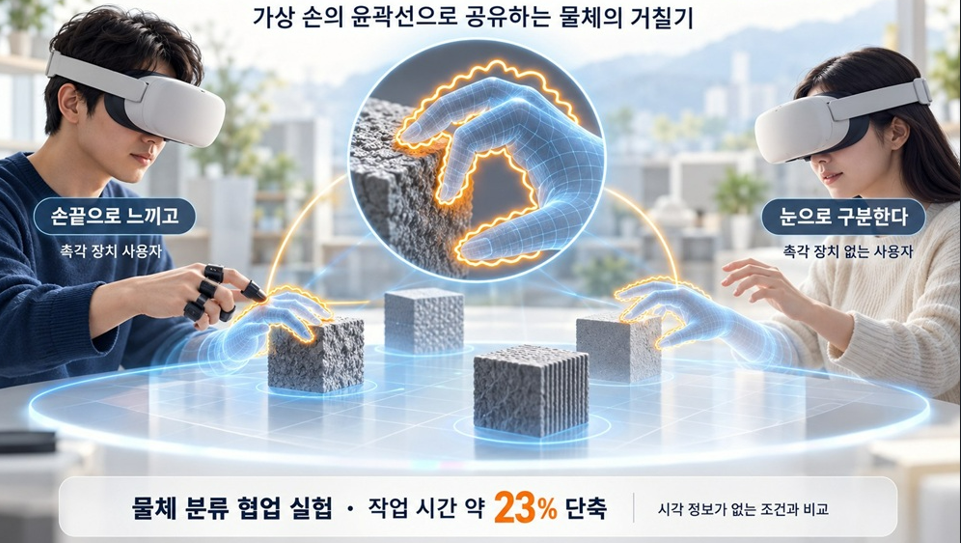
The core of the technology lies in converting fingertip sensations into visual information. In conventional VR environments, users needed to wear a separate haptic device — such as a vibration-based accessory — to feel an object's surface texture. Without such a device, users examining the same virtual object had no way to access tactile information, limiting collaborative work.
To address this, the research team modified the outline and movement of virtual hands appearing in the shared space to represent surface roughness across three levels: low, medium and high. The approach allows users without haptic devices to gauge an object's texture through the visual changes in the virtual hand.
To validate the technology, the team divided 48 participants into 24 pairs and conducted an experiment in which each pair jointly sorted objects in a VR environment. Each pair consisted of one user wearing a haptic device and one who was not.
When roughness information was displayed on both users' virtual hands, task completion time fell by about 23 percent compared with cases where no visual information was provided. Object-sorting accuracy also remained high.
Users without haptic devices responded particularly well: when roughness information was displayed on their own virtual hands, they rated their confidence in their judgments and their sense of contribution to the collaboration more highly.
The technology is expected to find applications in virtual product evaluation, remote education and training, and VR-based collaborative work. However, the research is currently at the stage of confirming effectiveness through user experiments, and further validation across a range of devices and working environments will be needed before it can be deployed in real industrial settings.
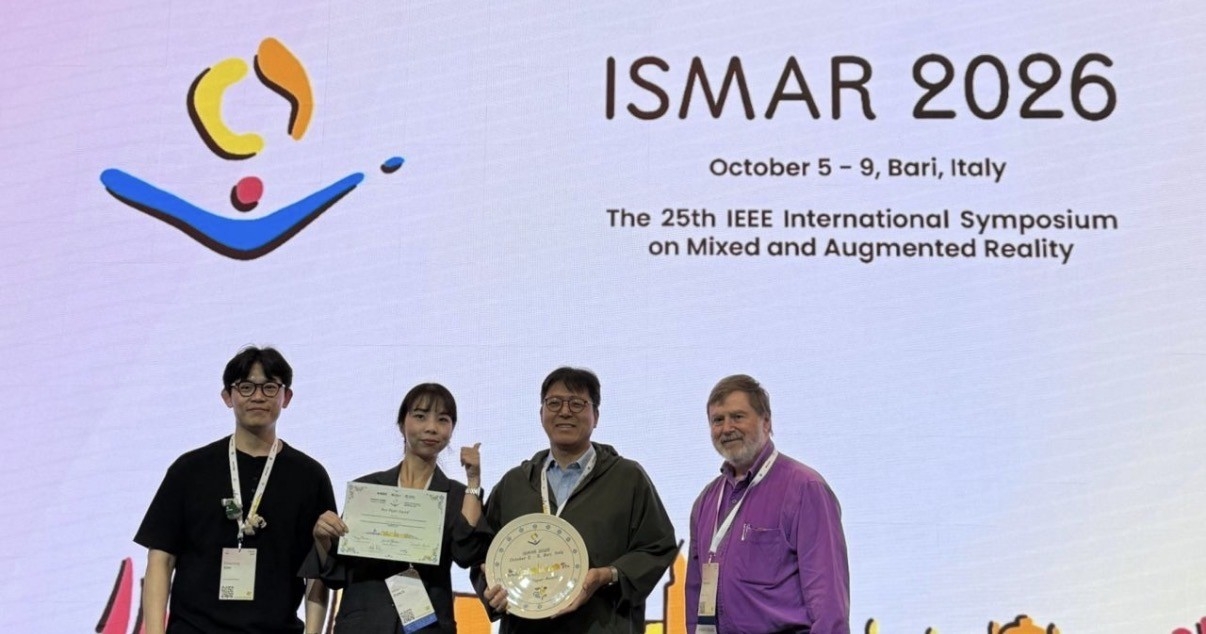
The research team received the Best Paper Award at IEEE ISMAR 2026, an international conference on mixed and augmented reality, for this work — marking the team's third consecutive win at the conference since 2024.
"Three consecutive wins reflect the combined efforts of government support for metaverse talent development and research, KAIST's research infrastructure, and the interdisciplinary work of young researchers," Woo said. "We will continue integrating extended reality and AI to pursue research that enables people to share knowledge and experience beyond the constraints of time and space."
nbgkoo@heraldcorp.com