
Construction industry warns of excessive risk under fixed-price model for first-of-kind APR1000 reactor
Korea Hydro & Nuclear Power disciplines officials over El-Dabaa losses
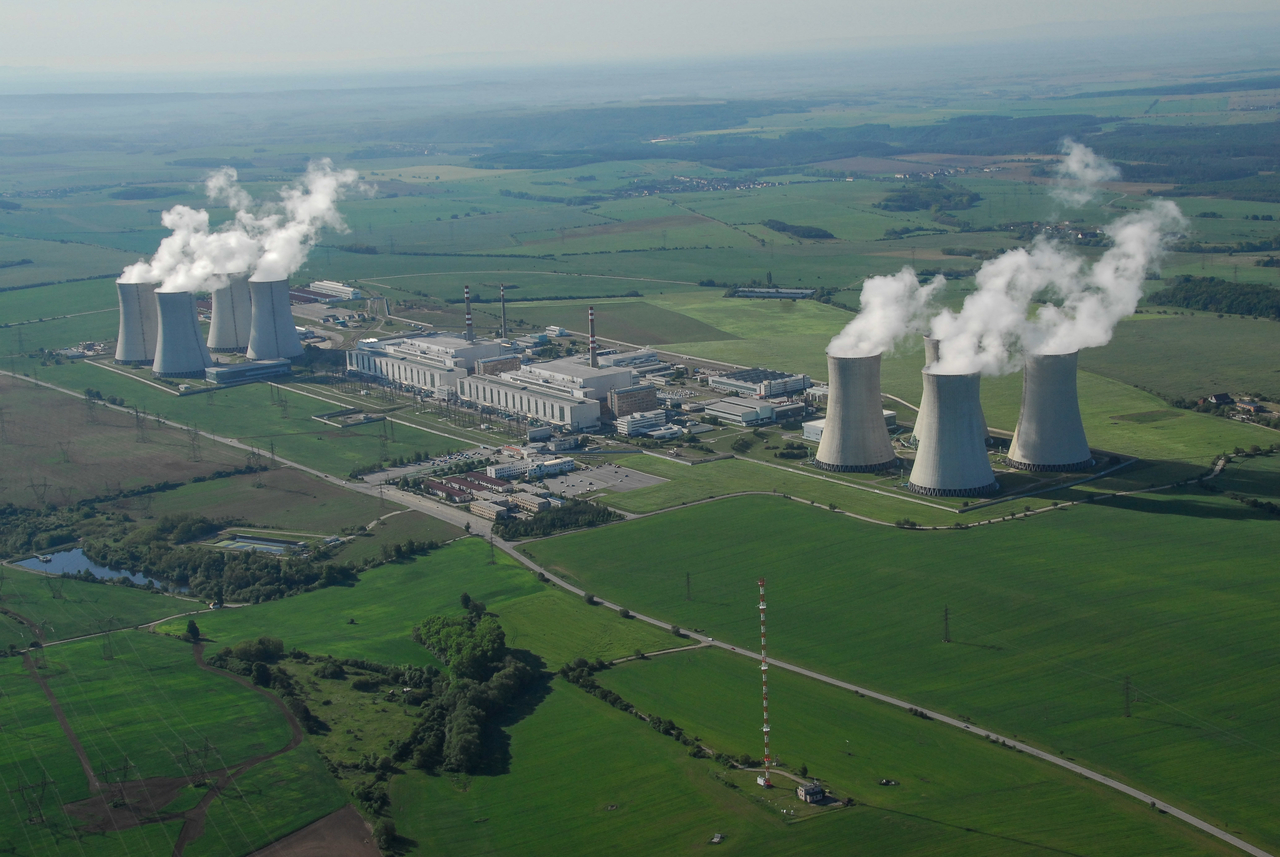
The roughly 27 trillion won ($20.2 billion) Czech Dukovany nuclear power plant project, secured by "Team Korea," has entered a new phase after contract negotiations with its main contractor collapsed. Korea Hydro & Nuclear Power plans to select a new contractor by July next year, but voices within the construction industry are calling for a fundamental rethink of the contract structure. The concern is that applying a lump-sum fixed-price contract — which locks in total construction costs before work begins — carries excessive risk for any contractor on a project using the APR1000 reactor, a design that has never been built before and whose scope and quantities have yet to be finalized.
The Ministry of Trade, Industry and Energy convened an emergency review meeting Monday at the Korea Chamber of Commerce and Industry in Jung-gu, Seoul, chaired by Vice Minister Park Dong-il. Officials discussed the timeline and procedures for selecting a new contractor, as well as how to keep key project milestones on track following the breakdown of the previous negotiations. The ministry said it would also draw up contingency plans to ensure no slippage in the project schedule, which calls for a construction permit application in April next year, site preparation to begin in January 2029 and a ground-breaking in November of that year.
Korea Hydro & Nuclear Power plans to select a new contractor for units 5 and 6 of the Dukovany plant by July next year. The state-run nuclear operator maintains that a lump-sum fixed-price arrangement is necessary to manage project costs, but the construction industry argues that the unique characteristics of the Czech project demand a different approach.
Under a lump-sum fixed-price contract, the total construction cost is set before work begins, and the contractor bears any cost overruns arising from rising material prices or increases in construction volume. While this gives the project owner predictable cost control, it can place a heavy burden on contractors when design changes or volume fluctuations are likely.
The APR1000 reactor to be used at the Czech plant is a first-of-kind design with no completed construction precedent. Because the scope and volume of work could shift as the design is refined, contractors say it is extremely difficult to calculate accurate costs at the bidding stage. If a contractor must also absorb cost increases driven by design changes or local conditions beyond its control, projecting profitability becomes nearly impossible.
That means the same problem could resurface in any new bidding process.
The breakdown between Korea Hydro & Nuclear Power and Daewoo Engineering & Construction stemmed from precisely this dispute over risk allocation. Korea Hydro & Nuclear Power says the construction consortium itself proposed and agreed to a lump-sum fixed-price contract at the original 2022 bid, and that the same model has been applied under international construction contract standards (FIDIC) as well as in domestic nuclear projects and the UAE Barakah plant.
Daewoo Engineering & Construction counters that the conditions surrounding the APR1000 are fundamentally different from those of previous nuclear export projects. Unlike the APR1400-based Barakah plant, which had reference facilities at home and abroad, the Czech project has not even completed its basic design, making construction volumes highly uncertain. Daewoo E&C also argues that holding a subcontractor with no design authority responsible for cost increases caused by design changes runs counter to the contractual principles of the FIDIC Red Book.
"A lump-sum fixed-price contract might be reasonable for the APR1400, but with the Czech plant still in the design phase it is very difficult to calculate accurate volumes," Daewoo E&C said. "Even at the time of the 2024 bid, we made clear that while we accepted the 8.2 trillion won contract value as a baseline, we intended to apply a quantity-settlement method."
The broader construction industry argues that liability should be allocated in proportion to what each party can actually control. If a contractor that has no say over design changes is also forced to absorb the resulting cost increases, the profitability projected at signing becomes unachievable. Even if the contractor covers overruns upfront and then seeks reimbursement through negotiation or litigation, it still faces cash-flow pressure and uncertainty over recovery.
Korea Hydro & Nuclear Power is itself absorbing losses of around 1.2 trillion won ($897 million) on the Egypt El-Dabaa project, which was also awarded under a lump-sum fixed-price contract. According to the company's audit materials, its construction loss provisions as of the first half of this year stood at approximately 1.2 trillion won, most of which is attributed to the El-Dabaa project. Construction loss provisions are recorded when a contractor expects a project to generate a net loss, recognizing the anticipated shortfall as an expense and liability in advance. Korea Hydro & Nuclear Power disciplined the senior manager responsible for the project with a one-month suspension and a department head with a one-month pay cut.
Yoo Seung-hoon, a professor in the Department of Future Energy Convergence at Seoul National University of Science and Technology, said it was unreasonable to insist on a lump-sum fixed-price model given that prices have risen significantly since the Czech contract was originally awarded. "Future nuclear export contracts should explicitly include provisions allowing construction costs to be adjusted for inflation, rather than locking in a fixed price," Yoo said.
Korea Hydro & Nuclear Power says it will press ahead with a new bidding process, but industry observers warn that finding a willing contractor will be difficult if the risk-sharing terms remain unchanged.
An executive at one construction company said overseas nuclear projects are far harder to predict than domestic ones, given the range of variables — local regulations, legal frameworks and tax environments — that cannot be fully anticipated in advance. "This is Korean companies' first foray into the Czech market, so accumulated experience and data are limited and unexpected costs can arise," the executive said. "If all the risks of a highly uncertain overseas project are pushed onto the contractor, who would want to take part?"
Another industry official noted that after suffering heavy losses on projects in the Middle East and Southeast Asia following the oil price crash in 2014, construction companies now subject even small overseas contracts to multiple rounds of profitability review. "The fundamental problem with this project, from a contractor's perspective, is that it requires bearing all the volume and price volatility risk before the basic design is even finished," the official said.
The official added that in the past, when construction volumes and costs were uncertain, unit-price contracts were used to settle costs based on actual work performed, with the total contract value fixed only after the detailed design was complete. "This time, they are demanding that the total price be set before the volumes are even determined — the whole sequence is backwards," the official said.
A separate industry official cautioned that the public airing of this dispute could do broader damage. "This is a government-to-government project, and there is potential for follow-on contracts such as the Czech Temelín plant, so it is not desirable for this conflict to attract international attention," the official said. "Nuclear project owners around the world are watching how this unfolds. The contract structure and risk-sharing framework need to be revisited, and the door should be kept open for renewed negotiations with the original contractor."
oskymoon@heraldcorp.com




