
Cashing out an IRP account triggers full retirement income tax on the spot
Receiving funds as a pension can also shelter investment returns from higher taxes
Workers who received mid-career settlements must check whether the special tax recalculation applies
Private school pension members may qualify for tax relief by transferring early-retirement bonuses to an IRP
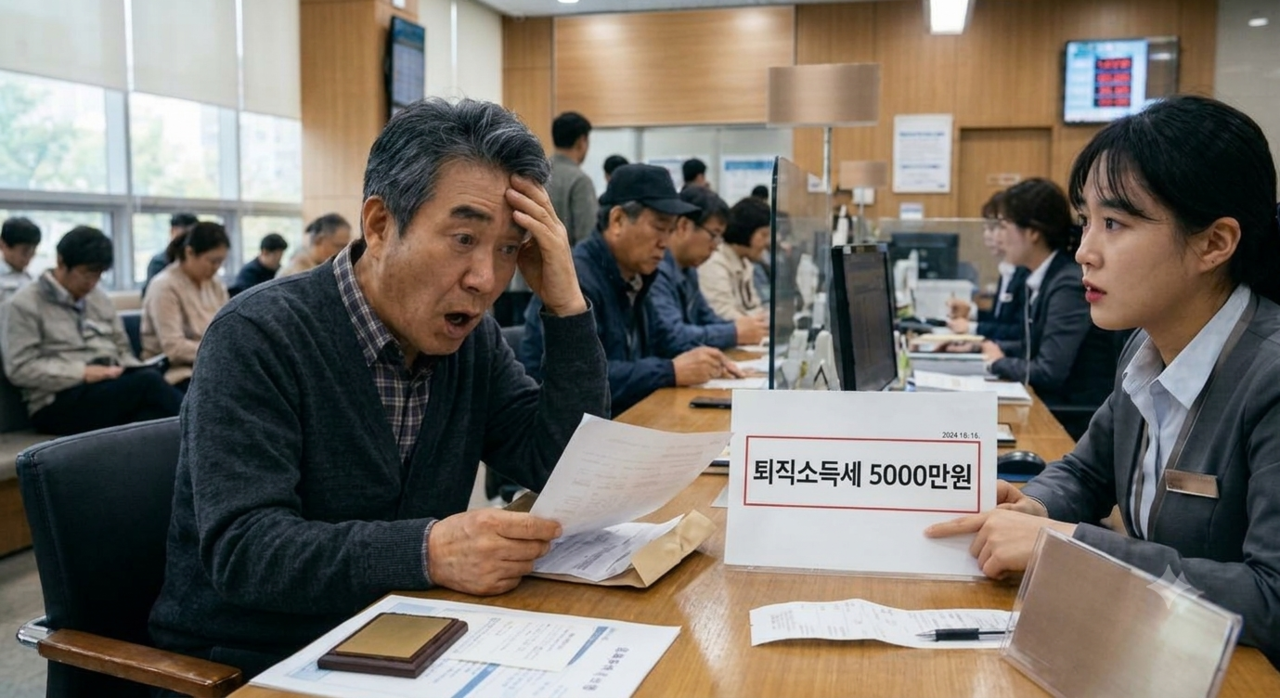
Park Yeon-geum, a managing director who wrapped up roughly 36 years of working life this past September, felt a bittersweet mix of emotions leaving a company he had called home for decades — but also looked forward to a well-earned rest before the next chapter of life.
Part of that optimism came from a retirement payout Park had never seen the likes of: 500 million won ($374,000). Eager to buy a new car and travel abroad, Park closed out the individual retirement pension, or IRP, account where contributions had been building throughout the career.
Park did it without a second thought — and then checked the bank balance. The 500 million won expected had shrunk to 450 million won. The retirement income tax that had been deferred all those years, amounting to 10 percent of the total, had been withheld in one lump sum. "I took it for granted that the retirement income tax would just take care of itself — I was far too complacent," Park said. "If I could go back, I would have taken it as a pension spread over time."
Q. Why was Park hit with retirement income tax all at once?
A. A retirement payout is absolutely the employee's rightful asset. But under the law, an IRP account functions as an institutional tax shield. As long as the money sits inside that shield, the National Tax Service recognizes it as funds set aside for retirement and defers taxation — a mechanism known as tax deferral.
The moment the account is closed and the balance withdrawn as a lump sum, however, 100 percent of the deferred retirement income tax is withheld on the spot.
Q. Can you explain further — how does retirement income tax differ from ordinary income tax?
A. Retirement income tax is calculated in an entirely different way from ordinary earned income tax. Regular wages are income that arises every year, but a retirement payout represents decades of accumulated earnings realized all at once. If that lump sum were taxed like ordinary annual income — with progressive rates applied to the full amount in a single year — the result would be a tax bill running into the tens of percent: a genuine tax bomb.
To prevent that, the National Tax Service uses two key mechanisms: the years-of-service deduction and the pro-rata principle, known in Korean tax law as "yeonbun." Yeonbun means dividing the retirement benefit by the number of years worked. Spreading a large payout over a long service period reduces the per-year figure, which in turn lowers the applicable progressive tax rate. The longer the service, the larger the deduction and the smaller the annual slice — pushing the effective rate down into the lower brackets of 6 to 15 percent.
How many years of service are recognized is therefore the single most important factor in determining retirement income tax. If an employee received a mid-career settlement — for example, to fund a home purchase — the service-year count resets from that point, which can sharply increase the tax burden.
Q. Does receiving a mid-career settlement always put you at a disadvantage?
A. Consider a hypothetical: an employee received a 100 million won mid-career settlement in 2010, at the 20-year mark, then worked 16 more years before retiring this past March. Because the service-year count restarts from 2011, the final tally comes to only 16 years. That shrinks the years-of-service deduction and reduces the divisor in the pro-rata calculation, pushing the effective tax rate higher under the progressive structure. In this situation, the provision to use is the special retirement income tax recalculation under the Income Tax Act.
This provision applies when a worker who previously received a mid-career settlement reaches final retirement. It combines the mid-career payout and the final payout, recalculates the tax liability using the full span of service, and requires the employee to pay only the difference after subtracting taxes already paid.
The special recalculation does not always work in the taxpayer's favor — in some cases it actually increases the tax bill. Anyone who received a mid-career settlement should apply for the special recalculation and carefully assess whether it helps or hurts before deciding.
Q. That covers the basics. What is the actual difference in taxes between cashing out an IRP and receiving it as a pension?
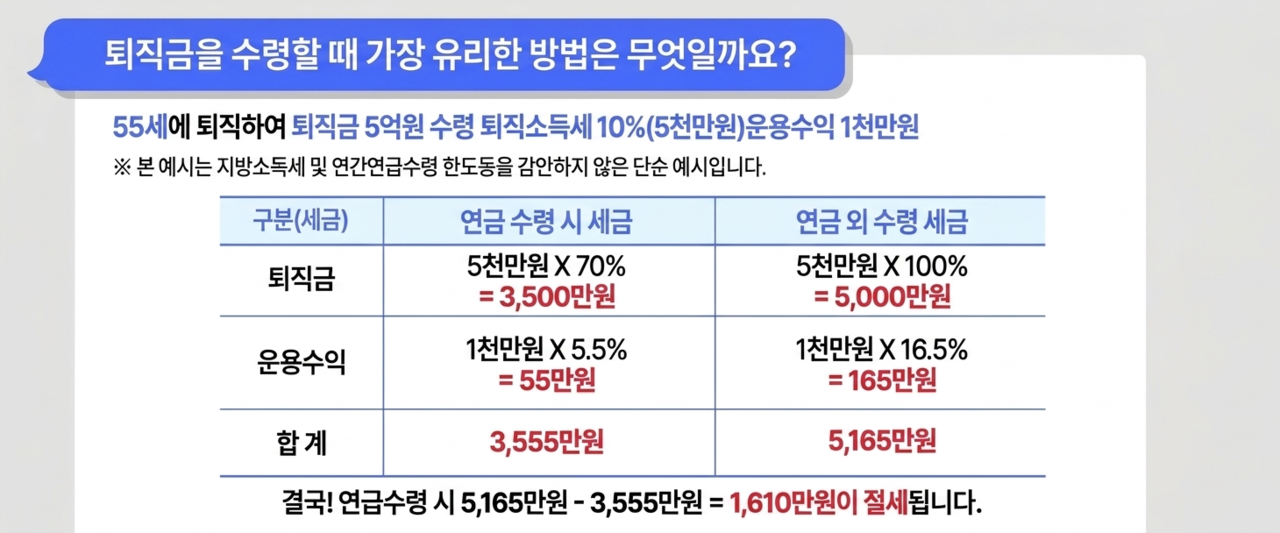
A. Take a hypothetical: someone retires at 55 with a 500 million won retirement payout. Assume the retirement income tax comes to 50 million won — 10 percent — and that the IRP has generated 10 million won in investment returns.
Withdrawing everything as a lump sum means paying the full 50 million won in retirement income tax. The 10 million won in investment returns would also be subject to a miscellaneous income tax of 16.5 percent if taken as a lump sum, adding another 1.65 million won. The total tax bill for a lump-sum withdrawal: 51.65 million won.
Now consider taking the funds as a pension. The retirement income tax itself changes. For a pension payout period of 10 years or less, the retirement income tax is reduced by 30 percent — bringing the 50 million won bill down to 35 million won.
The tax treatment of investment returns also differs. Rather than the standard financial income tax rate of 15.4 percent, pension withdrawals are subject to pension income tax. For recipients between the ages of 55 and 69, that rate is 5.5 percent, meaning the tax on 10 million won in investment returns is just 550,000 won.
Total taxes under the pension option: 35 million won in retirement income tax plus 550,000 won in pension income tax on investment returns, for a combined 35.55 million won. Choosing the pension route saves 16.1 million won compared with a lump-sum withdrawal.
Stretching the pension payout period even further yields additional savings. Starting in 2026, the retirement income tax reduction rate is adjusted based on the actual pension payout period: 30 percent for years one through 10, 40 percent for years 11 through 20, and 50 percent from year 21 onward.
Even if a large monthly pension is not immediately needed, withdrawing as little as 100,000 won per month to begin accumulating pension years, then stepping up to the 40 percent reduction from year 11 and drawing the bulk of the pension from year 21, can cut the retirement income tax bill by up to 50 percent.
Ultimately, the difference in taxes depending on how retirement funds are received can run not into the millions of won but into the tens of millions. Planning carefully — when to start, how much to draw, and in what form — is the single most important first step in protecting retirement assets.
Q. I've heard that private school pension members are in a different situation from ordinary employees.
A. There are important points that private school pension members need to know about using an IRP for their retirement allowance and early-retirement bonus.
Many people think of the private school pension only as the monthly benefit received after retirement. In practice, the retirement income paid out at the time of leaving a job falls into three broad categories.
The first is the private school pension itself, paid monthly for life. The second is the retirement allowance, a lump sum paid at the time of retirement. The third is the early-retirement bonus, paid to those who retire voluntarily before the age of 60.
The most important issue is how the retirement allowance and the early-retirement bonus are taxed — because only taxable funds can be deposited into an IRP.
The early-retirement bonus is fully subject to retirement income tax. The retirement allowance, however, depends on the period of service. The portion corresponding to service before Jan. 1, 2002 is tax-exempt and therefore cannot be transferred to an IRP.
The portion corresponding to service on or after Jan. 1, 2002 is taxable and can be transferred to an IRP.
Consider a hypothetical: a professor who worked at a school for 33 years and is approaching mandatory retirement receives a retirement allowance of 90 million won.
If the portion attributable to roughly 24 years of service after Jan. 1, 2002 amounts to 60 million won, that amount can be transferred to an IRP. The portion corresponding to service before Jan. 1, 2002 is tax-exempt and cannot be moved into an IRP.
Many people are unaware of this distinction and simply take the entire retirement allowance as a lump sum. Using an IRP, however, opens the door to several benefits.
Q. Please explain further — why should private school teachers transfer funds to an IRP?
A. The first advantage is a reduction in retirement income tax. Transferring an early-retirement bonus or a taxable retirement allowance into an IRP qualifies the recipient for a retirement income tax reduction.
Even with the same retirement payout, the amount that actually ends up in hand can differ significantly depending on whether it is taken as a lump sum or managed through an IRP.
That is why it is important to plan the method of receiving the retirement allowance well before the retirement date.
The most critical point is that the transfer to a pension savings account or IRP must be requested within 60 days of receiving the retirement benefit. After 60 days, a transfer to a pension account may no longer be possible, so the deadline must be confirmed without fail.
The second advantage is tax savings on investment returns.
Managing retirement funds through ordinary financial products means paying financial income tax on any returns. If financial income exceeds 20 million won in a given year, it becomes subject to comprehensive financial income taxation, which can push the effective rate considerably higher.
Investment returns generated inside an IRP, by contrast, are subject to a pension income tax rate of just 3.3 to 5.5 percent when received as a pension. Tax deferral also allows the full pre-tax amount to keep compounding, and the eventual tax rate is lower than that applied to ordinary financial income.
The third advantage is national health insurance premium management. Upon retirement, a person moves from the employer-subscriber category to the local-subscriber category. Retirement benefits received from an IRP are not subject to national health insurance premiums — meaning that using an IRP, rather than withdrawing the retirement payout and investing it in ordinary financial products, can help reduce the health insurance burden.
By Seo Sang-hyeok and Han Yu-jin, deputy manager at Woori Bank

hyuk@heraldcorp.com




