
Seoul Metropolitan Government unveils comprehensive water-source thermal energy supply plan
Cumulative capacity to grow from current 53 MW to 305 MW by 2030
Han River and waterworks supply to heat and cool buildings in Jamsil and Seongsu-dong
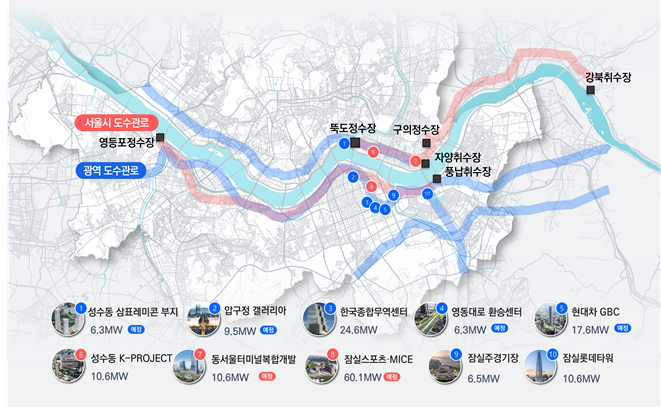
The Seoul Metropolitan Government plans to expand the use of water-source thermal energy — a technology that draws on the heat stored in the Han River and the city's water supply conduits — with a target of increasing capacity sixfold by 2030.
The city aims to develop the technology into a new renewable-heat supply chain linking Seoul's water infrastructure with urban development, going beyond heating and cooling systems in individual buildings.
According to the Seoul Metropolitan Government on Saturday, water-source thermal energy harnesses the natural temperature of water — cooler than the air in summer and warmer in winter — to heat and cool buildings. The method is considered environmentally friendly because it reduces greenhouse gas emissions.
Under a comprehensive plan to promote water-source thermal energy in Seoul, the city intends to raise cumulative installed capacity from 53 MW, as of last month, to 305 MW by 2030.
As a first step, the city will use existing water supply conduits to introduce 110 MW of water-source thermal energy across six sites, including the Jamsil Sports and MICE complex, the K-Project development in Seongsu-dong, and a mixed-use redevelopment of the East Seoul Bus Terminal.
The plan links the heating and cooling demand of large-scale development projects with available supply conditions, creating a structure in which urban development and renewable-heat expansion reinforce each other.
The city will also examine the feasibility of introducing a flagship water-source thermal energy model for the Yongsan International Business District that draws directly from the Han River. Officials plan to compare using existing conduits against direct river intake to identify the most suitable supply model for large-scale urban development.
The city plans to increase the share of conduit flow available for thermal use as well. Currently about 53 percent of the water drawn through supply conduits can be allocated to thermal energy applications; the city aims to raise that ceiling to as much as 75 percent by 2030, provided water treatment and tap-water supply are not disrupted.
Public buildings will be required to assess water-source thermal energy adoption from the earliest planning stage. The requirement applies to structures with a total floor area of at least 10,000 square meters located within 500 meters of a water supply conduit. Private development projects will also be subject to a new regime requiring thermal energy assessments from the outset of urban management planning.
Starting next month, the city will operate a "Seoul Renewable Heat Promotion Council" to provide integrated support covering feasibility checks, permits and fiscal assistance. For privately built new structures, the city plans to subsidize renewable-heat installation costs — including water-source pipeline construction — of up to 250 million won ($187,000) per site.
Seoul Mayor Oh Se-hoon, in a video address at the 2026 Seoul Future Energy Forum on Wednesday, said the city would "reflect eco-friendly energy use from the urban planning stage and further expand the supply of renewable heat, including water-source thermal energy from the Han River."
ken@heraldcorp.com




