
A Korea Herald reporter visits Jump, Nowon-gu's new indoor sports complex
21,886 visitors since opening Oct. 2
235-meter indoor zip line is a first in Korea; go-kart track is the country's largest
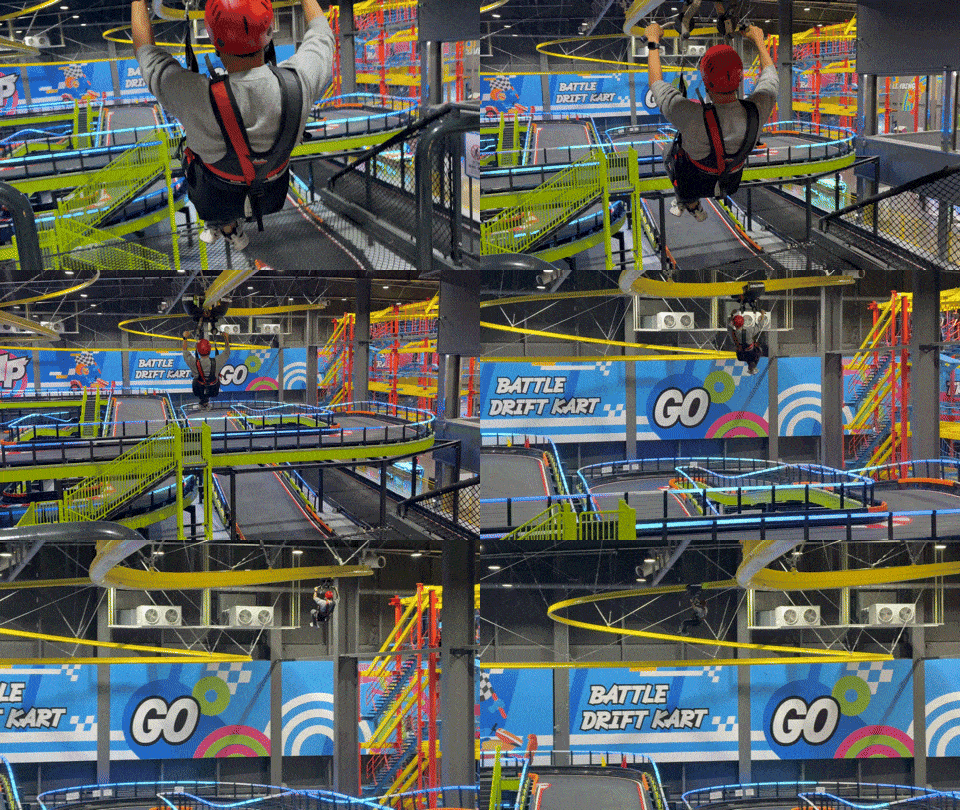
"OK, here we go." From a boarding platform 13 meters up, a staff member's calm instruction prompts a press of the handle button. The body lurches forward with a whoosh and slides along the rail. Speed builds in an instant, and suddenly the middle of the track is rushing past. Then comes the corner. The rail twists through the curve and the body tilts hard to one side. Both legs fly up into the air. The stomach drops, and a jolt runs from the tailbone to the top of the skull. It is somewhere between terror and thrill — and it is hard to say which side of that line this falls on. Composing oneself, a glance along the rail reveals how far there is still to go, how many more corners lie ahead. Time slows. The people waiting on the platform look very far away. One thought takes over: this was a mistake.
On Oct. 2, Jump — a district-run indoor sports and activity complex — opened at 102 Hangeul Biseok-ro in Nowon-gu, Seoul. The facility sits on a 14,063-square-meter site with a total floor area of 8,612 square meters and stands about 15 meters tall. Though technically two stories, it is the equivalent of a three- to four-story conventional building, making it the largest indoor activity facility in the country. It is equipped with a range of attractions: a Sky Glider (zip line), Battle Drift karts (go-karts), an indoor climbing wall, laser survival combat and a Sky Trail aerial walkway.
A Korea Herald reporter visited Jump on Thursday to try the zip line and go-karts firsthand. The Sky Glider described above is a zip-line-style ride in which riders hang from a wire and travel along a rail suspended from the building's ceiling. The total track length is 235 meters, with an actual riding distance of 210 meters excluding the start and finish zones. Only one person may ride at a time, and there is no age restriction — anyone 140 centimeters or taller can board. The zip line equipment was imported from Bulgaria.
To ride the Sky Glider, the reporter made the way up to the second-floor boarding platform, put on a helmet, and strapped into a harness and safety belt. Both hands went up to grip the handle overhead. "Press the button on your right to pick up speed. Cross your legs. OK, here we go." The staff member's gentle voice was disarming — until the first corner, where the fear doubled. The zip line reached 25 kilometers per hour. After a few more corners, the sensation was one of the soul leaving the body. The total ride from start to finish: 52 seconds. Only afterward did the staff member mention: "If you don't press the button, it goes at a leisurely 9 kilometers per hour."
Next up was the Battle Drift kart — one of Jump's most popular attractions. Riders climb into a low-slung kart and race around a 380-meter track. The karts can reach a maximum of 60 kilometers per hour, though the speed inside Jump is capped at 35 kilometers per hour. Both the karts and the track were sourced from Italy, the home of motorsport.
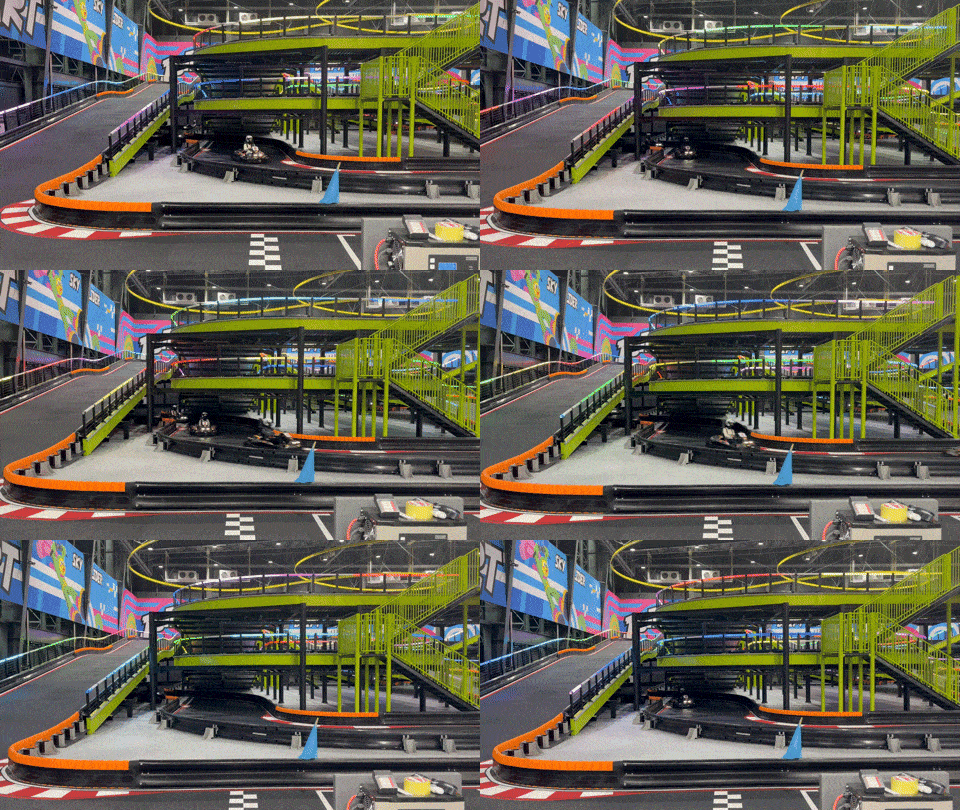
In the waiting area, a staff member handed over a helmet and a balaclava. The black balaclava goes on first, then the helmet — to keep sweat, cosmetics and other residue off the equipment. A safety briefing followed: no reckless overtaking, no sharp steering corrections, maintain a safe following distance.
Seated in the kart with the seatbelt fastened, the accelerator is on the right and the brake on the left, color-coded blue and red respectively to match the traffic-light signals. Pressing the accelerator sent the kart shooting down the track immediately. Staff control maximum output speed remotely. Depending on how the brake is applied, drifting is also possible. While the reporter fumbled through a corner, a kart behind let out a high-pitched whine and swept past. The track runs across three levels in total. On the third lap, a staff member waved a red flag and directed the kart toward the finish line. Currently 12 karts are in operation — 10 single-seaters and two two-seaters. The two-seater option, popular with parents and children, will be expanded: four more two-seaters are set to be added in November, along with a personal lap-time recording system.
Jump is divided into six zones: a Ride Zone, Adventure Zone, Survival Zone, Arcade Zone, RC Play Zone and Kids Ground Zone. The Ride Zone houses the Battle Drift karts and Sky Glider described above. The Adventure Zone features Sky Trail — an aerial exploration course that takes riders through 39 obstacles at a three-story height — along with Clip 'n Climb, an indoor artificial climbing wall up to 11 meters tall with 29 themed routes, and Net Play, an aerial net playground. The Survival Zone offers Battle World Laser Tag, a team-based combat game. The Arcade Zone is an interactive sports area that responds to body movement, while the RC Play Zone lets visitors operate RC heavy machinery and mini cars to complete missions and races. The Kids Ground Zone provides play content for preschool children under 120 centimeters tall.
Since opening on Oct. 2, Jump has drawn visitors from across the country. School groups arrive on field trips, and office workers take days off to bring their families. According to Nowon-gu, a total of 21,886 people visited Jump between opening day and Thursday. "Many people come up from places like Busan or South Jeolla Province," a Jump official said. "Some arrive with their children right when we open at 10 a.m. and stay until closing time at 6 p.m."
The complex also offers rest areas including a terrace and party rooms, as well as a food lounge with 400 seats. Jump is open daily from 10 a.m. to 8 p.m., except on seollal and chuseok. Admission details, reservations and ticketing information are available on the facility's website. Excluding the karts, visitors can use all facilities for 14,200 won ($11) per hour. A kart ride costs 15,000 won for a single-seater on weekdays.
From the land purchase in 2018 to completion and opening, Jump took eight years to bring to life. The site was originally secured for a school, but declining school-age enrollment meant construction never materialized. The project gained momentum when then-District Mayor Oh Seung-rok acquired the site for the Jump development. The total budget came to about 54.6 billion won ($40.9 million), of which 33.2 billion won — roughly 60.9 percent — came from district funds. The equipment inside Jump was imported from the United Kingdom, Italy and Bulgaria.
Nowon-gu District Mayor Seo Jun-o said the facility represented "something close to a challenge for a basic local government, both in scale and in the quality of its content," adding that he hoped "children, teenagers and adults who visit Jump will all find exhilarating fun and a sense of achievement."
cook@heraldcorp.com




