
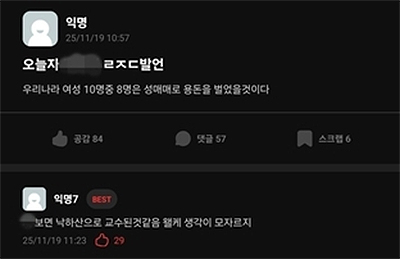
"Eight out of 10 women in this country have probably earned pocket money through prostitution."
A professor at a private university in Daejeon who made sexually harassing and abusive remarks to students during class received a two-month pay cut — the lightest category of disciplinary action — before retiring at the mandatory retirement age and leaving the institution.
The National Human Rights Commission of Korea's gender discrimination remedies division received a complaint alleging that the remarks by the professor, identified only as A, violated students' personal dignity, investigated the case and notified the complainants of the outcome, Yonhap reported Friday.
In its notification, the commission acknowledged that A, as a faculty member, had made derogatory remarks targeting a specific gender toward students enrolled in the course, causing sexual humiliation or aversion and infringing on their personal dignity.
However, the commission determined that no separate remedy or additional measures were necessary, as A had already been referred to the university's faculty disciplinary committee over the remarks and received a confirmed penalty of a two-month pay cut.
The controversy erupted last year when it became known that A had made sexually harassing and abusive remarks to students during class.
During lectures, A was reported to have said that female students "could turn to prostitution if they were desperate" and that "eight out of 10 women in this country have probably earned pocket money through prostitution."
A was also alleged to have made demeaning and insulting remarks about students, including "Students from Seoul National University, Korea University and Yonsei University get A+, but you get a C rating" and "Not only do you have the misery of graduating from a regional university, you're also worthless." A was further accused of making politically charged statements unrelated to the coursework.
As the controversy spread, the university removed A from all teaching duties in late May and imposed a two-month pay cut. A university official told Yonhap that disclosing the disciplinary outcome had been difficult because it constituted personal information, but confirmed that the two-month pay reduction had been imposed and that follow-up education to prevent recurrence had also been conducted.
Among disciplinary measures applicable to university faculty, a pay cut is generally classified as a minor penalty, alongside a formal reprimand.
After the controversy broke and the disciplinary process concluded, A retired at the mandatory retirement age in August and left the university.
A separate complaint was subsequently filed with the commission arguing that the university's failure to disclose the disciplinary outcome violated the right to information of affected and enrolled students. The commission dismissed it, however, ruling that the matter fell outside its jurisdiction under the Act on Disclosure of Information by Public Institutions.
betterj@heraldcorp.com




