
Adopting families to receive up to 1 million won a year in medical and insurance support
Four university veterinary hospitals to launch public-service pilot program
Elderly and seriously ill dogs unable to be adopted to receive state care for life
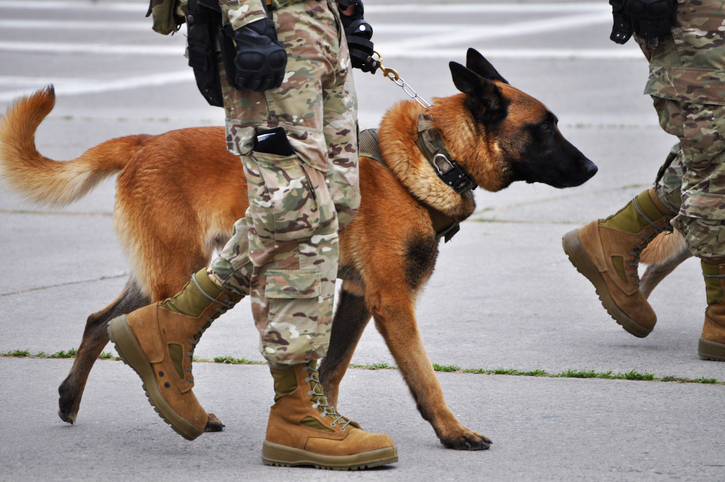
South Korea will establish a dedicated support center to ensure that retired military dogs, police dogs and quarantine detection dogs receive state care in their old age. Animals too old or too ill to be adopted will receive lifelong protection from the government, while families that adopt retired service animals will be reimbursed up to 1 million won ($749) per year — covering 60 percent of veterinary bills, vaccination costs and insurance premiums.
The Ministry of Agriculture, Food and Rural Affairs and the Animal and Plant Quarantine Agency held the fourth "Quarantine Detection Dog Homecoming Day" on Friday at the Quarantine Detection Dog Center on Yeongjongdo, Incheon, with 11 retired detection dogs and their adoptive families in attendance. Officials used the event to review government policy on support for national service animals.
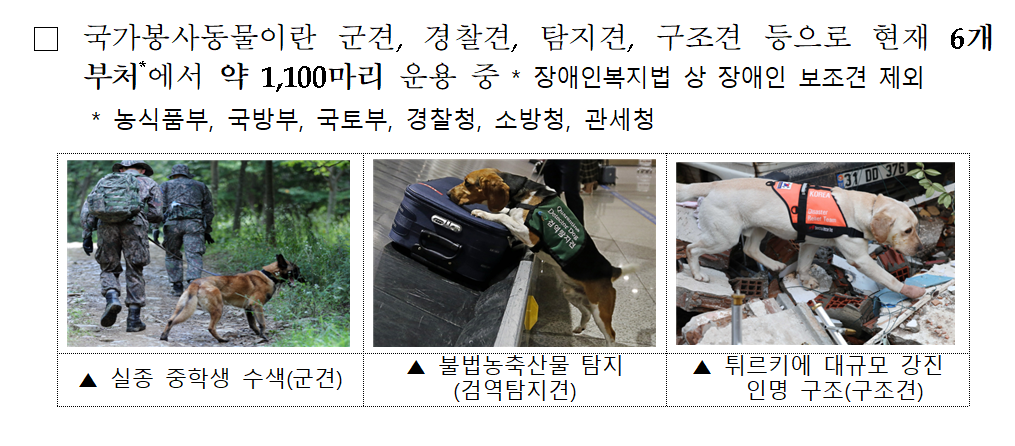
National service animals are those that perform official state duties, including military dogs, police dogs, detection dogs and search-and-rescue dogs. Six agencies — the Ministry of Agriculture, Food and Rural Affairs, the Ministry of National Defense, the Ministry of Land, Infrastructure and Transport, the Korean National Police Agency, the National Fire Agency and the Korea Customs Service — currently operate about 1,100 such animals.
The centerpiece of the government's plan is the establishment of a dedicated retirement support center. Animals finishing their service will be transferred to the center for resocialization and adoption matching, while those that cannot be placed due to advanced age or serious illness will remain under the center's care for the rest of their lives.
The government also plans to expand opportunities for prospective adopters to meet retired service animals in person. On top of the integrated adoption platform already operating through the National Animal Protection Information System, the authorities plan to introduce pre-adoption bonding programs.
Veterinary cost support — consistently cited as the biggest burden for adoptive families — will also be strengthened. Since April, the government has reimbursed adopters of retired national service animals for 60 percent of expenses on treatment, vaccinations and insurance, up to a maximum of 1 million won per year. The program covers up to 100 animals annually.
Discount benefits through partnerships with the veterinary and animal-industry sectors have also expanded. The number of partner businesses offering discounts on veterinary fees, feed, funeral services and insurance grew from 56 in 2024 to 73 this year. At 44 partner veterinary clinics, adopters can receive a 30 percent discount on health checkups and treatment.
To improve access to medical care, the government is also preparing a pilot program using university veterinary hospitals as public-service hubs. On Oct. 2, it signed MOUs with the veterinary hospitals of four universities — Kangwon National University, Chungbuk National University, Chungnam National University and Chonnam National University. The public-hub veterinary hospitals will provide public-interest medical services not only to active service animals but also to retired animals living with private adoptive families.
At Friday's event, adoptive families received certificates of appreciation, shared updates on their animals and took part in an autumn sports day. Park Ji-ho, director of Haneul Animal Hospital and a cooperative veterinarian for the quarantine agency and the Korea Customs Service, led a session on pet health management.
Kim Jeong-uk, director general for agricultural industry innovation policy at the Ministry of Agriculture, Food and Rural Affairs, met with adoptive families to hear their concerns — including the burden of veterinary costs — and reviewed the support status of each association.
"We are grateful to the adoptive families who have taken an interest in national service animals and welcomed them into their homes," Kim said. "The government will continue to strengthen support so that national service animals, who have devoted themselves to the country and its people, receive the recognition and care they deserve in retirement."
adastra@heraldcorp.com




