
Samsung Electronics, SK hynix both fall sharply in early trading
'No short-term supply-demand fix — disappointed sellers unloading'
Alphabet's 12.64% overnight plunge adds to pressure
Positive outlook for next year's earnings fails to lift shares
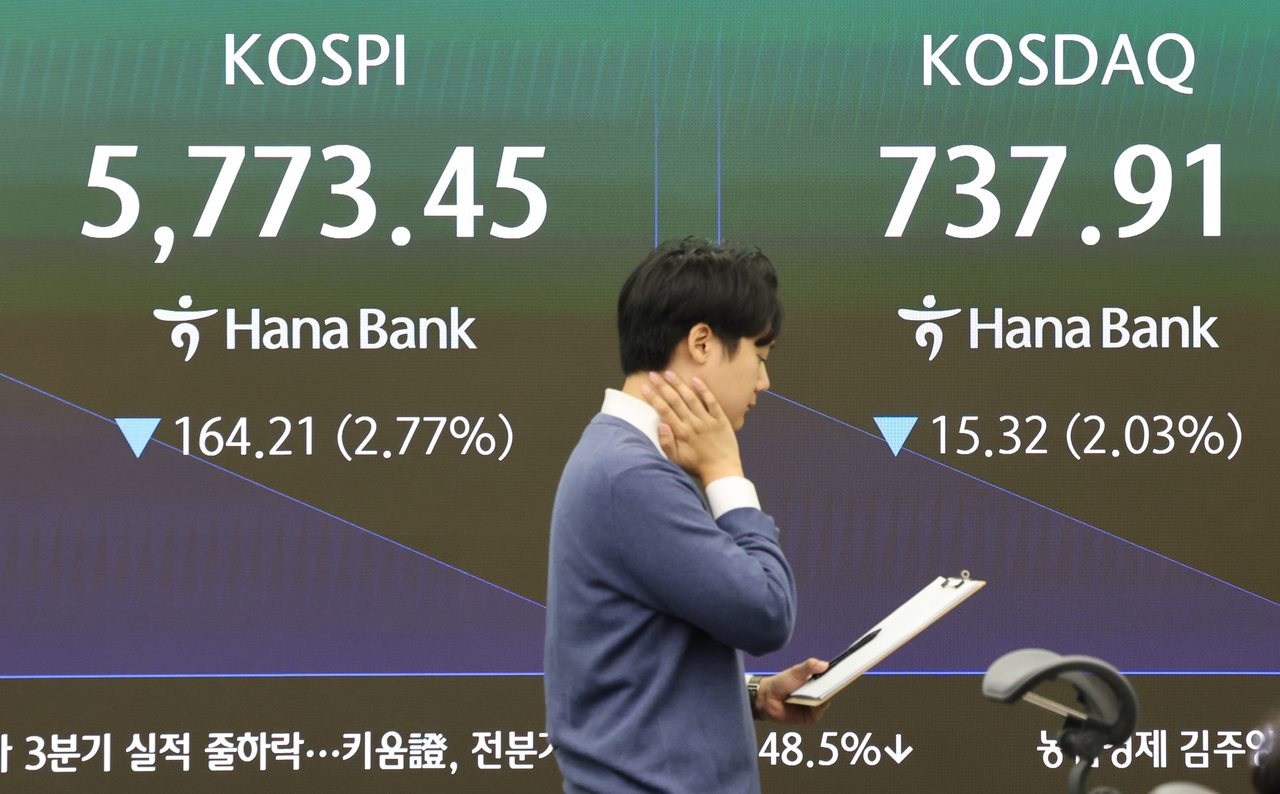
Samsung Electronics and SK hynix both plunged in early trading Friday, with a sell-side sidecar also triggered on the Kospi.
The selloff came after Samsung Electronics' earnings release Thursday failed to provide specific details on its shareholder return plan, spreading disappointment across the market, compounded by a sharp overnight decline in US technology stocks.
As of 10 a.m. Friday, Samsung Electronics was down 4.74% at 221,000 won ($166), while SK hynix had fallen 7.99% to 1.4 million won, according to Korea Exchange.
At 10:04 a.m., a sell-side program trading sidecar was triggered on the Kospi — the first such activation in 11 trading sessions since Oct. 15.
Samsung Electronics preferred shares were also down 5.55%, and SK Square — SK hynix's largest shareholder with a 20.5% stake — fell 7.03%.
Samsung Electronics shares had already dropped 4.13% on Thursday, and the stock extended those losses sharply into Friday's session.
On Thursday, Samsung Electronics announced a shareholder return plan of up to 110 trillion won for the year, including a 30 trillion won cash dividend for the third quarter, but stopped short of releasing detailed execution plans — triggering a wave of disappointed selling.
The company said the remaining shareholder return budget for the year stood in the 55 trillion to 75 trillion won range, with specifics to be confirmed at a board meeting at the end of January next year.
Profit-taking following a sharp two-session rally of 9.93% also appeared to be adding to index volatility.
Lee Young-gon, head of research at Toss Securities, said Samsung Electronics' shareholder return policy was positive in terms of scale and direction, but the announcement covered only the annual return size and general approach, with no details on additional buyback volume or a specific execution timeline. "It appears that disappointed sellers are unloading because the short-term supply-demand improvement measures the market had been expecting did not materialize," Lee said.
IBK Investment Securities lowered its target price for Samsung Electronics from 460,000 won to 350,000 won. Analyst Kim Un-ho said that while a fair value of 460,000 won was justified given current profitability and market conditions, "the shareholder return policy fell short of market expectations, and considering that investor preference is likely to decline relative to competitors, upside in the share price will be limited."
SK hynix had closed up 2.62% at 1.53 million won on Thursday. The stock outperformed Samsung Electronics after SK hynix announced Wednesday that it would carry out 100 trillion won in total shareholder returns for the year, following the completion of a 40 trillion won buyback.
On Friday, however, SK hynix was falling more steeply than Samsung Electronics, weighed down by the overnight Wall Street decline and profit-taking after the previous session's gains.
Technology stocks fell sharply on Wall Street on Thursday as concerns over AI investment resurfaced.
Alphabet, Google's parent company, reported revenue that missed market expectations while its AI-related cash burn accelerated sharply, reigniting those concerns.
Alphabet's share price fell 12.64%, while Micron Technology dropped 4.98%, AMD declined 2.08%, and SK hynix's American depositary receipts slipped 1.58%. The Philadelphia Semiconductor Index also fell 1.42%.
Despite the selloff, analysts broadly maintained a positive outlook for Samsung Electronics and SK hynix's earnings and industry conditions next year.
Ryu Hyung-geun, an analyst at Daishin Securities, said demand for sixth-generation HBM, known as HBM4, from Samsung Electronics appeared to be surging. "Next year is expected to be a landmark year in which Samsung secures the No. 1 position in HBM market share," Ryu said.
Ryu Young-ho, an analyst at NH Investment & Securities, said the memory chip industry was undergoing structural changes unlike anything seen before, pointing to targets of allocating 60 to 70 percent of total volume to long-term agreements through 2030.

jiyun@heraldcorp.com




