
South Korean, US defense chiefs hold 40-minute meeting on sidelines of ADMM-Plus
Kang calls agreement on operational control transfer 'biggest achievement'
Intelligence-sharing limits described as 'very small' military matter
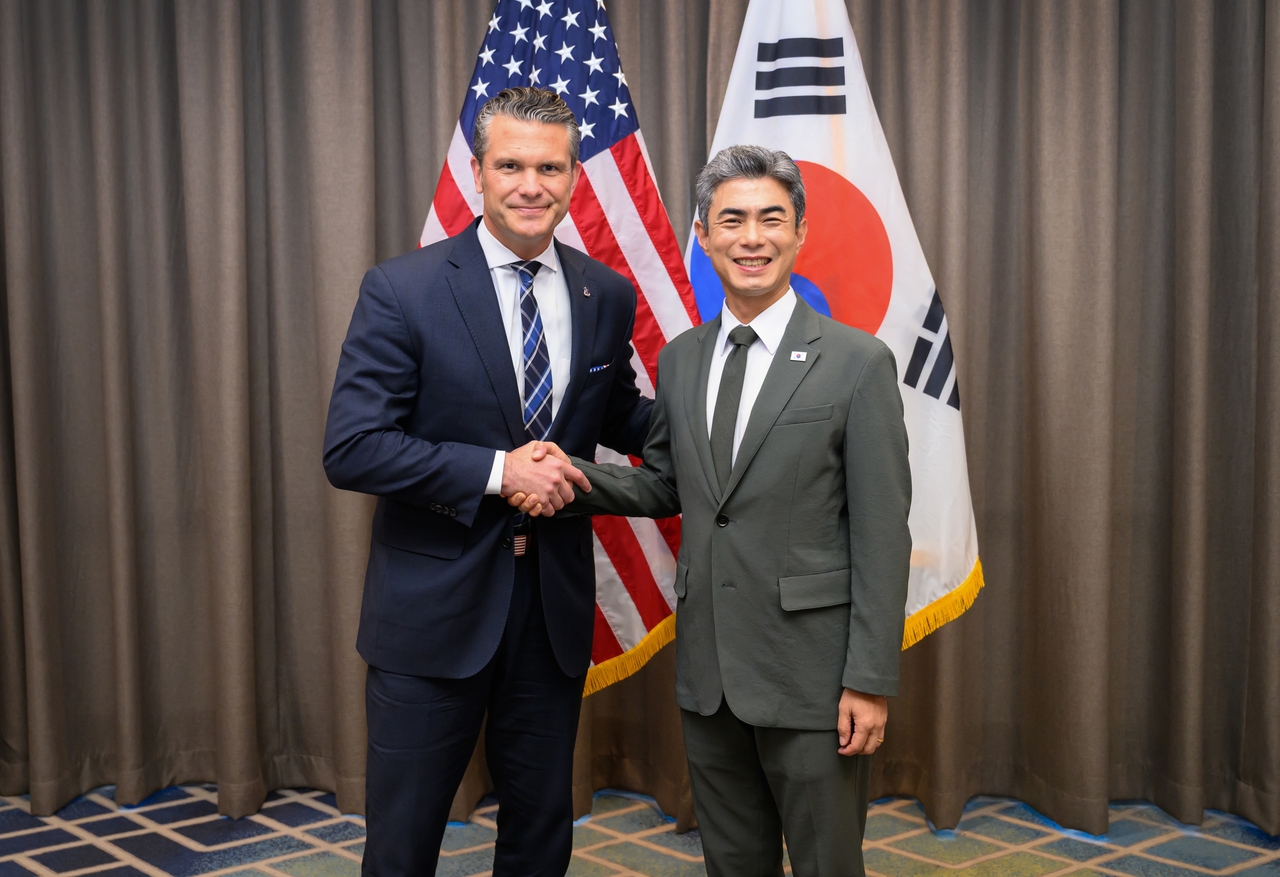
South Korea's Defense Minister Kang Shin-chul moved Friday to tamp down a string of reports suggesting strain in the South Korea-US alliance, saying US Defense Secretary Pete Hegseth had dismissed the accounts as "fake news" and that the two defense chiefs had no disagreements.
Kang spoke to reporters outside the Defense Ministry in Seoul after returning from the ASEAN Defence Ministers' Meeting-Plus, known as ADMM-Plus, held in the Philippines. Asked whether there had truly been no differences between the two sides, Kang said, "There were no disagreements."
"In fact, regarding all the talk going around about problems in the alliance, Secretary Hegseth said just one thing — 'fake news,'" Kang said. "I agree with that." Kang added that such reports "cannot and should not shake the solidity of the South Korea-US alliance."
The two ministers held a separate meeting on the sidelines of the ADMM-Plus on Wednesday, lasting about 40 minutes. During the talks, the South Korean side raised the recent domestic media reports about alleged strains in the alliance, and Hegseth was said to have responded that he did not believe them and considered them fake news.
On the transfer of wartime operational control, Kang offered only a broad answer. Asked whether the two sides had agreed to complete a full operational capability verification of the Future Combined Forces Command in time to set a target year for the transfer at next year's Security Consultative Meeting, Kang did not answer directly. "The biggest achievement was that we agreed to work together toward the transfer of operational control," Kang said. "This was a good meeting that reaffirmed the strength of the South Korea-US alliance."
Asked whether the meeting had addressed lifting restrictions on North Korea-related intelligence sharing between the two countries, Kang said the military dimension of the issue was "very small" and that the ministry did not see it as a major problem. "You should think of it as falling under a different area of intelligence," Kang said.
Earlier, National Intelligence Service Director Lee Jong-seok also shrugged off reports of problems in South Korea-US intelligence cooperation during a national audit before the National Assembly's intelligence committee on Thursday. According to Democratic Party of Korea lawmaker Yoon Geon-young and People Power Party lawmaker Yoo Young-ha, who lead their respective parties' sides on the committee, Lee said that while "some intelligence has been restricted due to remarks related to 'composition'" by Unification Minister Jeong Dong-young, "there are absolutely no other restrictions." The NIS said the restrictions cover only a narrow slice of US satellite imagery and can be adequately supplemented by NIS reconnaissance assets.
The US partially restricted the sharing of intelligence related to North Korea's nuclear facilities in March, after Jeong publicly referred to a "North Korean-constructed uranium enrichment facility" — a move Washington viewed as a breach of protocol.
rimsclub@heraldcorp.com




