
First upgrade in 143 years of diplomatic relations; advanced industry, defense, energy cooperation to expand
Lee requests equal treatment under EU industrial acceleration law; Merz pledges to 'look into it carefully'
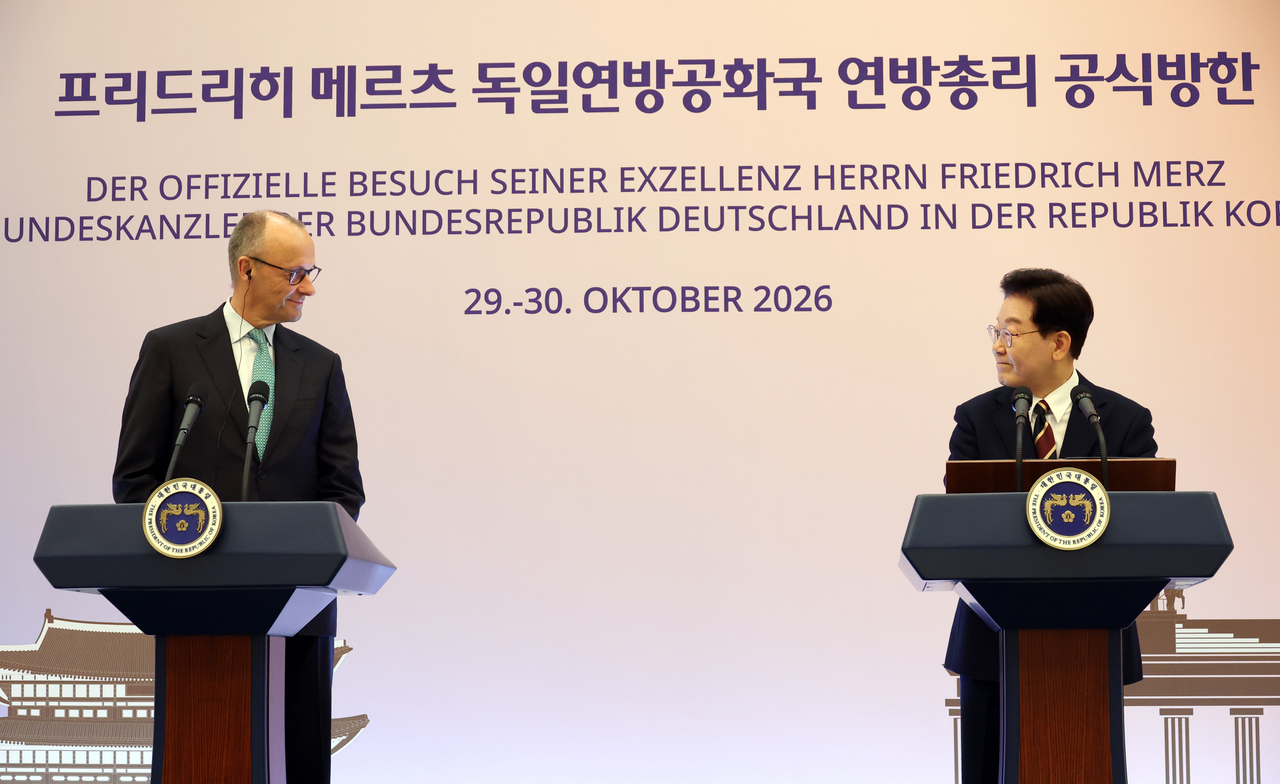
President Lee Jae-myung and German Chancellor Friedrich Merz held a summit at Cheong Wa Dae on Thursday and agreed to establish an "enhanced strategic partnership" — the first upgrade in bilateral ties since the two countries established diplomatic relations in 1883. The two sides agreed to deepen cooperation across politics, security and the economy, including strengthening collaboration in advanced industries such as semiconductors, batteries and AI, and pursuing the early conclusion of a military classified information protection agreement.
Cheong Wa Dae Chief Spokesperson Kang Yu-jung said in a written briefing Thursday afternoon that Lee and Merz "held a summit at Cheong Wa Dae and engaged in in-depth discussions on ways to expand practical cooperation between the two countries and on major regional and international developments." The visit marks Merz's first official trip to South Korea since taking office.
Germany is South Korea's largest trading partner in Europe and a leading manufacturing power; the two countries have consistently maintained annual bilateral trade of more than $30 billion. Kang said the two sides had been expanding their strategic cooperation amid global instability and supply chain disruptions, adding that the Asia-Pacific Business Conference held in Seoul to coincide with Merz's visit reflected "Germany's determination to strengthen future-oriented cooperation with South Korea, a trusted partner in the Indo-Pacific region."
At the summit, the two leaders adopted a joint statement expressing their commitment to cooperation across politics and security, the economy and advanced industries, and cultural and people-to-people exchanges — alongside the formal establishment of the enhanced strategic partnership, the first since diplomatic ties were forged.
On the economic front, the two leaders agreed to pursue complementary integration of advanced technologies including semiconductors, batteries and AI. They agreed to expand joint research on strategic technologies and researcher exchanges to boost technological competitiveness and broaden investment and business opportunities for companies. Lee specifically asked for Germany's attention and support in ensuring that South Korea — a key EU free trade agreement partner — receives treatment equivalent to EU member states in connection with the bloc's push for an industrial acceleration law. Merz responded that he would "look carefully into South Korea's request."
The two countries signed a joint letter of intent on an economic and high-tech partnership framework, agreeing to significantly expand cooperation beyond trade and investment into supply chain diversification, critical minerals, energy security and advanced technology. They also signed a renewed joint letter of intent on building a Korea-Germany energy partnership to strengthen renewable energy and power grid cooperation, and concluded a protocol amending the Korea-Germany double taxation avoidance agreement to lay the groundwork for a fair investment environment.
The two leaders also moved to strengthen the institutional foundation for defense and security cooperation. They agreed to enhance strategic communication between defense authorities, pursue the early conclusion of a military classified information protection agreement, and identify mutually beneficial cooperation opportunities between companies based on their respective defense industry strengths.
People-to-people and cultural ties were also reaffirmed. The two leaders noted the 60th anniversary this year of Korean nurses being dispatched to Germany, recognizing the contributions of the miners and nurses who went to Germany in the past to the growth of bilateral friendship, and agreed to expand exchanges for future generations through education, culture and working holiday programs.
On the security situation, the two sides agreed that the security of the Korean Peninsula and Europe are closely interlinked and committed to strengthening communication on Ukraine and Korean Peninsula issues. Lee expressed gratitude to Germany for its support for efforts to build a peace regime on the Korean Peninsula and resume dialogue.
At the close of the summit, Merz extended a formal invitation for Lee to visit Germany next year, saying it "would be very meaningful" if Lee could join a digital summit to be held in Berlin in the fall of next year. Lee expressed appreciation and said a visit would come at an appropriate time.
sunpine@heraldcorp.com




