
IBS and German research team confirm long-range electronic effects that alter bond strength in metal catalysts; new predictive model published in Science
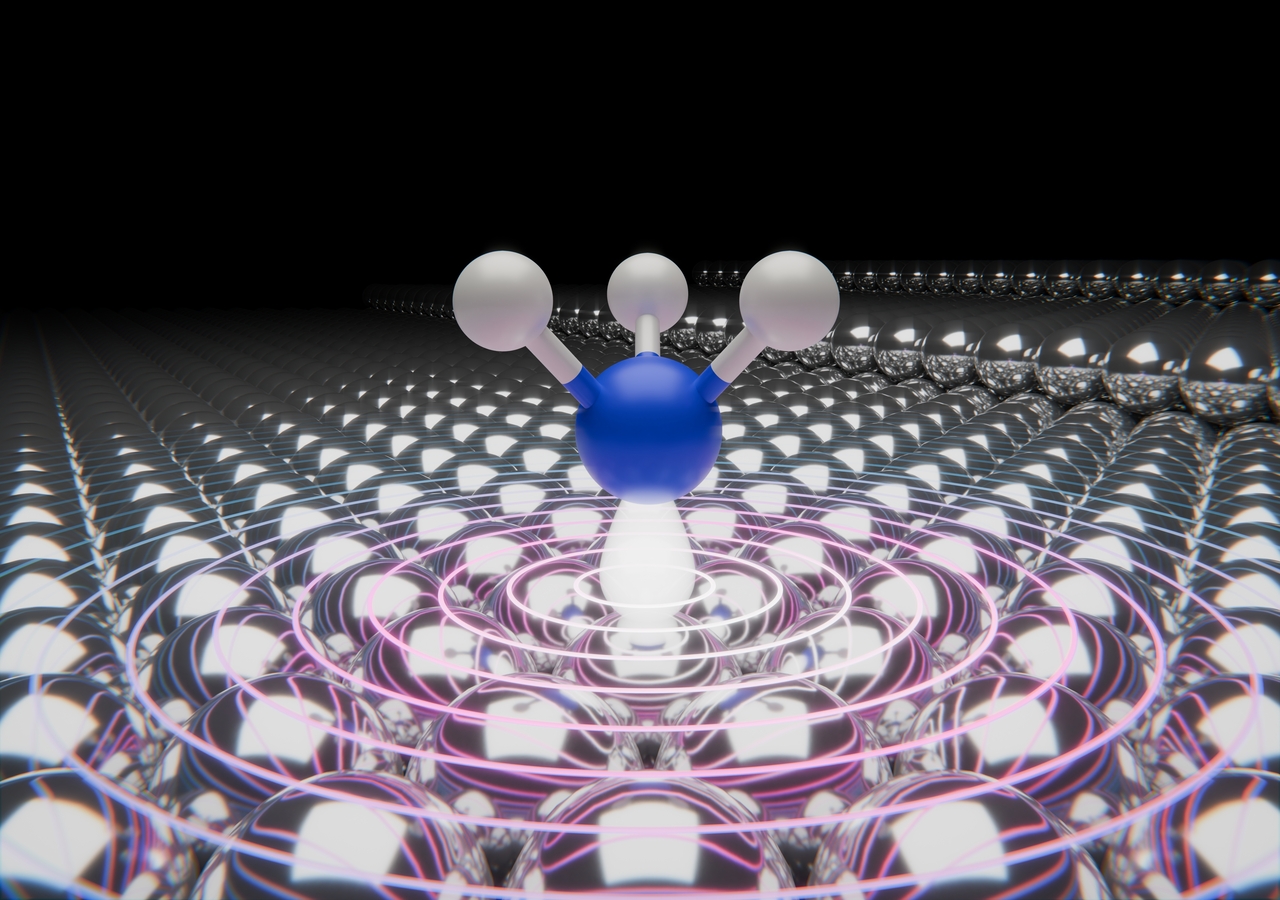
Scientists have confirmed that when a molecule binds to a metal surface, atomic structures several nanometers away — not just immediately neighboring atoms — can influence the strength of that chemical bond. The finding pushes beyond the limits of conventional bonding theory and is expected to open new possibilities for designing high-performance catalysts with greater precision.
The Ministry of Science and ICT and the Institute for Basic Science (IBS) announced Thursday that a joint research team from the IBS Center for Quantum Nanoscience and Germany's Max Planck Institute for Multidisciplinary Sciences had experimentally confirmed long-range electronic effects in chemical bonding on metal surfaces. The findings were published Thursday in the international journal Science.
Metal catalysts are essential materials that accelerate chemical reactions. They are used across a wide range of industries, from the production of ammonia — a key ingredient in chemical fertilizers — to fuel manufacturing.
The scientific community had long held that bonds between molecules and metals are determined primarily by the atoms in direct contact. While it was known that distant atomic structures could affect electrons, the prevailing view was that such effects had little practical impact on actual bond strength.
The research team fabricated a platinum surface with atoms arranged in a staircase-like pattern and varied the spacing between the steps, then precisely measured the bond strengths of ammonia (NH₃), carbon monoxide (CO) and nitric oxide (NO) molecules.
As a result, the team found that even when the atomic structure at the bonding site was similar, bond strength varied depending on the distance to the surrounding steps.
In particular, the range over which distant atomic structures exerted influence extended approximately 4 to 7 nanometers, depending on the type of molecule — roughly the distance spanned by tens of atoms placed side by side.
The difference in binding energy reached a maximum of about 0.2 electron volts (eV), a magnitude sufficient to alter how stably a molecule adheres to the metal surface.
The research team also identified the cause of this phenomenon: interactions among electrons spread broadly throughout the metal.
Electrons inside a metal are not fixed to individual atoms but are distributed across a wide area. When a molecule attaches to the metal surface, its electrons interact with those spread throughout the metal, causing the influence of distant atomic structures to be reflected in the chemical bond.
In other words, chemical bonding is not solely a matter of the atoms a molecule directly touches, but the result of electronic interactions spanning a broad region of the metal surface.

To explain the phenomenon, the research team also proposed a new theoretical framework called the Frontier Orbital-Band Model.
The model combines the molecular orbital concept from chemistry with the electronic band concept from physics. It explains why long-range effects vary by molecule type even on the same metal surface — because each molecule has a different electronic state and interacts with different electronic states within the metal.
The study is significant in that it quantitatively confirmed long-range electronic effects that had not been adequately accounted for in conventional catalyst design.
In particular, considering both the atomic arrangement and the electronic structure of a catalyst surface together is expected to enable more accurate predictions of molecular bond strength, with potential applications in developing new catalyst materials.
"Catalyst development in the past relied on lengthy experimentation and trial and error, but we are now moving toward predicting and designing desired properties based on the underlying principles of chemical reactions," said Dmitriy Borodin, group leader at the IBS Center for Quantum Nanoscience. "We expect this research to contribute to more sophisticated calculations and efficient catalyst design."
nbgkoo@heraldcorp.com




