
July saw forced selling; October has a buyer vacuum
Foreign selling, end of buybacks converge
SK hynix announces 20 trillion won in new buybacks, but sustainability in question
Wealthy investors buying in tranches, keeping 30–40% in cash
Reducing leverage, rebalancing on any bounce
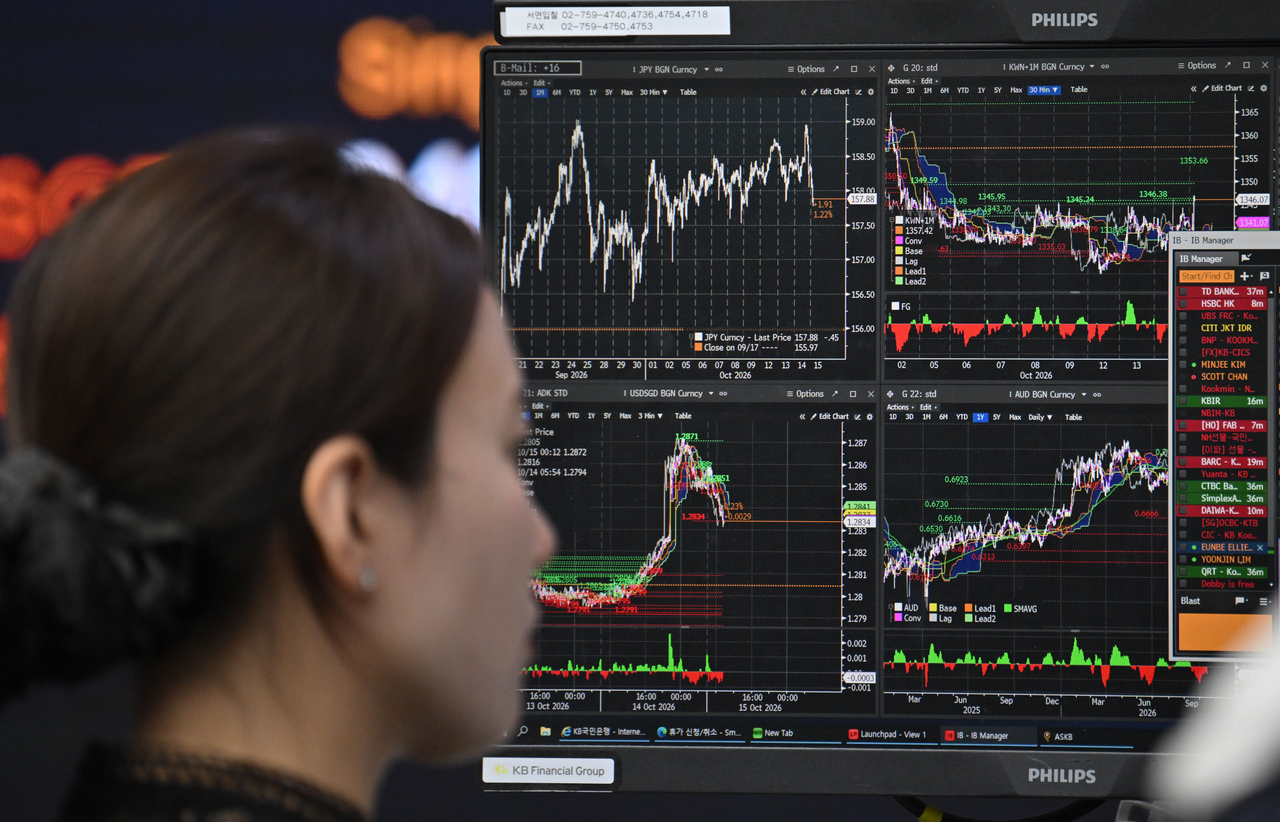
"Hold on and it will come back." That was the lesson the July crash left investors. But the October crash, arriving barely three months later, is making people question it.
What has changed is how the market is read. In July, investors waited because they expected a V-shaped rebound. In October, they are waiting because no one can promise one will come. Private bankers at brokerage firms say the strategy among their wealthiest clients has shifted — from "how cheaply can I buy?" to "how long can I hold out?" Rather than rushing to buy the dip, big-money investors are focused on preserving cash for the next opportunity, whenever it arrives.
The shock has been comparable in scale. Kospi fell 18.8 percent from 6,838.04 at the end of September to 5,554.22 on Oct. 15, dropping 7.57 percent in a single session that day and triggering a circuit breaker during trading. The decline from Oct. 1 to Oct. 16 — 17.11 percent — was the steepest among major global markets over that period, with 68.8 percent of listed stocks falling. Samsung Electronics lost 19.74 percent and SK hynix dropped 28.38 percent. On Monday, Kospi slid further to 5,469.47, its lowest level in roughly six months.
Yet the two crashes differ in a fundamental way. In July, sellers drove prices down. In October, prices are falling because buyers have disappeared. The surface-level drop looks similar, but the market mechanics are entirely different — and understanding that difference explains why big money is sitting on cash right now.
July had too many sellers; October has too few buyers
Look back at July. Chipmakers were actually seeing their earnings forecasts revised upward, yet share prices kept falling. The culprit was an invisible wave of forced selling.
Leopold Aschenbrenner's hedge fund had taken on leverage of up to four times on AI infrastructure stocks before facing margin calls from its prime broker and offloading most of its listed holdings to Citadel. In Korea, single-stock leveraged products and forced liquidations on margin accounts amplified the decline.
As prices fell, investors who had borrowed to buy faced margin calls they could not meet, triggering forced liquidations. Those sales pushed prices lower, setting off more forced selling in a vicious cycle. The problem was not a sudden deterioration in corporate fundamentals — it was a market crushed by supply that had to be sold.
The numbers bore this out. Kospi fell 17.2 percent over the three sessions from July 28 to July 30, then surged 17.91 percent in a single day on July 31 and fully recovered its losses within 10 trading sessions by Aug. 13. Once the forced selling was exhausted, prices snapped back quickly. The structure was one where removing the sellers was enough to trigger a rebound.
Private banking centers were flooded with sell inquiries at the time, but experienced wealthy investors largely held firm. The panic selling came mainly from latecomers — people who had liquidated real estate and savings deposits to enter the market just before the crash. Established investors, judging that the long-term growth outlook for their holdings had not materially changed, either held their positions or used a portion of their cash to buy the dip. In the end, those who waited won.
October is the opposite. The bigger problem this time is not the volume of forced selling but the absence of buyers willing to absorb it. If there is no buying pressure to soak up the supply hitting the market, prices can keep falling no matter how far they have already dropped. In a word: a demand vacuum.
Four factors explain why that vacuum formed. First, aggressive foreign selling. Foreign investors net sold 17.72 trillion won ($13.3 billion) from Kospi over the 10 trading sessions from Oct. 1 to Oct. 16, with 80 percent of that concentrated in Samsung Electronics and SK hynix. Concerns about oil prices, exchange rate instability and doubts about the durability of AI investment all converged. With the semiconductor heavyweights that have led the domestic market becoming the primary targets of foreign selling, the broader market buckled.
Second, the firewall that had been absorbing foreign selling disappeared. The main force cushioning the foreign selling offensive since September was buying by other corporations — a category that included the buyback programs of Samsung Electronics and SK hynix. Without those large-scale repurchases, the impact of foreign selling on share prices would likely have been far more direct. The fact that the index barely moved in September is better understood as the effect of that absorption than as any new upward catalyst.
Samsung Electronics then completed its roughly 15 trillion won buyback program early on Oct. 6, and SK hynix finished its 40 trillion won program as well. Together, the two companies deployed 55 trillion won. Given that the two stocks account for roughly half of Kospi's total market capitalization, the shift in supply-demand dynamics from the end of those programs cannot be dismissed.
Wednesday's announcement by SK hynix of a new 20 trillion won buyback plan has changed the picture somewhat, but how quickly and consistently broader market buying pressure recovers remains to be seen.
Third, retail investors have run low on firepower. A correction stretching back to late June has left many individual investors sitting on losses. Investor deposit balances and cash management account holdings have shrunk, and trading volume has fallen noticeably. A sharp price decline may look like a buying opportunity, but investors who have already committed substantial capital to equities have little room to add more.
Fourth, the role of pension funds has limits. The National Pension Service widened its permissible range for domestic equity holdings in May from plus or minus 3 percentage points of its target allocation to plus or minus 6 percentage points, effectively deferring rebalancing. National Pension Service Chairman Kim Seong-ju told a national audit session on Oct. 14 that without the deferral, the fund would have had to sell 800 billion won worth of shares a day. That meant avoiding selling pressure during the rally — but it also meant the fund had limited capacity to provide support during the crash.
On top of all this, credit risk in AI investment acted as a trigger. The corporate bond yield of CoreWeave, a US cloud computing company, surged to 15.06 percent. A sharp drop in bond prices and a spike in yields signal that investors have begun pricing in significantly higher credit risk for the company.
Until recently, markets focused on how much capital was flowing into AI and how fast the industry could grow on the back of that investment. Now the question has changed. It is no longer "how much is being invested in AI?" but "can those investments generate enough cash to service the debt?" Separate from the long-term growth potential of AI, doubts are growing about the cash-generating ability of companies that have borrowed heavily to build out data centers and infrastructure.
The macroeconomic backdrop adds further pressure. US consumer prices rose 3.7 percent year-on-year in September, above the market consensus of 3.6 percent. Gasoline prices jumped 9.1 percent within a month. With inflation anxiety flaring again, the yield on the 10-year US Treasury note climbed as high as 5.278 percent at one point. Higher bond yields reduce the incentive to take on the greater risk of equities, and the burden falls hardest on companies whose share prices already reflect high expectations for future growth.
The result is an uncomfortable situation: too many unsettling variables to justify buying, while selling pressure keeps coming. That is the defining difference between July and October. In July, the rebound only required the selling to stop. In October, a rebound requires new buyers to show up. Forced liquidations eventually end, but a demand vacuum persists until investors willing to fill it emerge. That is why a V-shaped rebound like July's cannot simply be assumed just because prices have fallen sharply.
Big money abandons V-shaped rebound hopes, keeps 30–40% in cash
The changed market is written directly into how wealthy investors are behaving. On the surface, their actions in July and October look similar: no rush to sell, caution about buying the dip. But the reasons for waiting and the way cash is being managed differ in clear ways.
In July, the strategy was to hold on until the rebound came. The portfolios private bankers recommended at the time carried roughly 40 to 50 percent in growth assets, 20 to 30 percent in value and dividend assets, and 20 to 30 percent in cash equivalents. The approach was to hold domestic large-cap semiconductor and AI names alongside quality US stocks and gradually increase the growth allocation during the correction. With the rebound arriving quickly after the crash, that aggressive asset allocation paid off.
In October, the same basic portfolio framework is being maintained, but with a higher cash weighting. Even when prices bounce, the emphasis is not on holding unconditionally — the strategy calls for selling a portion into any rally to rebuild the cash position.
According to private bankers, only a small share of their experienced wealthy clients have actually added to positions. Those who have bought are doing so in tranches rather than deploying their reserves all at once. Once prices rise past a certain level, they sell part of the position again to keep cash at 30 to 40 percent or more of the portfolio.
The reason these investors are holding cash is not simply that they expect prices to fall further. It is that they want to preserve the flexibility to adjust their strategy at any time, given how many unknown variables lie ahead.
Consider what happens if an investor deploys all available reserves because prices have dropped 20 percent, and then prices fall another 10 to 20 percent. Even if the investor believes in the company's long-term growth, there is nothing left to add, and the only option is to sit with the loss until a rebound arrives. By contrast, an investor who deployed capital in tranches can respond to further declines and position for new opportunities once the market stabilizes.
The core point is this: a cheaper price alone is not enough reason to fire all remaining ammunition at once. In July, deploying cash and waiting roughly 10 days brought a reward. In October, no one can say when a rebound will begin or how long it will last once it does. Investors must now account for the possibility that ammunition spent cannot be reloaded.
That does not mean wealthy investors are simply sitting on idle cash. If a V-shaped rebound is unlikely, the period of holding cash could be long. As a result, there is a visible effort to generate some return while waiting to buy equities.
Products being discussed as alternatives include three-year Kospi-linked equity-linked bonds offering annual yields in the 5 percent range, interest rate-linked equity-linked bonds, long-short funds and short-duration bonds. The strategy is to keep capital available for equity investment while defensively deploying the portion not yet committed.
Interest in overseas assets is also growing. With the exchange rate falling back to the low 1,300-won range per dollar, there is demand to secure dollar-denominated assets at a more favorable rate than before. Some wealthy investors are considering a strategy of acquiring dollars at current levels and then buying US Treasuries in tranches once financial market volatility eases after the US midterm elections. Dollar-denominated annuity insurance products are also drawing attention.
None of this means investors should exit semiconductor and AI stocks entirely. Private bankers say reviewing the semiconductor weighting makes sense, but clearing it out completely risks missing the long-term growth opportunity in AI. The industry's growth drivers — strong memory chip prices and expanding AI demand — remain intact.
Investment criteria, however, need to change. As the CoreWeave case illustrates, believing in the long-term growth of the AI industry is a very different thing from believing any AI-related company is worth buying. Companies that continue to pour in capital without generating sufficient cash flow are vulnerable to sharp share price swings when funding conditions tighten. The time has come to focus on companies that prove their competitiveness through actual earnings and cash generation, not vague growth expectations.
Ultimately, the shift in strategy among big-money investors comes down to one thing: they are not abandoning high-potential assets, but they have become far more deliberate about when and how much to invest in them. In a market where confidence in a near-term rebound has evaporated, cash is no longer an inefficient, non-earning asset — it is the tool for enduring uncertainty and staying ready for the next opportunity.
What the market needs now is not the ability to call the bottom, but the ability to wait
The moves being made by big-money investors carry important lessons for retail investors as well. There is no need for individual investors to replicate the scale or risk tolerance of the wealthy. But the principle holds regardless of portfolio size: in an uncertain market, the priority is not fear of missing an opportunity — it is preserving the capacity to act when one arrives.
In a market like the current one, where sharp drops and bounces alternate, the greatest risk factor may be the impatience to recover losses quickly. The fact that prices have already fallen sharply does not mean the risk of further declines has disappeared.
Three principles stand out for retail investors. First, avoid leverage. In July, single-stock leveraged products and forced margin liquidations amplified the decline. In October, a new wave of leveraged dip-buying has appeared. In the first four trading days of October alone, overdraft balances at the five major banks rose by 1.56 trillion won. Forced liquidations from Oct. 1 to Oct. 15 totaled 333.9 billion won — 1.5 times the 219.1 billion won recorded across all of September.
The urge to recover stock market losses is natural. But buying more of a fallen stock with borrowed money is essentially a bet that prices will rebound quickly — a bet made with one's remaining investment capacity. If the rebound takes longer than expected or prices fall further, even stocks held with genuine conviction about long-term growth may end up being sold at the worst possible time.
As the July crash demonstrated, even a correct investment judgment is worthless if there is not enough capital to sustain it. Wealthy investors, too, are prioritizing reducing leverage on every bounce in a market this volatile.
Second, keep cash as designated ammunition — and do not spend it all at once. Holding a large cash position alone does not complete a safe investment strategy. If cash is fully deployed every time prices dip under the rationale of buying cheap, there will be nothing left when a genuinely better opportunity arrives.
In July, deploying some cash brought a quick reward. But in an October-style market, where buying pressure is thin, investors need to be prepared for a longer wait and further declines. Holding cash is not passive investing — it is an active strategy to keep options open even when the market moves differently than expected.
Third, rebalance mechanically when a target return is reached. In the current market, a bounce is more likely to attract sellers than to sustain itself. Investors who endured losses through the crash may begin selling once prices start to recover, either to cut losses or to recoup principal.
With that kind of supply waiting in the wings, even a sharp one- or two-day rally can stall quickly. Rather than expecting every bounce to extend further, investors should take partial profits and rebuild their cash weighting according to predetermined return targets and asset allocation rules. Securing cash on the way up is what makes it possible to respond when prices fall again.
None of this means unconditionally conservative investing. Opportunities to increase exposure to risk assets will arise depending on how conditions develop. What matters is not letting a large price decline alone be the trigger for that decision.
Rebound signals should not be read from a single day's index gain either. Investors should watch whether foreign net buying sustains for several consecutive sessions, whether investor deposit balances are recovering, and whether US Treasury yields are stabilizing. Concluding that the market's direction has changed requires evidence that durable capital — not just a temporary burst of buying — is returning to equities.
The demand vacuum will not last forever. But who will fill it, and when, is still unknown. Believing in the possibility of a rebound is different from being certain one is imminent. What is needed now is neither unconditional pessimism nor premature optimism — it is the patience to protect one's assets while waiting for the rebound and watching for confirmation that the market has genuinely turned. The more volatile the market, the more it is disciplined, unglamorous principles — not clever strategies — that preserve wealth.

th5@heraldcorp.com




