Sales surge 103% but shares fall 2.9% for fifth straight session
AMD, Broadcom rally as Nvidia's dominance faces cracks
Supply chain grip, talent retention, AI customer defection in focus
Analysts see value but flag leadership vacuum as discount factor
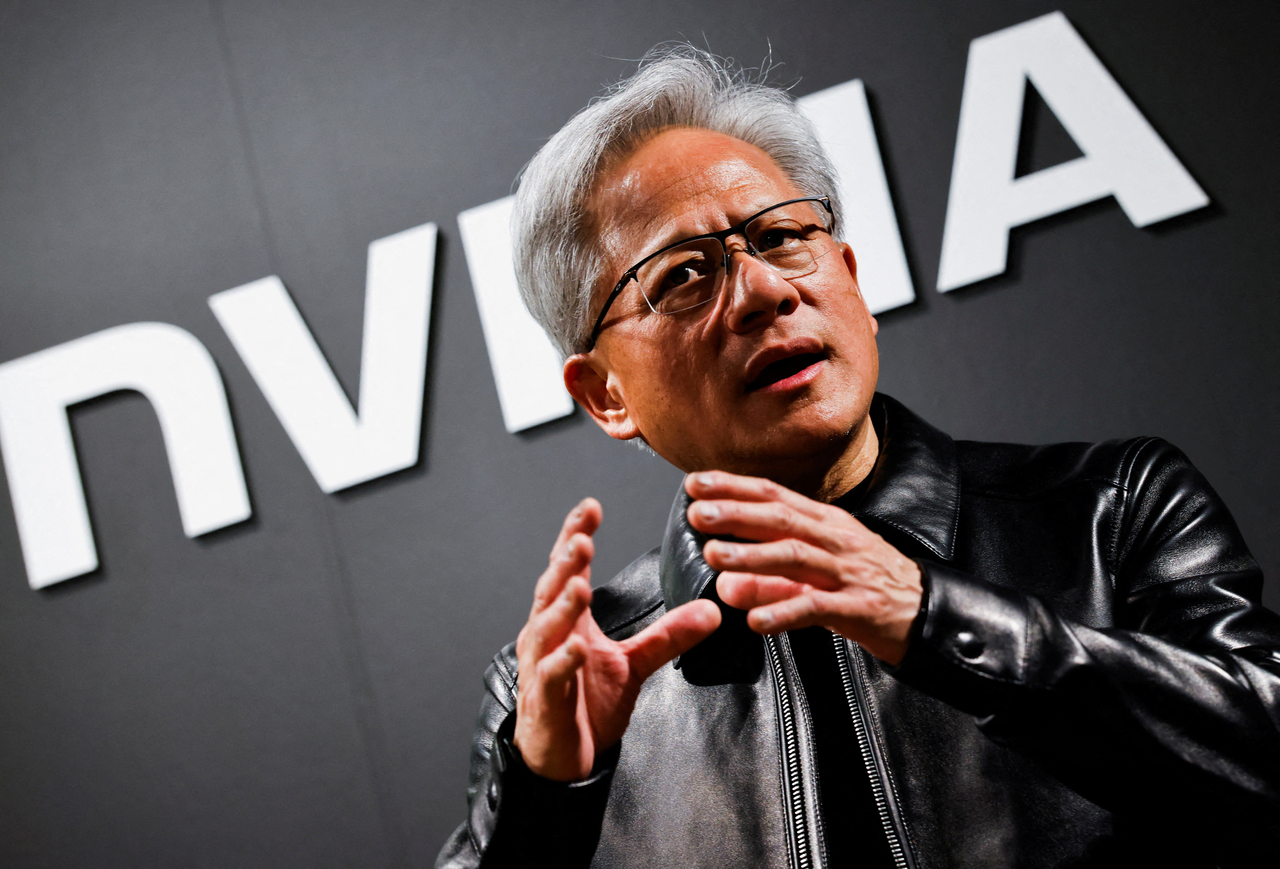
Uncertainty is growing over the future of Nvidia without Jensen Huang, as the AI chipmaker's shares extended their losing streak to five consecutive sessions despite blowout earnings that surpassed market expectations.
Analysts acknowledge the company's explosive earnings growth and the appeal of buying at lower prices following the recent share price drop, but say the long-term impact of losing founder and former CEO Jensen Huang on Nvidia's competitive edge warrants close attention.
Nvidia shares closed at $150.96 on Wednesday (local time) on the New York Stock Exchange, down 2.9% from the previous session, according to the financial investment industry. The stock has now fallen for five straight trading days, accumulating a 13.1% decline since Huang resigned on Nov. 12.
Nvidia's market capitalization has slipped to approximately $3.64 trillion. The company shed roughly $549 billion in market cap over the past five sessions alone. Compared with a month ago, the share price has fallen more than 30%.
Nvidia posted sales of $115.8 billion for the third quarter of fiscal year 2027, up 103% from a year earlier — roughly 6% above market estimates. The company guided for fourth-quarter sales of $130 billion and raised its fiscal year 2028 sales growth forecast to 75% from 70%.
Even so, the market appears more sensitive to management uncertainty than to Nvidia's earnings. Concerns are also emerging that the company's market dominance could be shaken as rivals gain momentum.
On the same day, Nvidia competitors AMD and Broadcom rose 5.3% and 3.6%, respectively, on the New York Stock Exchange. AMD competes directly with Nvidia in the data center GPU market, while Broadcom handles custom AI chip (ASIC) development for major technology companies.
With Nvidia's board having officially ruled out any possibility of Huang's return, maintaining the company's existing market dominance under new leadership has emerged as the central challenge. Because Huang personally drove not only technology development and business expansion but also relationships with key customers and partners, the transition may represent a more fundamental shift than a simple change of management.
Park Je-min of SK Securities identified three risk factors that warrant close monitoring: Nvidia's grip on its supply chain, retention of key talent, and the growing influence of major AI developers.
The first concerns the impact on Nvidia's supply chain and business partnerships. Huang maintained a close working relationship with TSMC, the world's largest foundry, for more than 30 years — a bond built on deep personal trust accumulated over decades.
"Jensen Huang said he never once signed a contract throughout the 30-year partnership with TSMC," Park said. "That reflects a company that actively embraced an Asian style of doing business grounded in mutual trust." Park added that "the gap in dominance makes it easier for ASICs and AMD to penetrate the market."
The concern is that if Huang's departure weakens Nvidia's hold over its supply chain and key customers, rivals will have more room to expand their market share. There is also a possibility that customers who relied on Nvidia could diversify their supply by turning to in-house AI chips or AMD products.
The second risk is the potential departure of key talent. Nvidia is a company Huang led for 33 years, maintaining a distinctive organizational structure in which roughly 60 executives reported directly to him and he made the major decisions himself.
Park said the loss of that central figure raises the possibility that key personnel could be unsettled during any organizational restructuring under new leadership. Park also noted that the company offered only general answers when analysts asked about talent retention.
In a sign of internal unease, more than 6,700 people who identified themselves as current Nvidia employees have reportedly signed a petition called "Stand with Jensen" calling for Huang's return — a significant number relative to the company's total workforce of roughly 40,000.
The third risk is the growing influence of major AI developers. Nvidia has dominated the AI ecosystem through its GPUs and its proprietary software platform CUDA, but competition is intensifying as big technology companies develop their own chips.
Park highlighted that Anthropic is reducing its dependence on CUDA by using Google's Tensor Processing Units (TPUs) and Amazon's Trainium chips. As AI developers gain more chip options, Nvidia's market dominance and profitability could weaken, the analysis suggests.
Analysts broadly agree that Nvidia's earnings and valuation remain attractive, but say the leadership vacuum left by the founder's departure cannot be resolved by strong earnings alone.
Kim Se-hwan of KB Securities maintained an "overweight" recommendation, saying "the first earnings without him are still strong," but separately flagged "remaining variables — commitments, guarantees and the management vacuum" as reasons for caution.
Nvidia's total future commitments — combining purchase obligations, leases and equity investments — stand at $518 billion, while maximum guarantee exposure reaches $118 billion. Analysts say the appointment of a new CEO, a board investigation and US Commerce Department export controls remain as discount factors for the company's valuation.
Jo Jae-un of Daishin Securities also gave a positive assessment of Nvidia's strong earnings and solid growth outlook, but said "the variable that earnings numbers cannot resolve is the CEO vacancy." Jo added that "since earnings and forward indicators improved further this quarter, the near-term share price will be driven more by the timing of a new CEO appointment than by the earnings themselves."

th5@heraldcorp.com