
Korea Land and Housing Corporation moves to get ahead of security risks following financial sector hacking incidents
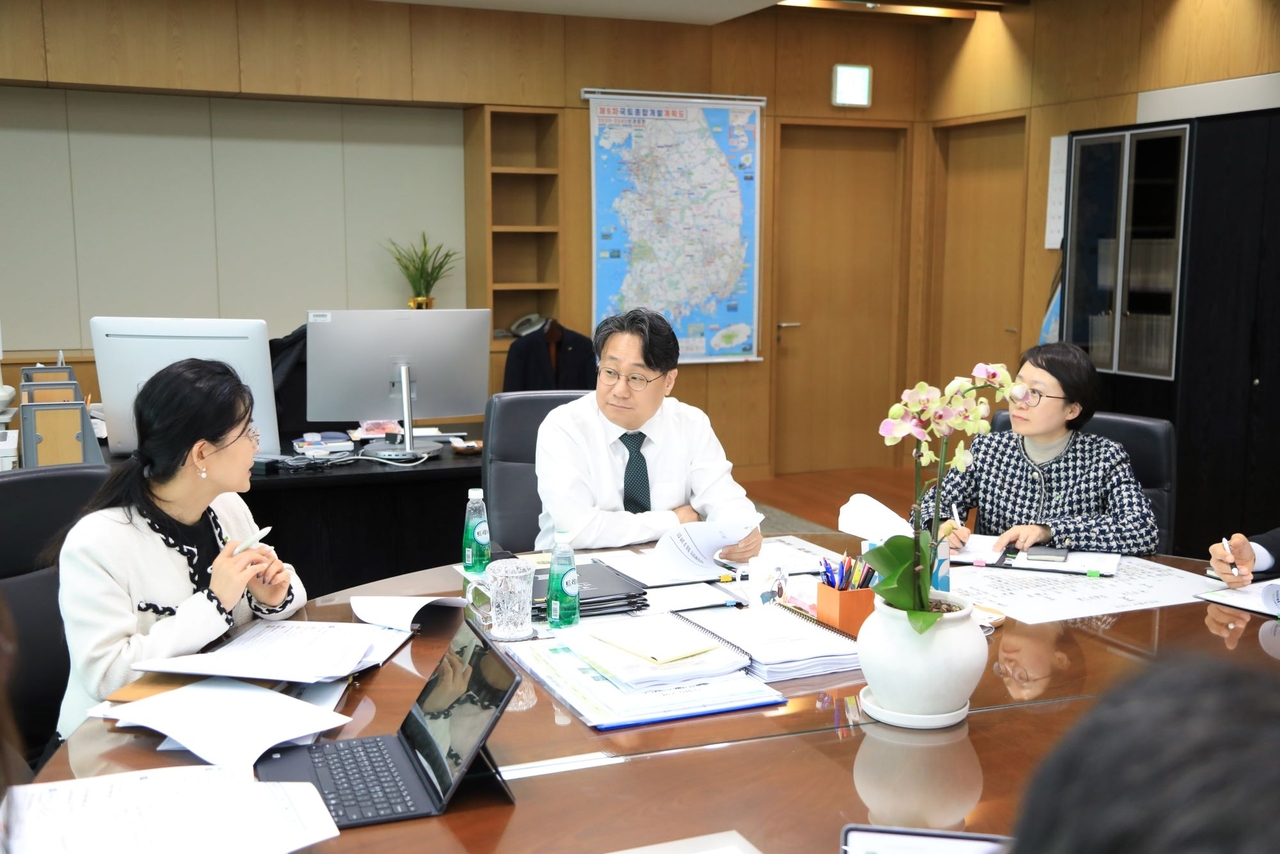
Korea Land and Housing Corporation said Thursday that President Lee Seong-hun chaired a cybersecurity review meeting at the corporation's headquarters in Jinju to strengthen defenses against cyber threats.
The meeting comes as cybersecurity risks have been mounting, with a series of hacking incidents hitting the financial sector and a critical vulnerability discovered in PHP, a programming language used by roughly 70 percent of websites worldwide.
Lee convened the meeting to assess the corporation's cybersecurity response status and the state of its defense systems. Attendees included the heads of the information security division and key departments overseeing external information systems.
The meeting covered four topics: the results of emergency responses to the financial sector hacking incidents, the status of PHP vulnerability checks and remediation measures, key security issues affecting major information systems, and plans to build an AI-based security platform.
Participants focused particularly on the emergency response to the financial sector hacking incidents. Following those attacks, LH immediately blocked suspicious IP addresses, conducted a full review of system access logs, incorporated AI-based attack patterns into its internal security systems, and stepped up monitoring of external access services.
The meeting also reviewed LH's response to a PHP security vulnerability alert issued by the National Intelligence Service on Oct. 22. The corporation had checked all of its information systems for PHP usage immediately after the alert and examined the status of emergency remediation measures, including security patches for affected systems.
"As an institution providing large-scale public services closely tied to people's daily lives — including housing supply and apartment subscriptions — protecting information assets is our most critical responsibility," Lee said. "I ask that you raise our level of information security to meet increasingly sophisticated cyber threats, and spare no effort in identifying and blocking every security risk before it materializes."
Meanwhile, LH strengthened its zero-trust security framework last year. Zero trust is a security principle that protects devices and networks by treating all access requests as untrusted by default and requiring continuous verification.
This year, the corporation completed an automated platform for checking information system vulnerabilities. Building on the results of Thursday's meeting, LH plans to advance an AI-based upgrade project to actively counter increasingly sophisticated cyber threats. The corporation had earlier introduced "AI Frontier," an internal network of AI innovation talent aimed at leading AI adoption across its operations and spreading a culture of AI use throughout the organization.
hss@heraldcorp.com




