
- KBSI study finds ursolic acid improves learning and memory in mice
- Compound reduces brain inflammation, oxidative damage and protects synaptic connections

A natural compound found in apple peels and medicinal herb leaves can reduce brain inflammation and prevent memory decline, a new study has found. Researchers confirmed that the substance suppresses damage to brain neurons and restores the synaptic connections critical to memory formation.
The Korea Basic Science Institute (KBSI) announced Thursday that a research team led by Kwon Hee-seok and Choi Ga-young of its Ochang Bio and Environmental Research Center had confirmed the brain inflammation-suppressing and memory-improving effects of the natural compound ursolic acid through animal experiments.
Ursolic acid, a natural compound found in apple peels and various medicinal herbs, is known for its anti-inflammatory and antioxidant properties. Whether it could protect the structure and function of neurons damaged by brain inflammation, however, had not been clearly established.
Brain inflammation is closely linked to degenerative neurological conditions such as Alzheimer's disease. When the brain's immune cells become overactivated, the resulting inflammatory response increases the production of reactive oxygen species, damaging neurons. This process can also impair the brain functions responsible for learning and memory.
The research team administered ursolic acid to mice in which brain inflammation and cognitive decline had been induced, then analyzed behavioral changes and brain tissue.
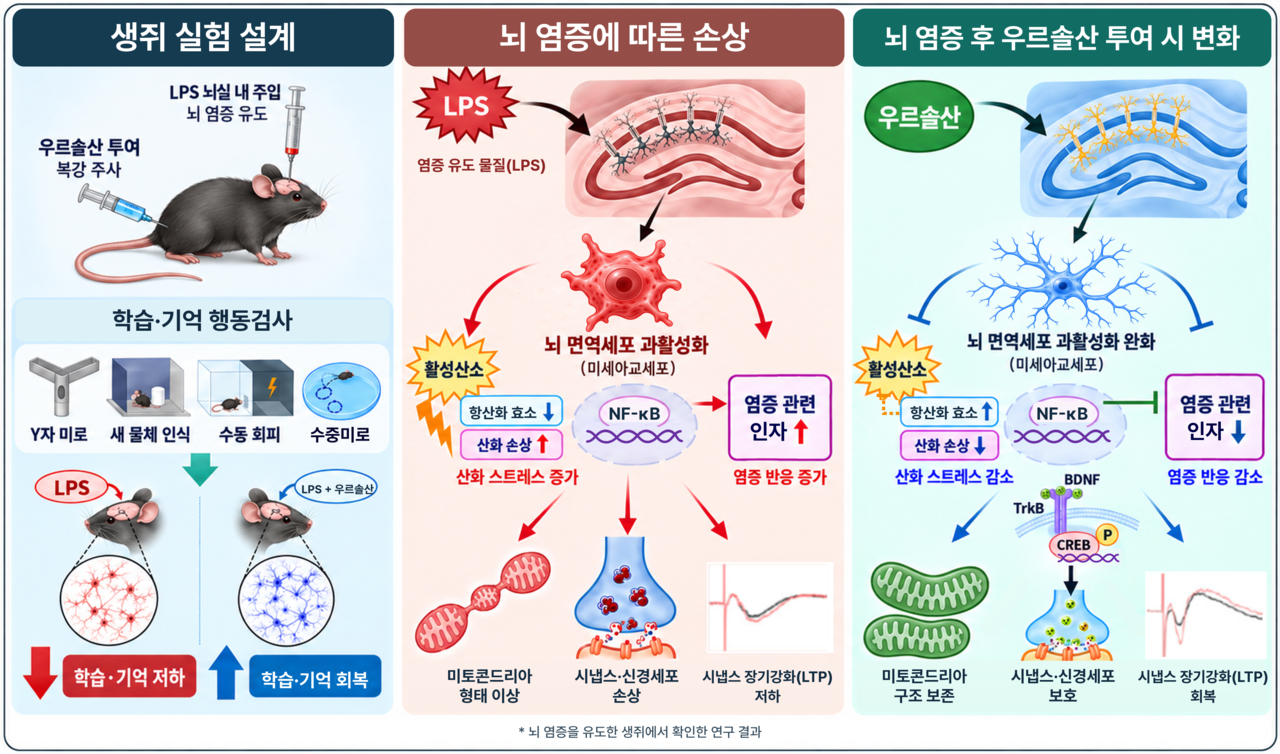
As a result, mice that received ursolic acid showed improved ability to remember specific locations and to distinguish between new and familiar objects.
Marked changes also appeared in the hippocampus, the brain region central to memory formation. Excessive activation of microglia — the brain's immune cells — was suppressed, and levels of inflammatory substances and oxidative damage fell. The activity of antioxidant enzymes that neutralize reactive oxygen species also recovered.
Synaptic function also improved — synapses being the connections through which neurons exchange information. The strengthening of synaptic signal transmission is the core mechanism by which learning and memory are formed.
The research team also used KBSI's advanced transmission electron microscope and three-dimensional imaging technology to observe changes in the fine internal structures of neurons.

In mice treated with ursolic acid, synaptic structures were well preserved, and abnormal fragmentation of mitochondria — the organelles responsible for cellular energy production — as well as their beading into chain-like formations, were also reduced.
The findings suggest that ursolic acid does more than simply suppress brain inflammation: it may also protect the structure and function of neurons at the same time.
However, the study was conducted at the animal-experiment stage, and further verification is needed to determine whether the same effects would occur in humans.
"We confirmed the comprehensive mechanism by which ursolic acid protects the structure and function of neurons under conditions of brain inflammation," Choi said.
"It is particularly significant that we were able to directly observe three-dimensional changes in mitochondrial connectivity and morphology using advanced electron microscopy," Kwon said.
The findings were published online Sept. 8 in Phytomedicine, an international journal covering natural products and pharmacology.
nbgkoo@heraldcorp.com




