
Event co-hosted with Ministry of Trade, Industry and Energy marks first Engineers' Day
Minister Kim Jung-kwan and experts to join panel discussion
"In an era where AI designs and runs experiments, how do we cultivate engineers who can identify problems on their own?"
The National Academy of Engineering of Korea will co-host the inaugural Engineers' Day with the Ministry of Trade, Industry and Energy on Friday at the National Assembly Members' Office Building in Yeouido, Seoul, where it will publicly unveil "Korea Engineering's Big Question 10" — ten defining questions for South Korean engineering to answer.
The academy drew the final ten from a pool of 55 candidate questions proposed across eight specialist divisions, incorporating member feedback and a rigorous review by an expert selection committee. The questions reflect the industrial and social challenges South Korea faces and the role engineering must play in addressing them.
The academy said the selection went beyond a simple vote-count ranking, taking into account the engineering significance of each question, its industrial and economic impact, its forward-looking relevance, cross-disciplinary balance and social importance.
In the "Intelligence and Semiconductors" category, key challenges include developing next-generation semiconductors that boost AI performance while cutting power consumption, and building a competitive edge in specialized AI by leveraging South Korea's manufacturing capabilities and industrial data. The spread of autonomous AI and physical AI also raises pressing questions about control, accountability and safe human-robot collaboration.
The "Life and Materials" category focuses on the challenges of a super-aged society and resource dependency, asking how engineering can help predict aging and dementia early and support healthier lives.
The "Energy and Infrastructure" category addresses how to secure a stable energy supply while simultaneously managing rising power demand, reducing carbon emissions and safeguarding energy security. It also asks how to assess the risks posed by aging infrastructure and design systems resilient enough to maintain essential functions through climate disasters.
The "Innovation Systems and People" category asks how South Korea can cultivate engineers who go beyond finding answers to given problems — engineers who can define new problems themselves and devise original solutions in an age of AI.
The event was organized around the idea that South Korean engineering, which has long driven industrial growth through technological catch-up and advancement, must now take on a new role: defining the problems of the future and creating new industrial and social value.
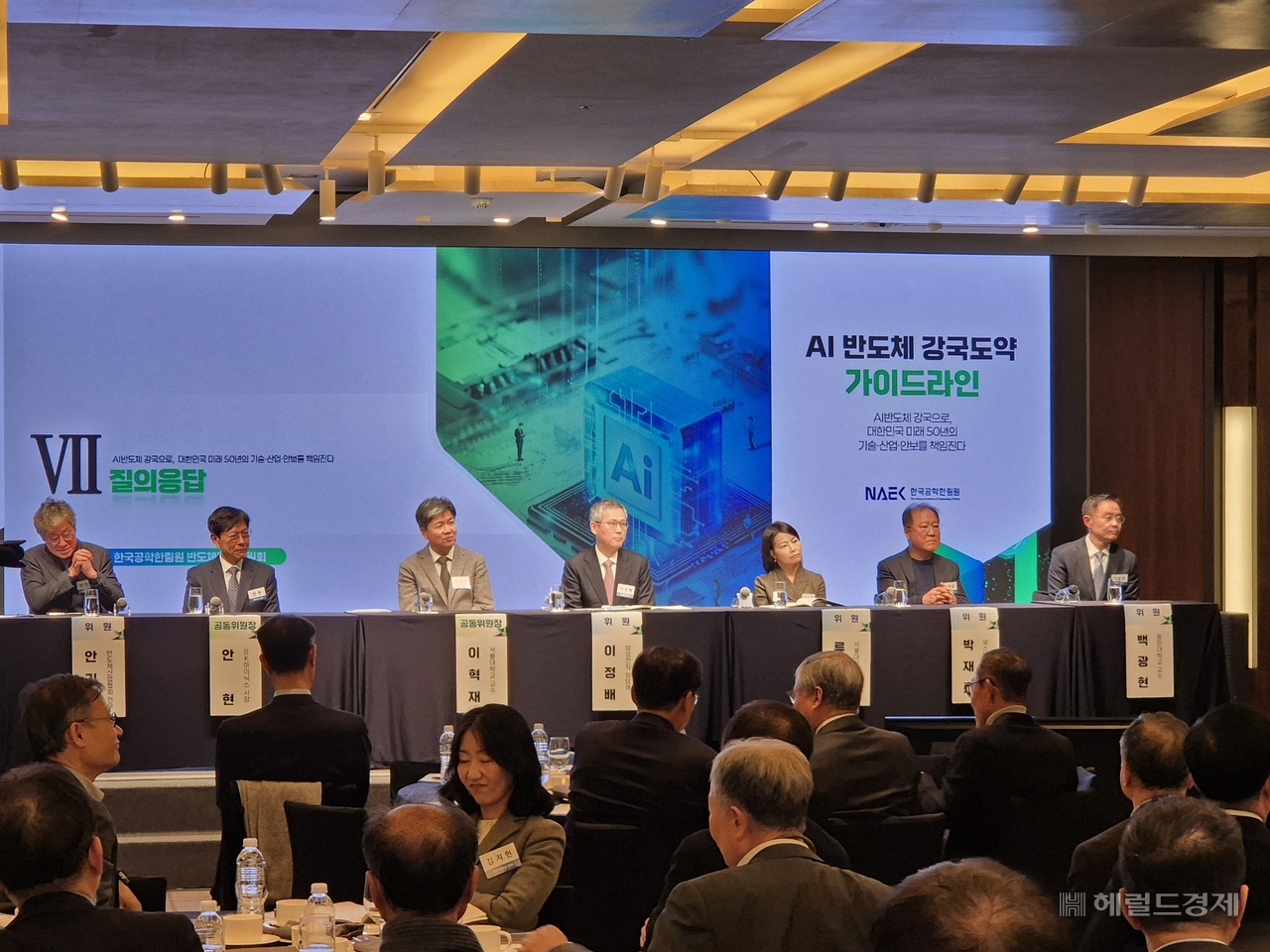
At the talk concert, Ahn Jun-mo, director of the academy's Policy Research Center, will serve as moderator. Minister of Trade, Industry and Energy Kim Jung-kwan will join academics, industry representatives and young researchers for a panel discussion centered on the safety and productivity of physical AI, the development of South Korea's next core industrial technologies, and the direction of engineering innovation and support.
"Korea Engineering's Big Question 10 is a starting point for asking together what future South Korea should prepare for and what engineering must solve," said Yoon Eui-joon, president of the National Academy of Engineering of Korea. "Going forward, we will prepare expert explanations and follow-up content for each question and develop them into shared agenda items that academia, industry, society and government can explore together through forums and policy discussions."
[Korea Engineering's Big Question 10]
I. Intelligence and Semiconductors
① How can Korean semiconductors use less power while making AI smarter?
② In the global AI race, in which fields can South Korea seize the lead?
③ As AI takes over human tasks, how do we control it — and who is responsible?
④ As physical AI works alongside people, how can it do so safely while raising productivity?
II. Life and Materials
⑤ Beyond the limits of aging and dementia, what can engineering do to help everyone live a healthy life?
⑥ How can we stably supply the materials industry needs while reducing dependence on oil and critical minerals?
III. Energy and Infrastructure
⑦ For a country that imports more than 90 percent of its energy, how can it secure a stable supply while protecting both the economy and the environment?
⑧ As national infrastructure ages all at once, how should it be repaired and redesigned to sustain daily life even through climate disasters?
IV. Innovation Systems and People
⑨ How can South Korea cultivate its next core industrial technologies that the world will need?
⑩ In an era where AI designs and runs experiments, how do we cultivate engineers who can identify problems on their own?
joze@heraldcorp.com




