
360-degree imaging and light-transmission scans detect defects
YJ Food in Pyeongtaek sorts up to 1.44 million eggs a day
AI analysis data to be shared with farms to improve quality
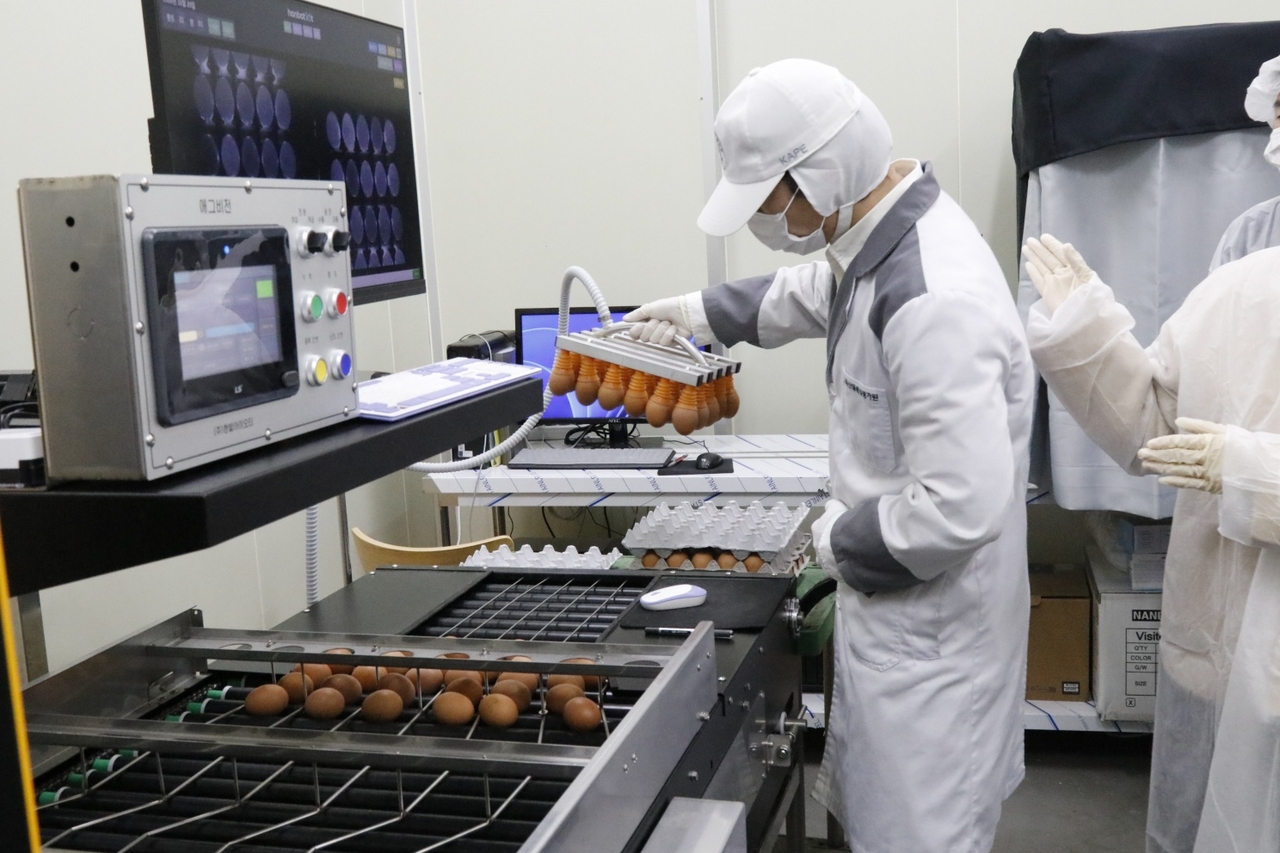
Artificial intelligence can now detect even the faintest hairline crack in an eggshell. The system photographs eggs from multiple angles and shines light through them, analyzing the resulting images to identify contamination or fractures. What was once a visual inspection carried out by human eyes is giving way to AI-driven precision measurement.
At YJ Food, an agricultural corporation in Pyeongtaek, Gyeonggi Province, AI-based egg quality assessment equipment is already in use for full-scale grading operations. The company took part in a pilot program with the Korea Institute for Animal Products Quality Evaluation last year to test the AI grading system and help establish its evaluation framework, and has been running full AI-based grading since this year.
The AI equipment photographs each egg's exterior from four directions to capture the entire shell surface. It analyzes the images to assess cleanliness and detect any abnormalities, then assigns a quality grade from A to D.
A separate light-transmission scan checks for shell cracks. The AI analyzes the transmitted-light images to identify hairline fractures or breaks that would be difficult to spot with the naked eye. Results are displayed on screen alongside the measured values.
AI does not, however, determine every quality grade on its own. Egg grading draws on three assessments: an exterior inspection, the light-transmission scan, and a breaking test in which the egg is cracked open so its interior can be examined.
The breaking test evaluates the flatness of the yolk and the condition of the albumen. Haugh Units — a measure of freshness calculated from the egg's weight and the height of the thick albumen — are also assessed. Based on these combined results, eggs receive a grade of 1+, 1 or 2.
YJ Food is an affiliate of Yangji, founded in 1969. It sorts, processes and packages eggs produced on its farms and supplies them to retailers, food manufacturers and restaurant chains. Last year's sales reached 115 billion won ($86.1 million), and the company employs 95 people.
The Pyeongtaek facility operates three egg-sorting machines. Running eight hours a day, they can sort up to 1.44 million eggs.
Sorters No. 1 and No. 2 handle 960,000 raw eggs per day. Sorter No. 3, a new machine dedicated to processed eggs installed this year, handles up to 60,000 eggs per hour, or up to 480,000 per day.
In 2024, the company automated its egg collection center and introduced a manufacturing execution system. This year, it added the processed-egg sorter and completed a 1,254-square-meter expansion wing.
Another role of AI quality assessment is to build up farm-level quality data. Where the system previously stopped at identifying defects and cracks, the institute now plans to share AI analysis data directly with farms so it can be used to improve quality at the production stage.
The institute is developing a feedback model that analyzes each farm's rates of cracked and defective eggs and provides guidance on improving feeding management and egg collection and handling practices.
Retailers will also receive quality data to help them secure a stable supply of consistently graded eggs. The institute also plans to develop technology linking egg-sorting machines with AI grading equipment to enable real-time grading.
adastra@heraldcorp.com




