
Forum held for second National Participation Growth Fund managers
Performance monitoring and management strategies discussed
About 33,000 subscribers; 630 billion won in total assets
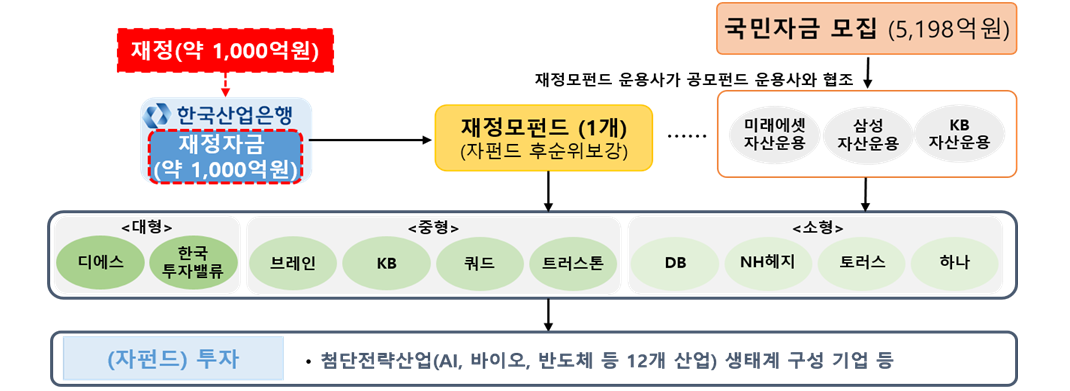
The second National Participation Growth Fund is set to deploy a total of 630 billion won ($471 million), combining retail investor contributions and government fiscal funds. Financial authorities addressed recent concerns about weak early returns from the first fund, explaining the structural characteristics of the five-year closed-end product — which includes unlisted shares — and urging investors to take a long-term view.
The Financial Services Commission held a forum Thursday for managers of the second National Participation Growth Fund at the Korea Financial Investment Association in Yeouido, Seoul, chaired by FSC Vice Chairman Shin Ji-chang. Korea Development Bank, Korea Growth Investment Corp. and the three public fund managers — Mirae Asset, Samsung and KB Asset Management — attended alongside the chief executives of 10 sub-fund management firms responsible for actual investment operations, to discuss investment strategies and performance management plans.
The National Participation Growth Fund is designed to let ordinary citizens invest directly in long-term public-private projects aimed at nurturing advanced strategic industries such as AI, semiconductors and biotech, allowing them to share in the gains. After the first fund, launched in May, sold out ahead of schedule, a second fund was added — originally unplanned — and went on sale Sept. 30, closing Oct. 15.
The second fund drew 32,756 subscribers, 2,718 more than the 30,038 who joined the first, raising about 520 billion won in retail investment. Combined across both tranches this year, total subscribers reached about 62,800 and cumulative sales hit about 1.12 trillion won.
Ten firms were newly selected as sub-fund managers for the second fund. They will each receive an allocation of the total 630 billion won — which combines retail investment and fiscal funds — and manage it according to their designated scale.
The ten firms are DS Asset Management, Korea Investment Value Asset Management, Brain Asset Management, KB Asset Management, Quad Asset Management, Truston Asset Management, DB Asset Management, NH Hedge Asset Management, Taurus Asset Management and Hana Asset Management.
The managers are required to invest at least 30 percent of the fund's committed capital in the form of new money into unlisted companies or Kosdaq technology-exception listed companies, and to channel at least 60 percent of committed capital — including that portion — into advanced strategic industries.
Vice Chairman Shin directly addressed criticism that the first fund's initial three-month return, reported at 0.5 percent as of Sept. 11 in a recently disclosed asset management report, was disappointing.
"The National Participation Growth Fund is a closed-end fund with a five-year maturity and is still in its very early stage of operation," Shin said. "Given the nature of advanced strategic industries, which require medium- to long-term investment, and the fact that capital is being diversified across various sectors and companies, it will take considerable time before tangible results emerge."
Shin added that the investment universe extends beyond listed shares to include unlisted equities and mezzanine instruments that are difficult to value immediately, meaning the timing of valuation differs by asset class. "It is therefore difficult to say that the current return rate fully reflects the fund's value," Shin said. "Rather than reacting to short-term fluctuations in returns, I ask that you take a long-term perspective and watch the fund and the companies grow together."
Shin also reiterated the safety mechanisms and incentive structures in place to reduce the burden on retail investors from long-term commitments. Subscribers receive an income deduction of 10 to 40 percent depending on the amount invested, along with a separate dividend income tax rate of 9.9 percent. The subordinated capital contributed by fiscal investors and sub-fund managers is structured to absorb losses of around 20 percent before any losses are borne by retail investors. Conversely, a performance-based incentive structure applies whereby managers share in a portion of excess returns if the fund performs well.
Shin invoked the concept of sharing the fruits of growth with the people and called on the fund managers to draw on their understanding of industry, their eye for promising companies, and their accumulated investment experience and networks to identify and support high-potential firms, so that the public can enjoy the rewards of growth together.
In response, the sub-fund managers said they would prioritize identifying and supplying new capital to companies at the early investment stage, serving as a catalyst for growth. They also said they plan to build well-balanced portfolios without overconcentration in any single stock, focusing their capabilities on companies with strong growth potential.
Going forward, a public fund consortium — comprising Korea Development Bank as the fiscal contributor, Korea Growth Investment Corp. as the fiscal mother-fund manager, and the three public fund management firms — plans to continuously monitor investment conditions, activate risk management systems and ensure the stable operation of the funds.
The first asset management report for the National Participation Growth Fund — managed by Mirae Asset, Samsung and KB Asset Management — showed a return of approximately 0.5 percent as of Sept. 11. The combined cumulative return across the 10 invested private equity funds stood at minus 6.48 percent.
jiyun@heraldcorp.com




