
Yonsei University's Jung Bo-young among researchers at wrap-up meeting on anticoagulation therapy for moderate-risk atrial fibrillation patients; DOAC cuts composite clinical event risk by 69% without increased bleeding; findings expected to inform guideline revisions and insurance coverage expansion
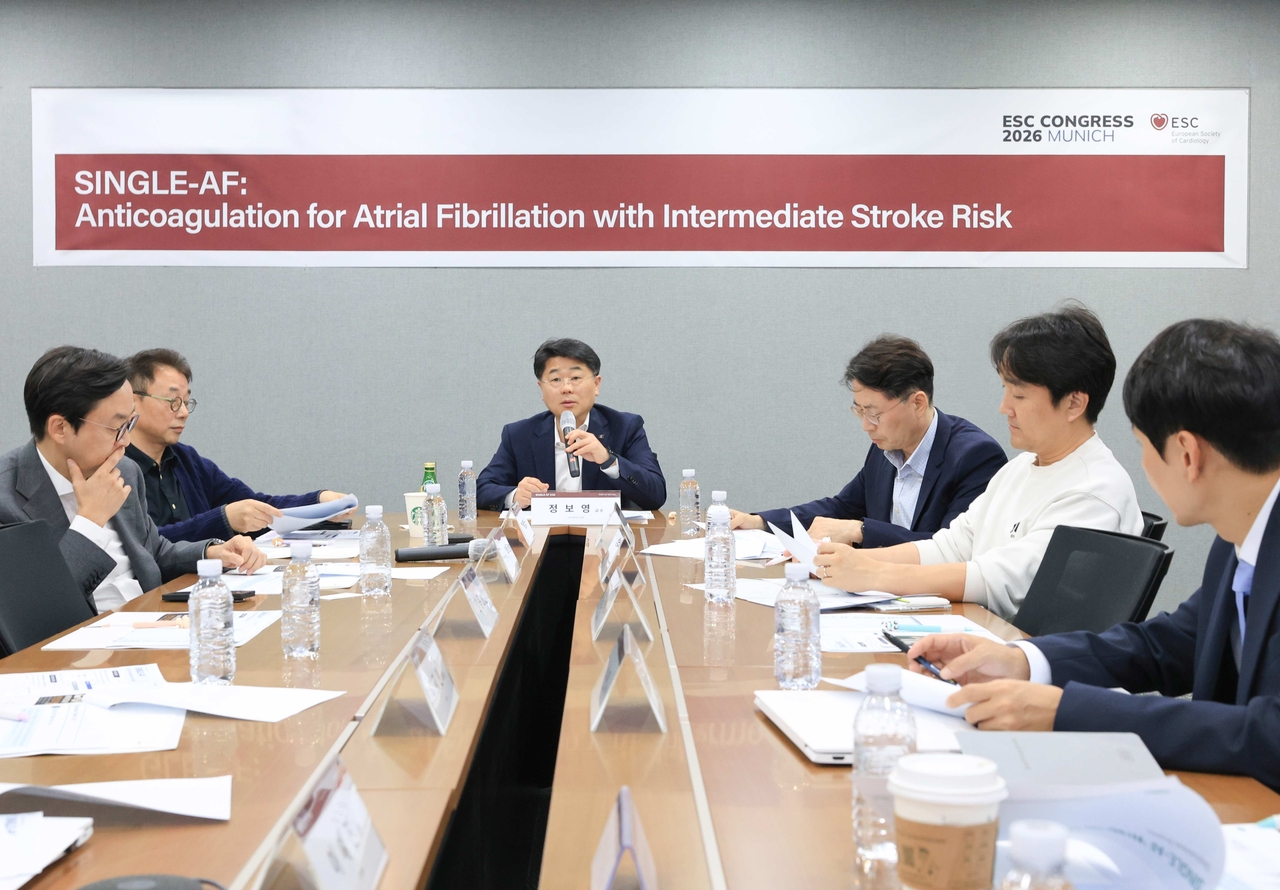
Samjin Pharmaceutical announced Thursday that it held a wrap-up meeting Monday at its Magok research center in Gangseo-gu, Seoul, to share results from the SINGLE-AF study — which the company supported — and to discuss how the findings could be applied in clinical settings.
The meeting was organized to review the study's presentation at the Hot Line session of the European Society of Cardiology Congress 2026, one of the world's most prestigious cardiology conferences, and its simultaneous publication in the New England Journal of Medicine, and to examine the clinical value of the results and pathways for their practical application.
Jung Bo-young, a professor of cardiology at Yonsei University's Severance Hospital and the study's principal investigator, attended along with other key members of the research team. The discussion centered on anticoagulation treatment strategies for atrial fibrillation patients at moderate stroke risk.
SINGLE-AF was an investigator-initiated, randomized controlled clinical trial conducted across 18 medical institutions in South Korea, enrolling 1,803 atrial fibrillation patients at intermediate stroke risk. Using the CHA₂DS₂-VASc score — a standard tool for assessing stroke risk — the research team enrolled patients who scored 1 (men) or 2 (women) and divided them into a direct oral anticoagulant (DOAC) treatment group receiving apixaban or rivaroxaban (902 patients) and a control group that did not receive the drugs (901 patients), following both groups for 24 months.
The cumulative incidence of the primary composite endpoint — comprising stroke, systemic embolism, major bleeding and cardiovascular death — was 0.5 percent in the DOAC group and 1.5 percent in the control group. The DOAC group showed a statistically significant 69 percent reduction in the risk of composite clinical events compared with the control group (HR 0.31, p=0.03). Stroke incidence was markedly lower in the DOAC group (0.3 percent) than in the control group (1.1 percent), while rates of major bleeding showed no significant difference between the two groups, demonstrating a preventive effect without an increase in bleeding risk.
Participants reviewed criteria for treatment decisions based on individual patient risk profiles and disease type, protocols for reassessment during follow-up, and the evidence needed to support future guideline revisions and insurance coverage discussions.
The study provides concrete treatment evidence for moderate-risk atrial fibrillation patients — a group for which clear clinical standards on anticoagulant use had not been established — and is expected to drive discussions on revising domestic and international guidelines and expanding insurance coverage criteria.
"The SINGLE-AF study offers new evidence for moderate-risk atrial fibrillation patients where a judgment on anticoagulation therapy is needed," Jung said.
Kim Sang-jin, president of Samjin Pharmaceutical, said it was meaningful to see another domestically conducted study supported by the company recognized through the ESC Hot Line, NEJM and JAMA, following the ALONE-AF and A-CLOSE studies. "We will continue to support research that generates the evidence clinicians need in practice and advances academic progress," Kim added.
silverpaper@heraldcorp.com




