
Special prosecutor: 'No reason to hesitate' on death penalty for destroying constitutional order
Defense: 'Only 280 unarmed order-maintenance troops deployed — there was no riot'
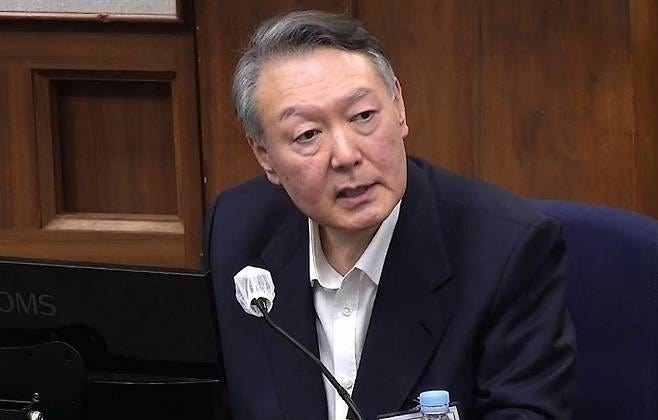
The special prosecutor's team investigating the Dec. 3 emergency martial law incident asked an appeals court Thursday to impose the death penalty — the maximum sentence under law — on former President Yoon Suk Yeol, who faces charges of leading an insurrection.
At the closing arguments of Yoon's appeal trial, held Thursday before the Seoul High Court's Criminal Division 12-1 (presiding judges Lee Seung-cheol, Jo Jin-gu and Kim Min-a), the special prosecution team formally sought the death penalty. The team had also sought the death penalty at the first trial, but the court sentenced Yoon to life imprisonment in February.
"The crime of leading an insurrection cannot be fully held to account by any sentence other than death," the special prosecution team said. "There is no reason to hesitate in imposing the death penalty."
The team said "the Dec. 3 insurrection launched by defendant Yoon Suk Yeol demolished every principle of common sense and every achievement of this nation's constitutional history," and that "the commander in chief, who had sworn to uphold the Constitution, instead dispatched troops bearing arms against the people." The team also said the "self-coup staged by an elected president plunged the entire nation into shock and horror," calling the Dec. 3 insurrection "an unforgivable act of constitutional destruction that sought to turn back South Korea's clock by 40 years."
The special prosecution team said the first-instance court, which sentenced Yoon to life imprisonment, had interpreted the preparation period and purpose of the emergency martial law too narrowly. "The lower court fell short of fully uncovering the full picture of the insurrection and holding the defendants accountable in proportion to their crimes," the team said. "It applied only half of the legal principles established by the Supreme Court, took a narrow view of when the insurrection was prepared and what its purpose was, and that error led to sentences far too lenient relative to the defendants' conduct."
The team particularly stressed that the emergency martial law was a crime planned well in advance over an extended period. "Even based solely on the facts the lower court acknowledged, the Dec. 3 martial law was an insurrection prepared over eight months — and if the notebooks the lower court overlooked are taken into account, the preparation period exceeds one year," the team said. "The Dec. 3 martial law was by no means a spontaneous event."
The team also pushed back against the factors the first-instance court had treated as mitigating circumstances in Yoon's favor. The lower court had cited, among other things, that the planning did not appear to have been carried out with extreme precision in advance, that the martial law ended quickly and that the military and police exercised restraint, and that a relatively small number of troops were mobilized.
"It was the soldiers and police on the ground who exercised restraint — not defendant Yoon Suk Yeol," the team said. "It was others, not Yoon, who prevented bloodshed." The team added that "the martial law ended quickly because the National Assembly passed a motion demanding its lifting — it was not that he chose not to act, but that he was unable to."
The team also said Yoon has shown no remorse. "The lower court noted that a so-called 'warning martial law' of the kind the defendant described cannot legally exist," the team said. "Yet defendant Yoon Suk Yeol has never once apologized to the people throughout the trial proceedings."
Yoon was indicted in January last year and has been held in detention since. Prosecutors allege that Yoon, in conspiracy with former Defense Minister Kim Yong-hyun and others, declared an unconstitutional and unlawful state of emergency martial law on Dec. 3, 2024, and dispatched troops and police to the National Assembly and the National Election Commission, among other locations, with the aim of subverting the constitutional order.
In February, the Seoul Central District Court's Criminal Division 25 (then presiding judge Ji Gwi-yeon) sentenced Yoon to life imprisonment at the conclusion of the first trial. The court found Yoon guilty of insurrection, determining that both key elements of the charge — the intent to subvert the constitutional order and the commission of a riot — had been established. The court rejected Yoon's argument that the martial law declaration was a "warning" or "appeal-style" measure. The special prosecution team appealed, arguing the lower court had insufficiently recognized the scope of the insurrection's preparation and purpose and had failed to adequately reflect the gravity of the offense in sentencing.
Article 87 of the Criminal Act prescribes the death penalty, life imprisonment, or indefinite imprisonment for the crime of leading an insurrection.
Defense attorneys for Yoon met with reporters after the prosecution's sentencing demand Thursday and criticized the special prosecution team. "There is no legal basis and no evidence," they said. "This sentencing demand laid bare the face of a political special prosecution that has sold its conscience to political power and does nothing but repeat arguments made to order."
"Watching the special prosecution's closing argument — which does nothing but repeat delusional, fictional claims — we once again witnessed the grim reality of the rule of law and the judiciary in South Korea crumbling," the defense said. The attorneys noted that the special prosecution had argued at the first trial that the purpose of the emergency martial law was a self-coup aimed at prolonged rule, but that the lower court had rejected that argument.
"And yet the lower court still found insurrection. It was a contradictory ruling — no coup, but insurrection," the defense said. The attorneys said the special prosecution had again, in Thursday's closing argument, "stitched together phrases from the No Sang-won notebook that the lower court had already rejected, writing a fantasy novel and reviving the claim of a self-coup aimed at prolonged rule."
"The truth is entirely different," the defense said. "The reality of this case is that only 280 unarmed order-maintenance troops were deployed." The attorneys also said that video evidence presented during the appeal proceedings had "made it unmistakably clear through CCTV arguments that there was no riot that rendered the National Assembly and the National Election Commission unable to exercise their functions."
yg@heraldcorp.com




