
Korea Airports Corporation designated as L/S operator
Korea Airports Corporation to cover 1.48 trillion won of 2.7 trillion won total cost
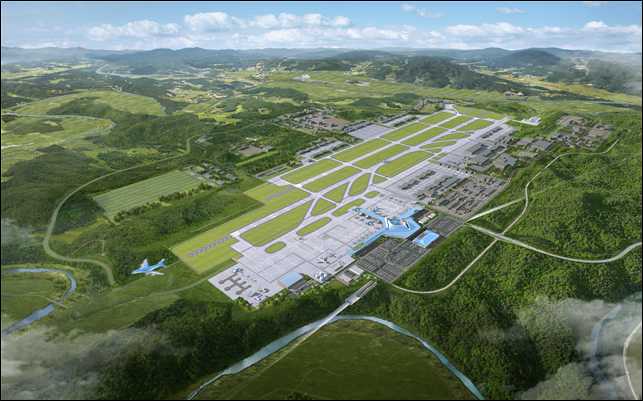
South Korea's Ministry of Land, Infrastructure and Transport has revised the basic plan for the civilian airport construction project at the Daegu-North Gyeongsang integrated new airport, completing the administrative procedures needed to designate an additional project operator and proceed with land expropriation. The move is expected to accelerate preparations for compensation and design work on the new airport.
The ministry announced Friday that it was revising and officially publishing the civilian airport basic plan under the Special Act on the Construction of the Daegu-North Gyeongsang Integrated New Airport. The revision was finalized after going through required procedures, including a review by the Aviation Policy Committee, consultations with local governments and public hearings.
The central change in the revised plan is the additional designation of Korea Airports Corporation as the project operator for the passenger and cargo terminal and parking facility — the landside, or L/S, segment. The designation follows the principle established under the Sixth Comprehensive Airport Development Plan, under which the government funds non-revenue-generating airside infrastructure such as runways and aprons, while airport operators cover the landside segment where cost recovery is possible. Korea Airports Corporation finalized its participation after a board resolution and financial review.
Under the revised plan, the ministry will cover 1.22 trillion won ($916 million) of the total civilian airport construction cost of 2.7 trillion won ($2.02 billion), with Korea Airports Corporation contributing the remaining 1.48 trillion won.
Consultations with the Central Land Expropriation Committee — including a public-interest review — have been completed, allowing a detailed register of land parcels to be incorporated into the basic plan. Under the Special Act, once a basic plan containing such a land register is established and published, project approval for land expropriation and use is deemed granted without any separate procedure, which is expected to speed up the land compensation process.
Jeong Chae-gyo, director general for aviation policy at the ministry, said the revision completed the key administrative steps needed to begin compensation and design work on the civilian airport project. "The budget required for next year has also been reflected in the government's proposal, so the project is proceeding without delay," Jeong said. Jeong added that because the project involves the integrated relocation of both civilian and military airports, compensation and design procedures would be carried out in line with the progress of the Daegu military airport relocation project.
hwshin@heraldcorp.com




